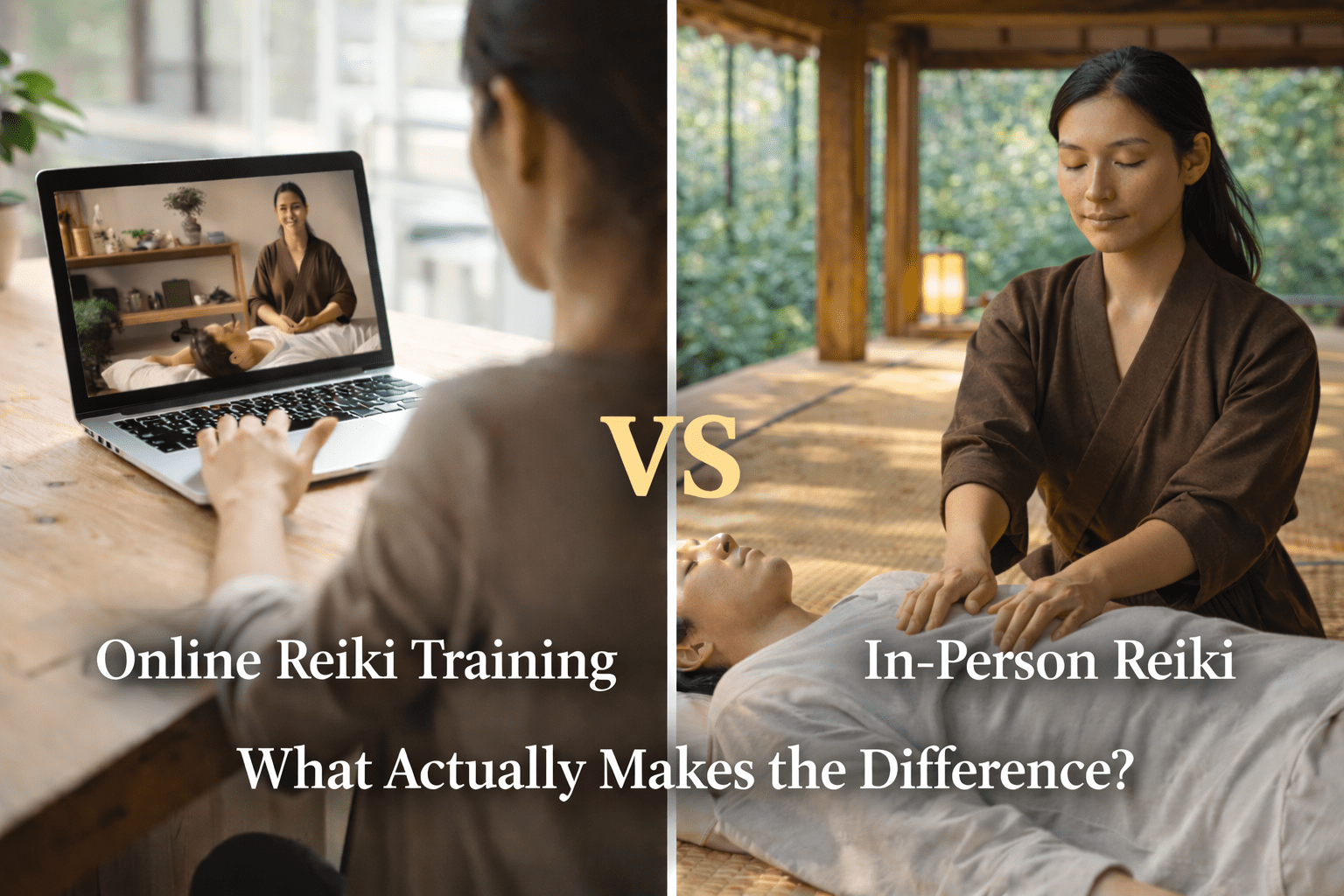
Online Reiki Training vs In-Person Reiki: What Actually Makes the Difference?
In-Person, Online, or Recorded? This article explores online Reiki training vs in-person Reiki in practical terms, focusing on how people actually learn, practise, and integrate Reiki. If you are trying to decide between online Reiki training and in-person Reiki, you are not alone. One of the most common questions people ask before enrolling on a course is whether Reiki should be learned face to face or whether online Reiki training can be just as effective. Some teachers insist Reiki must be taught in the same room, with hands-on guidance throughout. Others offer live online Reiki classes or structured recorded Reiki training and argue that distance does not limit the quality of learning or transmission. Online Reiki training can be effective when it is taught clearly and approached with engagement. Reiki transmission does not rely on physical proximity alone, but on how the student receives and integrates the process. The difference between online and in-person training lies more in learning structure, feedback, and pacing than in whether Reiki functions. What Actually Changes Between Training Formats This question is often framed purely as an issue of attunement, focusing on whether Reiki can be transmitted at a distance. In practice, the difference between online Reiki training and in-person Reiki courses affects far more than the moment of attunement. It influences how students learn to give a full Reiki treatment, how clearly hand positions and treatment flow are demonstrated, how often techniques can be reviewed, and how much opportunity there is to practise between sessions. It also affects pacing. In-person Reiki training often delivers a large amount of material over a short period, while online and recorded Reiki courses usually allow students to return to the material as their understanding deepens. Questions about physical presence matter, particularly in relation to energetic transmission and feedback. Questions about learning structure, repetition, confidence-building, and real-world practice matter just as much when deciding between online Reiki training or in-person Reiki. Rather than promoting one format over another, this article examines how Reiki training actually works across different formats. It looks at how transmission functions, how physical presence influences learning and practice, and how live and recorded Reiki training support skill development over time, so you can decide which approach fits your learning style and circumstances. 1. The Core Paradox The Smoking Gun: If Distance Healing Works, Why Would Distance Training Be Different? At Reiki Level 2, practitioners are taught distant healing, traditionally referred to as Enkaku Chiryo. This practice is based on a clear premise. Reiki is not understood as something that travels through physical space in a conventional way. Using the Hon Sha Ze Sho Nen symbol, a practitioner opens a channel through which a recipient receives healing regardless of physical location or time difference. This principle is widely accepted within Reiki practice. Once this is acknowledged, an obvious question follows. If a practitioner can open a channel that allows a recipient thousands of miles away to receive Reiki, a teacher can also open a channel that allows a student to take part in an attunement process without being in the same room. Any serious discussion about online or recorded Reiki training needs to engage with this point directly. 2. Reiki Is Drawn, Not Pushed Why Physical Proximity Supports Rather Than Governs Transmission A common misunderstanding around Reiki attunements is the idea that the teacher gives energy to the student. In both Reiki treatments and attunements, the teacher does not push energy into the recipient. The traditional explanation is that the practitioner becomes a clear channel, often compared to a hollow bamboo, through which Reiki flows, drawn through that channel by the recipient. The roles involved are distinct. The teacher holds the energetic framework and facilitates access to the resonance of Reiki.The student allows that resonance to permeate their own system. Being in the same room can help some students feel more settled, focused, and supported during the process. At the same time, physical proximity does not determine whether transmission occurs. The outcome is shaped by the recipient’s capacity to draw Reiki at a deeper level than conscious awareness, rather than by physical distance. This explains why many students report receiving attunements with the same clarity in live online settings, with cameras off, or through recorded guidance. In each case, they are engaging directly with the process rather than observing it passively. 3. The Source of Reiki Attunements Esoteric Buddhism and Empowerment Reiki did not develop in isolation from earlier spiritual traditions. In both Reiki and esoteric Buddhist systems, empowerment is understood as a process of energetic maturation. It authorises a practitioner to engage in specific practices by clearing internal pathways and stabilising their capacity to work with energy. In traditional Japanese Reiki lineages, this process is called Reiju. It is commonly described as a nuanced energetic clearing that allows Ki to flow more freely through the student’s system. In Buddhist traditions, particularly Japanese Mikkyō and Tibetan Vajrayana, the equivalent ritual is known as abhisheka or wang. These terms refer to the ripening of the practitioner’s mindstream so that deeper levels of practice become accessible. Despite differences in ritual form and terminology, both systems describe empowerment as a process that reveals existing potential rather than adding something external. Transmission is completed through the student’s ability to receive, integrate, and stabilise the experience. Mikao Usui’s teachings were shaped by Japanese esoteric Buddhism, known as Mikkyō. While earlier accounts described him as a Tendai priest, modern research points to a broader engagement with Shingon, Tendai, and possibly other influences. What matters here is structural similarity. The Reiki attunement process closely mirrors Buddhist empowerment practices in function. In both traditions, empowerment is experiential and operational in nature, and remote empowerments have been recognised for centuries and employed within various esoteric Buddhist schools. 4. Transmission Beyond Presence Why Time and Distance Do Not Limit Transmission Tibetan Buddhism provides a clear framework for understanding transmission beyond physical presence. In the Nyingma school, the Terma tradition describes teachings and empowerments transmitted across
Read More