Why Mindfulness Meditation is Critical in Hands-On Reiki Treatments
Why you should be incorporating mindfulness meditation into the practice of Reiki healing and not just in relation to the Reiki Precepts.

 Dec 24, 2021
Why you should be incorporating mindfulness meditation into the practice of Reiki healing and not just in relation to the Reiki Precepts.
 Dec 24, 2021
Reiki Jin Kei Do is a specific lineage and branch of the energy-healing discipline of Reiki. It contains the heart teachings of Usui Reiki.
 Dec 24, 2021
Are the Reiki symbols against religion? Where exactly do they come from, what do they mean, what do they do and how do they do it?
 Dec 24, 2021
Tonglen has been called, with good reason, the nuclear weapon of developing loving-kindness and compassion. It's not an easy practice.
 Dec 24, 2021
Exactly how can you use the system of Reiki to bring more abundance into your life? How does it relate to the Law of Attraction?
 Dec 24, 2021
The daily stresses of life have a powerful impact on the immune system and can lead to an increase in inflammation throughout the body.
 Dec 24, 2021
An analysis of what exactly Usui was experiencing during his meditation on Mt Kurama, referencing esoteric Buddhist teachings.
 Dec 24, 2021
Guidance for all beginners on how to practice mindfulness meditation, covering the how, where, and when with detailed instructions.
 Nov 12, 2021
The following piece originally appeared on a previous blog and is republished here as a prelude to a chapter of my book Mindfulness Meditation and the Art of Reiki, which explores the same topic in greater depth. It is a subject that genuinely deserves debate within the energy healing community. In the following video, Indian mystic, Sadhguru warns against the practice of energy healing. As a Reiki Master of 25 years, who has taught hundreds of students in different countries, I fully endorse what Sadhguru is saying. If you’re exploring whether Reiki itself is harmful or destabilising, I address that question directly in detail in this guide to whether Reiki is harmful. “Why would someone involved in energy healing, agree that energy healing is bad?” First, here is what Sadhguru had to say: If you are a Reiki practitioner or a Reiki Master, no doubt your hackles are up. They shouldn’t be. Sadhguru doesn’t say anything that contradicts the philosophy and tenets of the Reiki system. When I teach a Reiki class, I always make it clear to my students, that what I’m NOT doing is teaching them to be healers. They may well end up facilitating many healings, but they themselves won’t be healing anybody. I’ve facilitated many healings in the 25 years since I learned Reiki; physical healings, mental and emotional healings, and even environmental healings. But I’m not a healer and have no desire to be one. In the video, Sadhguru said: “All chronic illnesses are an indicator of a deeper problem that exists. If you erase the indicator it will find expression in some other way.” As an energy healer, you have no way of knowing what that deeper problem may be, or where it is located within the energetic matrix or physical body of the human being. Some believe that they can access this information and target the original cause. Mostly this is an expression of the ego because they can’t. The information pinpointing the original cause is certainly out there in the universal energy field (UEF) and within the energetic matrix of the human being. This information, however, when accessed by the energy healer, is filtered through the human mind and is subject to various influences: the perceptions of the ego, obscurations caused by our own imperfections, sensory data filtering as well as cultural, religious and time-specific influences. This all renders the originally pure information as potentially inaccurate or entirely wrong. Most people, most energy healers, do not have the spiritual connectivity, or spiritual awareness to read this information accurately, to know that it is being corrupted by themselves. Consequently, energy is manipulated, eradicated, replaced, basically fucked about with, by people who simply do not know what they are doing. In Reiki Jin Kei Do, there is an acknowledgment that the energy of Reiki is essentially an intelligent energetic life force. It knows, better than we do, what is required in a healing context. As a practitioner, therefore, it is important to allow this energy to do what is required without our limited conscious mind having any input because we simply do not know what is required to effect successful healing. So we ‘step the mind back’ out of the healing process. By engaging in meditation practice, called The Six Point Meditation we relinquish any conscious engagement in the healing process, and allow the energy to do whatever is required. The more we can remove our conscious intention to do this or do that in terms of healing, the more we allow the energy to do what is necessary. One of the problems we have as human beings is that we think we understand the nature of healing: There is a problem, let’s remove the problem, and healing is achieved. This is not always the case. We need to broaden our conception of what we mean by healing. Sometimes healing is not about removing the problem but allowing the problem to unfold. To allow it to teach us whatever is to be learned from the experience. Sometimes healing is about learning to lead a meaningful and happy, productive existence within the context of the problem. If we can do this, then the problem ceases to be a problem, and becomes a trigger for positive growth, for beneficial outcomes to manifest. So in Reiki, we don’t rip out the negative energy and replace it with positive energy. We encourage the transformation of this so-called negative energy, this health issue, to transform and take on a more positive aspect, by stepping our conscious minds out of the way and allowing to be, what is meant to be. To assume we understand what healing means; to assume we know how to fix a problem at its deepest pre-manifestation state is naive and childish. This is why Reiki is so dominant in the energy healing field. It has a much more sophisticated understanding of health and healing than other energy healing practices. If you want to heal the world, you start by being. You limit your amount of doing. Just being is very powerful. At its highest level, there is no contradiction between the words of Sadhguru, and the practice of Reiki when it is carried out correctly and in accordance with the foundations of the practice. Postscript: The original videos from which I quoted Sadhguru have been deleted from YouTube (unfortunately they are also referenced in my upcoming book). The video here presents some of the opinions that Sadhguru voiced in relation to the practice of energy healing, but not all.
 Oct 12, 2021
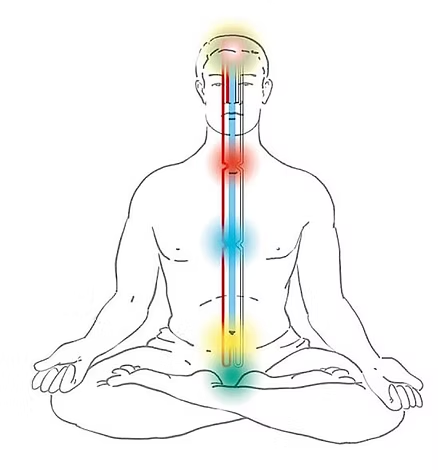
In some of my classes when the subject of the development of intuition within a spiritual practice comes up, I tell a story of when I was giving someone a Reiki/Buddho treatment and upon opening my eyes I could see all seven chakras spinning over the body of my client in the conventionally accepted colours that they are associated with. The question that arises from this experience is, why was I perceiving the chakras in this way, and why was I seeing specifically seven chakras and not some other number? I have no cultural or religious history to inform my understanding or perception of the human energy field. So where did this perception come from? My guess is that it was the product of spending too many years bumming around the New Age where I was picking up spiritual concepts based on the flotsam and jetsam that the New Age throws out after its finished raiding various spiritual traditions for their treasures. Sadly, the commonly known New Age version of the chakra system has very little to do with the original Hindu conception of them. The well-known seven chakra system is so pervasive now that even those who are not even that spiritually inclined, seem to have heard of it. It has developed over the years a fixed set of associations such as certain colours, crystals, attributes, even scents, and the Islamic names of God. It’s not meant to be this way. There are other ways of relating to the bio-field without recourse to thinking about chakras at all but even within the realm of the chakra-orientated, there needs to be a re-assessment of what it is we are actually dealing with here. The commonly understood version of the chakras in the West is based on the concepts of kundalini yoga and was first discussed in a 1919 book called The Serpent Power by the Englishman Arthur Avalon. Avalon’s books contained his own understandings of tantra, kundalini, and the chakras based on his translations of older Hindu texts. It is not very accurate in many of its details. Chakras or ‘channel wheels’ or ‘energy wheels’ as they are sometimes called, have associations with different parts of the body and are the interface between the physical and non-physical aspects of the human anatomy. Chakras play an important role in Tibetan Buddhism as well as in Hinduism. In the Tibetan Buddhist understanding of the chakra system, there are some major differences between the Buddhist and Hindu orientations to them. A Tibetan Buddhist would not commit himself to a static number of chakras as if they are inherently fixed and immutable. In the Tibetan system, depending on the practice you are engaged in, there could be four, five, seven, or ten chakras. Three of these chakras appear in all versions of the system, whilst the others tend to appear only when the practitioner is engaged in higher yogic practices such as Tummo (the practice of generating the inner furnace) or Completion Stage practices (where the subtle winds of the body are brought into the central channel to realise the state of the clear light of bliss and emptiness which ultimately leads to the realisation of enlightenment). The chakras are junction points for the three main energy channels that run along the spine: the central channel and the left and right channels which connect up the 72,000 nadis (streams of energy), allowing for a free flow of vital life-force through them. The classic five-chakra system in Buddhism was explained by HE Zasep Rinpoche whilst discussing the importance of the subtle body in healing practices: “We have crown chakra, we have throat chakra, heart chakra, navel chakra, and secret chakra. Five main chakras. These chakras all have different names. Crown chakra is called the ‘chakra of divine bliss.’ Throat chakra is the ‘chakra of enjoyment.’ Heart chakra is the ‘chakra of Dharma’ — or understanding. Navel chakra is the ‘chakra of manifestation’ or emanation. The secret chakra is the ‘chakra of holding bliss.” The three most important chakras are the crown, throat, and heart which are touched in devotional practices to the Buddha. The secret chakra is mostly limited to practices of Highest Yoga Tantra and the other two (or five, depending on the system) only referenced in very specialised practices. Reginald Ray had this to say in relation to the chakra system: “According to tantra, Enlightenment is fundamentally and originally present in the body. By putting one’s awareness in the body you find that the further down you go the more primordial, unconditioned, and unmanifest is the energy you encounter. The chakras begin at the perineum, which is the most primordial level of awareness, and as you go upwards they are more connected with expression. At the navel there is a sense of the earth, stability, and equanimity; at the heart is a feeling of warmth and compassion; the throat is about communication, expression, and connection; and the head is less a conceptual centre than a place where the energy reaches a crescendo. So the different chakras have very different feels.” The first three chakras are important as they relate to the body, speech, and mind. The crown chakra has a relationship to the body and is associated with activity in the physical world. The throat chakra is related to speech and more subtle activity such as in dreams. The heart chakra relates to the mind, centred on the heart (not the head where the brain sits). Working with the energy of these chakras is not something that is generally taught to outsiders within the Buddhist tradition because of the lack of understanding of their true nature and the inability of most to be able to relate to the chakras in a much more naked way than they would normally be used to. When working with the chakras we are essentially removing the coverings of our energy system to meet that powerful energy in a very direct way. When the ego is stripped
Read More