Author: Steve Gooch

A woman meditating on the banks of a river. Dec 22, 2025

How Reiki Jin Kei Do Compares to Other Reiki Systems

Today, the word Reiki describes a broad spectrum of systems, some rooted in Japanese spiritual practice, others filtered through New Age cosmology, angelic channels, or fast-track video certification. If you're exploring Reiki and want more than just another modality, if you're looking for discipline, depth, and a tradition you can grow with, this guide will help you understand how Reiki Jin Kei Do (RJKD) stands apart.

Dec 15, 2025

Is Reiki Jin Kei Do the Right Fit for You?

When exploring Reiki as a path, it’s easy to assume that all systems offer roughly the same thing: healing techniques, hand positions, attunements, and a certificate. But Reiki Jin Kei Do (RJKD) is built differently, and deliberately so. This system integrates spiritual discipline, meditative focus, and inner development alongside healing methods. It’s a path rooted in self-practice, inner clarity, and a lineage that prioritises personal evolution. That makes it a strong fit for some, and not necessarily the right fit for everyone. Why You Should Choose the Right Reiki Lineage Students come to Reiki with different intentions. Some are looking for quick training to begin a healing practice. Others are drawn to systems rich in symbolism or spiritual messaging. And some seek a path of steady practice and long-term transformation. Reiki Jin Kei Do invites a particular kind of inquiry: “Is this system aligned with what I actually want from Reiki, not just today, but over time?” If your interest lies in personal growth, meditative structure, and the deeper philosophy behind Reiki, this may be the system that supports you best. Who This is Not For Clarity around fit matters just as much as finding the right teacher. Reiki Jin Kei Do is not designed for mass delivery or fast-track certification. If your goals are rooted in convenience or recognition, this probably isn’t your path. This system is likely not for you if you: This isn’t about judging those paths; they serve different purposes. Reiki Jin Kei Do simply follows a different map: one that begins with inner transformation. When Reiki Isn’t What Someone Is Looking For Some years ago, I was teaching a small Reiki Level 1 class in Cairo, just four or five students: a quiet, focused group. During the first morning, one of the students interrupted and asked when we would be learning how to connect with guardian angels. I explained that we wouldn’t. This was a Reiki class, and that kind of material isn’t part of the Reiki system. A little later, she asked when we would be working with ascended masters. I gave the same answer. Reiki doesn’t involve channelling external beings or spiritual entities. She stayed for the rest of the day but didn’t return for the second. It was clear that what she had come looking for wasn’t going to be found in this training. This was simply a mismatch of expectations. She was looking for a symbolic or channelling-based spiritual framework, while Reiki Jin Kei Do is grounded in direct practice, self-awareness, and disciplined inner development. That kind of clarity is important. Reiki Jin Kei Do isn’t designed to meet every spiritual preference. It’s built for people who want a grounded, lineage-based practice, not one centred around angelic, cosmic, or externally guided systems. RJKD is the Right Fit If… RJKD tends to resonate with students who: This is a system for those who want to live their Reiki, not just learn it. This long-term, committed path ensures you gain access to the deepest teachings available in the lineage, including the potential for advanced internal practice in the Buddho system, for those seeking the profound. What RJKD Demands of Your Time and Focus Reiki Jin Kei Do asks for consistency, not perfection, and honours the fact that growth takes time. Here’s what to expect: This isn’t just a course; it’s an evolving relationship with the practice and yourself. What About Buddho? After Reiki Level 2, some students choose to explore Buddho, a meditative and energetic system preserved within the lineage of RJKD. Buddho builds on the foundation of Reiki, offering a deeper internal path of practice and energetic development. It’s not a requirement, but it’s available for those who feel drawn to more advanced internal work. This allows students to either continue with Levels 3A–3C of Reiki, or pivot into Buddho as an alternative progression. Why RJKD Remains a Smaller Lineage Reiki Jin Kei Do is practised globally, but it has never been designed for mass delivery. The structure of the system, and what it asks of the student, naturally limits how many people are drawn to it and how many choose to stay. The Pattern I See in Experienced Practitioners From time to time, people come to me who have already trained extensively in other Reiki traditions. Many of them are experienced practitioners, some already holding Reiki Master qualifications. What they tend to describe is not dissatisfaction with Reiki itself, but with how shallow, fragmented, or inconsistent their previous training felt over time. A recent example was a therapist who initially approached me because she was interested in Buddho, but openly admitted she had little respect for Reiki based on her earlier experiences. She described it as something she could not take seriously and had no desire to revisit. I explained that Buddho is built on a Reiki foundation and that she would need to complete Reiki Levels 1 and 2 first. Reluctantly, she agreed. As the training unfolded, her relationship with Reiki changed completely. What she encountered was not what she had previously experienced. She found depth, structure, and coherence. Reiki began to integrate naturally with other modalities she had trained in, rather than sitting alongside them as something superficial. She is now fully committed to the path and intends to train as a Reiki teacher herself. I see similar patterns with other students, including practitioners who have trained many times elsewhere and later choose to switch to Reiki Jin Kei Do because of the depth, integrity, and quality of the teachings. Why This Limits Scale by Design These are not isolated cases. Reiki Jin Kei Do tends to attract people who are committed to depth, self-inquiry, and long-term practice rather than speed, novelty, or external validation. That naturally filters out those looking for quick certification or light engagement. In a world where many spiritual systems are being streamlined for mass consumption, RJKD preserves a slower, more deliberate path rooted in practice, depth, and inner change. Its emphasis on meditative
Read More


Dec 11, 2025

Why Reiki Training Costs Vary So Widely – And What That Means for You

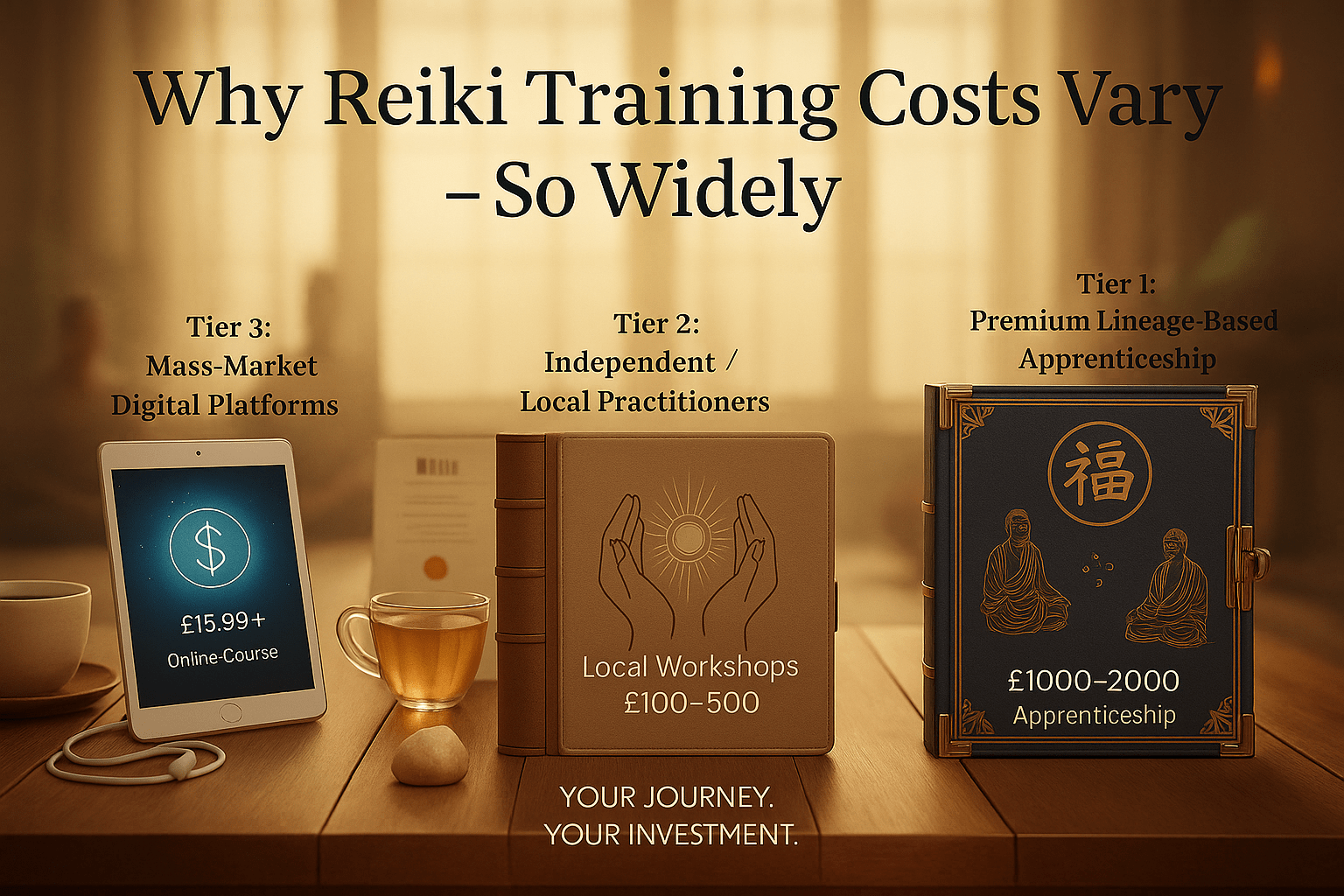
We answer common questions about Reiki training costs, show you typical price ranges by tier, and link to real-world examples. Search for Reiki training online and you’ll quickly notice a very wide variety of price points. Prices are in fact, all over the place. Some courses cost less than a Netflix subscription. Others run into the hundreds, or sometimes, thousands of pounds. Some promise a Reiki Master’s certificate in a weekend (or less). Others span months, even years. So, what are you paying for? This guide explores what justifies the various price tags so that you can choose the kind of training that aligns with your own goals, your values and intentions in taking up the practice. All prices are listed in GBP (£) for consistency. Original course prices in other currencies have been converted at the mid-market exchange rate as of February 2026. This standardisation is intended to aid clear comparison across international offerings. Which Training Path Matches Your Intent? Use this guide to identify which type of Reiki training may suit you based on what you’re hoping to get from it. The Reiki Training Market: A Tiered Structure Not all Reiki training is created equal. The market tends to divide into three very distinct tiers, each reflecting specific philosophies and outcomes: What You Actually Get at Each Tier *At Level 3B, students are required to complete significant post-training assignments and self-led integration before certification is awarded. This is supported through Q&A and quality checks. The Financial Return on Training For many students, Reiki training isn’t just personal, it’s a professional investment. If you’re planning to offer sessions or eventually teach, even a part-time practice can offset the cost of training surprisingly quickly. Let’s look at typical ranges: If you complete Level 1 and 2 with a total investment of around £435, you could recoup that in 6–10 client sessions. As a teacher, one or two well-attended workshops could return your full investment and more. Even if you don’t plan to teach, having a well-structured and supported training helps you deliver better client results, which builds your confidence, credibility, and referrals, important if you’re looking to grow a practice. Reiki Training Providers – Price, Levels & Format Comparison (All Prices in GBP) Notes: • Courses labelled “Master” or bundled offerings (e.g., Udemy, Centre of Excellence) usually prioritise accessibility over experiential depth, personal guidance, or lineage practice. These can be suitable for casual learners but may not meet the needs of those seeking comprehensive or traditional training.• Lineage-based systems such as Reiki Jin Kei Do or the International House of Reiki integrate meditation, spiritual development, and ongoing practice support, which contributes to higher pricing. The Hidden Costs of Cheaper Training While many low-cost or mass-market Reiki courses look appealing at first glance, the upfront price often doesn’t reflect the full cost of becoming a competent, confident practitioner. Here are a few hidden costs to consider: One often overlooked factor is professional legitimacy. Many budget or certificate-only Reiki courses don’t meet the standards required by insurers or professional associations, such as 20+ hours of live instruction per level, verified attunements, and teacher accountability. Without these, students may be unable to practise legally in some regions or may be forced to retrain later, increasing both time and financial investment. What starts as a budget-friendly option can quickly become more expensive when retraining or lost opportunities are factored in. Sometimes Less Is More: A Lesson in Simplicity Several years ago, I trained a woman named Hanna through Reiki Levels 1 and 2. As part of her ongoing development, we set up a weekly exchange, she would give me a Reiki treatment, and I would give her one in return. In the sessions I gave her, I often drew on everything I had learned over the years, not just Reiki Levels 1 and 2, but also Level 3 and my Buddho training. I used symbols, visualisations, refined hand placements, mantras, and subtle energetic techniques. These treatments were effective, and Hanna regularly commented on how deep and powerful they felt. Then one week, I was completely exhausted. By the time Hanna arrived, I was really tired and had little ability to do anything elaborate. I decided to give her the most basic Reiki treatment possible. No techniques beyond standard hand positions and no effort to refine or enhance the process in any way. Just simple, hands-on Reiki – a Reiki Level 1 approach . I wasn’t expecting much from it. When the session ended, Hanna looked genuinely surprised. She told me it was one of the most powerful treatments she had ever received. That moment changed how I understood value in Reiki training. It wasn’t the breadth of techniques or the complexity of what I was doing that made the difference. It was the clarity of presence and the simplicity of the practice itself. This is one reason why higher-quality training doesn’t always look impressive on paper, and why more techniques don’t automatically translate into better results. Depth, integration, and understanding often matter far more than accumulation. What Makes Reiki Jin Kei Do Different? The Cost of Choosing Poorly A Real Example of What Fast, Low-Cost Training Can Create In the early days of my teaching, I ran a Reiki support group for students to practise together and ask questions. At one meeting, one of my students invited a friend who had a serious foot injury. Her foot was in plaster due to either a broken ankle or a torn ligament. She received Reiki during the group and found it helpful, particularly in easing the pain. The experience left her interested in learning Reiki herself. She went on to train elsewhere. Her Reiki Level 1 training took place on a Saturday morning. Reiki Level 2 followed on Saturday afternoon. By the end of Sunday, she had been given a Reiki Master certificate. At the next Reiki support group, she returned confused and genuinely puzzled. She told me she did not understand why, now that
Read More

Jun 16, 2025

Reiki for Relationships: Emotional Healing for Toxic Patterns, Self-Love & Real Connection

Reiki for healing relationships isn’t about dramatic rituals or forcing closure: it’s about energetic clarity, self-awareness, and genuine emotional release. This blog explores how Reiki helps shift the patterns that keep you stuck, rebuilds self-love, and supports you in creating healthier connections. Whether you’re healing after a breakup or working through old dynamics, this is your guide to change that starts from within.

Jun 9, 2025

The Reiki Attunement: A Gateway to Authentic Empowerment

The Reiki attunement is the heart of the Reiki journey, a direct experience that awakens your natural connection to universal energy. This transformative process raises the vibration of your chakras, aligns your energy field, and clarifies your inner channels. Unlike common beliefs, it’s not a technique that can be undone or repeated; once received, it’s with you for life. Discover why attunement is more than a ceremony; it’s a profound reminder of your inherent potential.

Jun 2, 2025

Reiki & Chakra Healing Explained: Your Essential Guide to Energy Healing in 2025

Discover how Reiki and chakra healing work together in a grounded, authentic way to support your journey towards inner balance and self-realisation. This blog explores the roots of the chakra system in Hindu and Buddhist traditions, why "blocked chakras" is a modern myth, and how Reiki naturally harmonises energy without force. Learn how to integrate this timeless wisdom into your practice, transforming energy healing into a powerful path of spiritual growth.

Oct 12, 2023
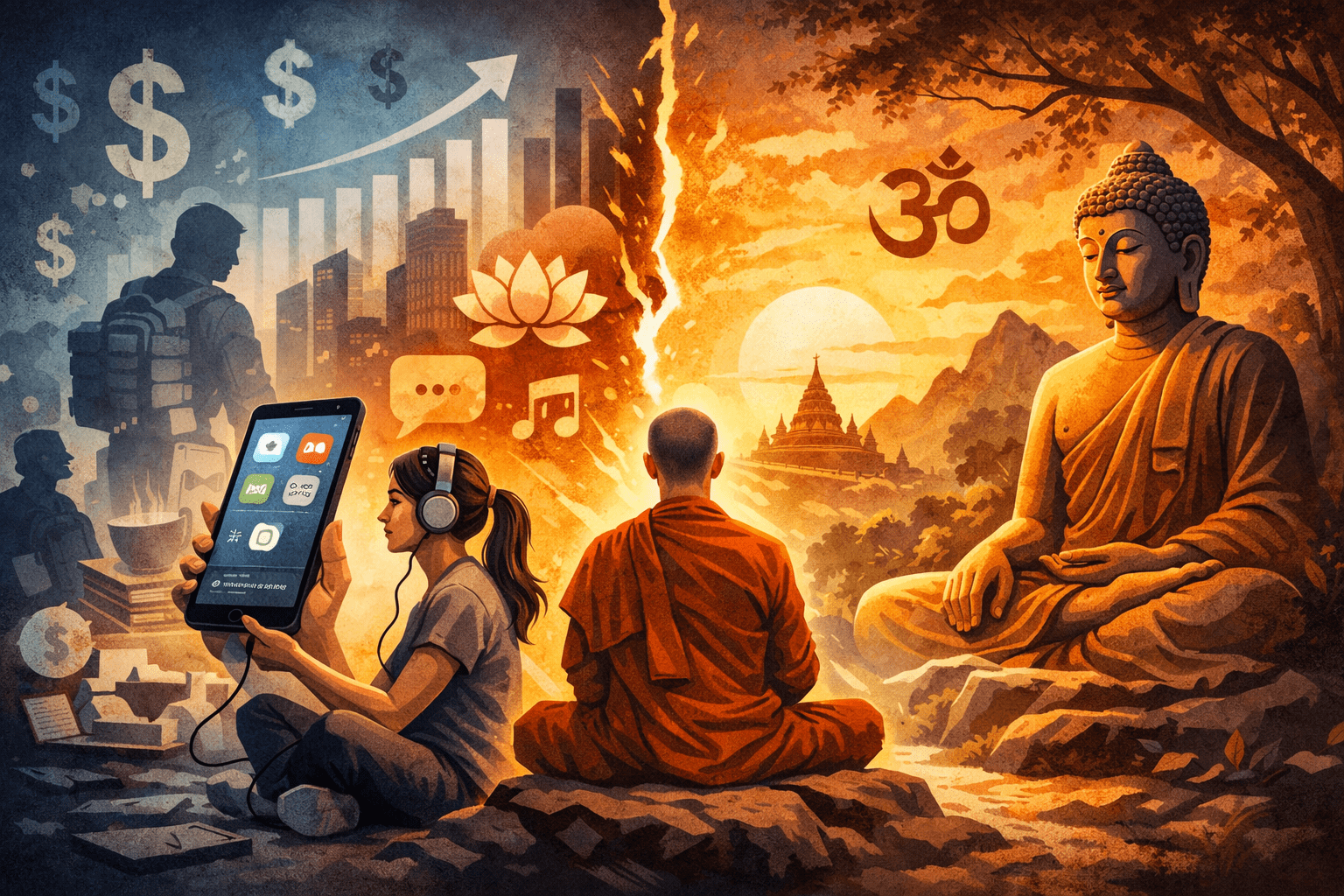
The future of the mindfulness industry, from the Buddha to modern meditation apps depicted Jan 8, 2020
A teacher and children doing mindfulness in school Dec 28, 2019
Dec 19, 2019

Reiki Fire

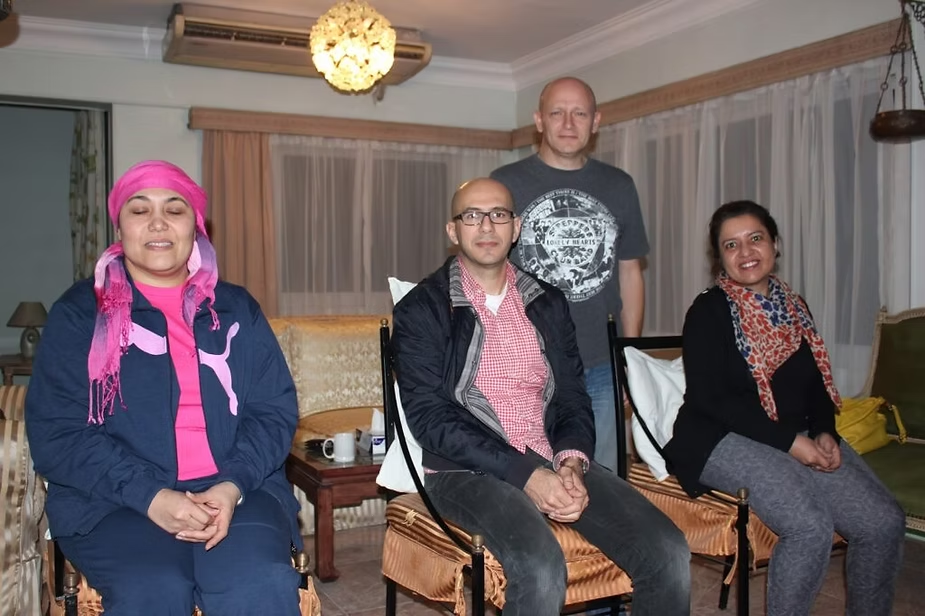
This was the Reiki Fire class that I'll never forget. It was a class that I had been looking forward to. It was in June 2014. Ten of my Reiki students from across the sprawling metropolis of Cairo, Egypt, accomplished and committed to their practice, about to start into their Master’s level training. The class was being held in my usual venue, a lovely 16th-floor apartment, owned by one of my students just off the Nile in the prosperous central-Cairo district of Zamalek.