
Best Reiki Training: 5 Signs of a High-Quality Course (+ Red Flags to Avoid)
A Guide for the Intentionally Curious
If you’re searching for the best Reiki training, this guide will help you make an informed and aligned choice.
Whether you’re just beginning to explore Reiki or ready to take your next step, this guide helps you assess the training landscape with clarity and confidence.
Still, with so many different approaches available, it’s natural to wonder: How do you choose a Reiki training that truly aligns with your goals, including price and value? For example, some systems prioritise accessibility and speed, whereas others focus on deep integration and long-term spiritual growth. Ultimately, no single path is “right” for everyone, only the one that fits your journey.
To assist you in this process, this article offers five clear pillars of a high-quality Reiki system in addition to a practical comparison of different training options, so you can make an informed and aligned choice.
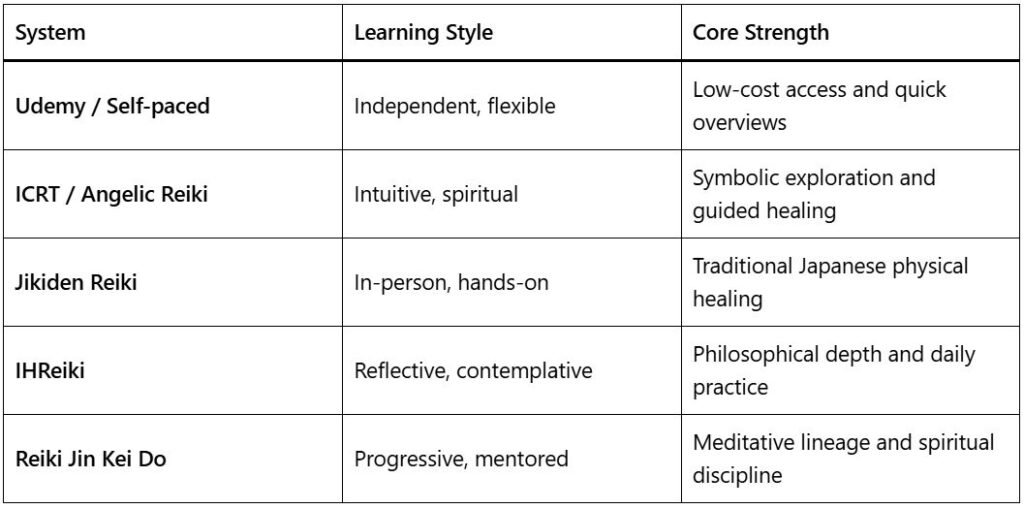
Importantly, not all Reiki systems share the same purpose. For instance, some focus on flexible self-paced learning, like Udemy or ICRT. In contrast, others, such as Jikiden Reiki, emphasise traditional Japanese healing techniques. Meanwhile, deeper paths like Reiki Jin Kei Do or the International House of Reiki offer structured, meditative training designed for long-term personal growth and spiritual development.
As a result, this guide helps you match the system not just to your schedule, but to your values and direction.
Summary: How Do We Define ‘The Best Reiki Training’?
- Clear, verifiable lineage
- Structured, live instruction with space for integration
- Consistent self-practice and meditative focus
- A coherent philosophical foundation
- A teacher who walks the path and offers support
Let’s explore these in more depth.
1. Lineage: Where Do the Teachings Come From?
What you’re learning should be grounded in consistent, time-tested practices. Moreover, a clear lineage also reveals the philosophical direction of the system, something that can vary significantly between traditions.
For example:
- Jikiden Reiki maintains traditional Japanese healing practices, with a strong focus on hands-on treatment.
- ICRT-based systems, by contrast, incorporate modern spiritual elements, including angels, spirit guides, and newly introduced symbols.
- International House of Reiki courses, on the other hand, centre on meditative awareness and daily engagement with the Reiki precepts.
- Reiki Jin Kei Do (RJKD), meanwhile, traces through Seiji Takamori and places strong emphasis on meditation, subtle energy, and Buddhist-rooted personal transformation.
Therefore, when looking for the best Reiki training, it’s wise to ask:
“How has the system evolved over time?”
“Who taught your teacher?”
2. Personal Practice: Is Inner Work Central?
The most meaningful Reiki systems are not just about helping others; they support your own transformation first.
Depth-oriented approaches typically include:
- Regular self-treatment
- Meditation as a core, non-optional practice
- Emphasis on inner inquiry and self-reflection
In Reiki Jin Kei Do, meditation is integrated from the very beginning. Similarly, the International House of Reiki places strong focus on the inner dimension, treating the Reiki precepts as daily contemplative anchors.
Ask yourself: Does this system help me become more conscious, balanced, and present in everyday life?
3. Structure: Is There Time to Absorb and Integrate?
Reiki is not something to rush. A high-quality system usually includes:
- Live instruction (not just pre-recorded video)
- Clear, step-by-step levels
- Time to practice between levels
- Encouragement to pause, reflect, and go deeper
- Optional mentorship or community support
For example:
- Udemy or other self-paced courses suit independent learners who want a quick overview.
- Jikiden, International House of Reiki, and RJKD tend to follow slower, mentored progressions with real-time guidance.
Ask: Will this training give me time to embody the practice, or just complete it?
4. Philosophy: What Is the Deeper Orientation?
Every system carries a worldview. Some centre on intuitive exploration and spiritual archetypes. Others focus on presence, discipline, and self-inquiry.
Compare these:
- ICRT and Angelic Reiki may include channelling, extra symbols, and guided spirit work.
- Jikiden Reiki stays closer to early Japanese healing methods.
- International House of Reiki and RJKD view Reiki as a life path, a contemplative, spiritual practice with roots in mindfulness and meditation.
The question to ask is: What qualities will this system help me develop, not just what techniques will I learn?
5. The Teacher: Do They Walk the Path?
A teacher’s presence can be more important than their content. You’ll likely benefit from someone who:
- Has an established, visible self-practice
- Offers post-course support or mentorship
- Teaches from experience, not just theory
- Respects your autonomy and encourages questions
Ask yourself: Does this teacher embody what they teach, and would I feel supported by them beyond the course itself?
Awareness Points: What to Be Mindful Of
Not all training models are designed to support depth and integration. If your goal is transformation rather than just certification, here are a few important things to watch for:
- Instant Mastery: Programmes that certify you as a “Reiki Master” in a weekend
- No Live Teaching: Pre-recorded or remote courses with no opportunity for personalised attunements or guidance
- Unclear Lineage: Systems that can’t clearly state their origins or philosophy
- Rapid Progression: Being encouraged to take multiple levels in a short space of time, without time to integrate
These formats aren’t necessarily “wrong”, but if you’re seeking spiritual depth and real inner change, they may not support that journey.
To see how different training approaches land in real life, you can read Reiki Training Reviews: What Students Say After Learning with Steve Gooch.
Interview Guide: Questions to Ask a Potential Teacher
Here are some empowering, respectful questions to help you vet your options:
About the Course
- How many hours of live instruction are included per level?
This gives a sense of how much real-time learning and guidance you’ll receive beyond any self-paced content. - Is the course designed to allow for integration between levels?
Rather than enforcing strict timelines, a quality system encourages students to honour their own readiness, trusting the energetic process to unfold naturally. - How are attunements delivered, and what’s the teacher’s approach?
Attunements can be shared effectively in many ways, including in person, at a distance, or in groups. What matters most is the intent, experience, and presence of the teacher offering them. To better understand this process, you can read more about how Reiki attunements work and why the teacher’s presence is so vital.
What About the System?
- Which Reiki lineage do you teach from?
Understanding the lineage helps you see the roots of the system and how it has been passed on and developed over time. - Can you share a written lineage chart or summary?
A clearly documented lineage shows transparency and a connection to the system’s origins, whether traditional or modern. - How would you describe the focus of this system, spiritual cultivation, healing practice, or an integration of both?
This helps you understand whether the path supports your personal intentions, whether you’re drawn to inner development, hands-on work, or a balanced combination.
Not Forgetting the Teacher
- What does your daily Reiki or meditation practice look like?
A teacher who actively engages in self-practice brings lived experience to their guidance, not just information. - Do you offer any form of support or mentorship after the course?
Ongoing availability, even informally, can make a huge difference in helping students build confidence and stay connected to the path. - How long have you been practising and teaching within this system?
This gives insight into their depth of experience, familiarity with the lineage, and long-term dedication to the work.
Comparison Snapshot: Different Systems, Different Strengths
Final Reflection: The Best Reiki Training?
There’s no universal “best system”, rather, it’s about finding the one that best aligns with what you want from Reiki.
If, for instance, you’re drawn to meditation, self-awareness, lineage, and a path of deep integration, then systems like Reiki Jin Kei Do or the International House of Reiki may be your natural fit.
Alternatively, if you’re simply curious or want to explore intuitive energy work, flexible self-paced options may serve you well.
In the end, you should ask yourself: Do I want to learn Reiki… or live it?
The best Reiki training is the one that works for you.
Related Articles:
Why Reiki Training Costs Vary So Widely
Is Reiki Jin Kei Do the Right Fit for You?
How Reiki Jin Kei Do Compares to Other Reiki Systems
Online Reiki Training vs In-Person Reiki: What Actually Makes the Difference?
Reiki Training Reviews: What Students Say After Learning with Steve Gooch
Other ways to stay connected:
Subscribe to Energy, Consciousness & The Self newsletter
