
Why Do People Draw Symbols Instead of What They See?
Why do people draw symbols instead of what they actually see? The answer lies in how the brain simplifies perception through mental schemas, predictive processing, and visual recognition.
Most people feel reasonably confident that they could draw a face from memory. This simple experiment helps explain why people draw symbols instead of what they actually see.
When psychologists examine these drawings, a consistent pattern appears. Anatomically, the eyes sit roughly halfway between the top of the head and the chin. In drawings produced from memory, the eyes are usually placed noticeably higher than this midpoint. The same pattern appears in children and adults across many cultures.
Another small experiment reveals a similar effect. Place a dinner plate on the table and look at it from your seated position. Because of perspective, the plate does not appear as a circle. It appears as a thin ellipse, with the edge closest to you slightly wider than the far edge.
Now draw the plate quickly without measuring.
Most people draw a circle or a wide oval. The drawing reflects what the brain knows about plates rather than the shape that actually appears in the visual field.
In both cases the eye provides accurate information, yet the brain replaces that information with what it expects to see.
These simple experiments reveal something fundamental about perception. When people draw without careful observation, they tend to draw the concept of the object rather than the visual structure in front of them.
Understanding why this happens offers a useful window into how the brain processes information.
Watch the short explanation below before continuing.
Why People Draw Symbols Instead of What They See
The visual world contains an enormous amount of detail. Every scene includes subtle variations in colour, texture, light, shadow, and spatial relationships between objects.
Processing all of this information continuously would require a tremendous amount of cognitive effort. To manage this complexity, the brain simplifies visual experience.
Instead of analysing every detail from scratch, the brain organises perception into structured patterns known as schemas. A schema is a mental model that summarises the typical features of a category of objects.
When someone sees a chair, the brain does not analyse every surface and angle individually. It activates a stored pattern representing the general structure of a chair and fills in the expected details automatically.
These schemas allow rapid recognition and efficient decision making. At the same time, they strongly influence what people draw when they try to represent objects from memory.
When observation is replaced by memory, the schema becomes the guide.
How Symbolic Drawing Develops
Symbolic drawing begins early in childhood. Developmental psychologists have documented consistent stages in the way children learn to represent the world through drawing.
Young children initially explore mark making through scribbles. As coordination improves, these marks gradually take on meaning.
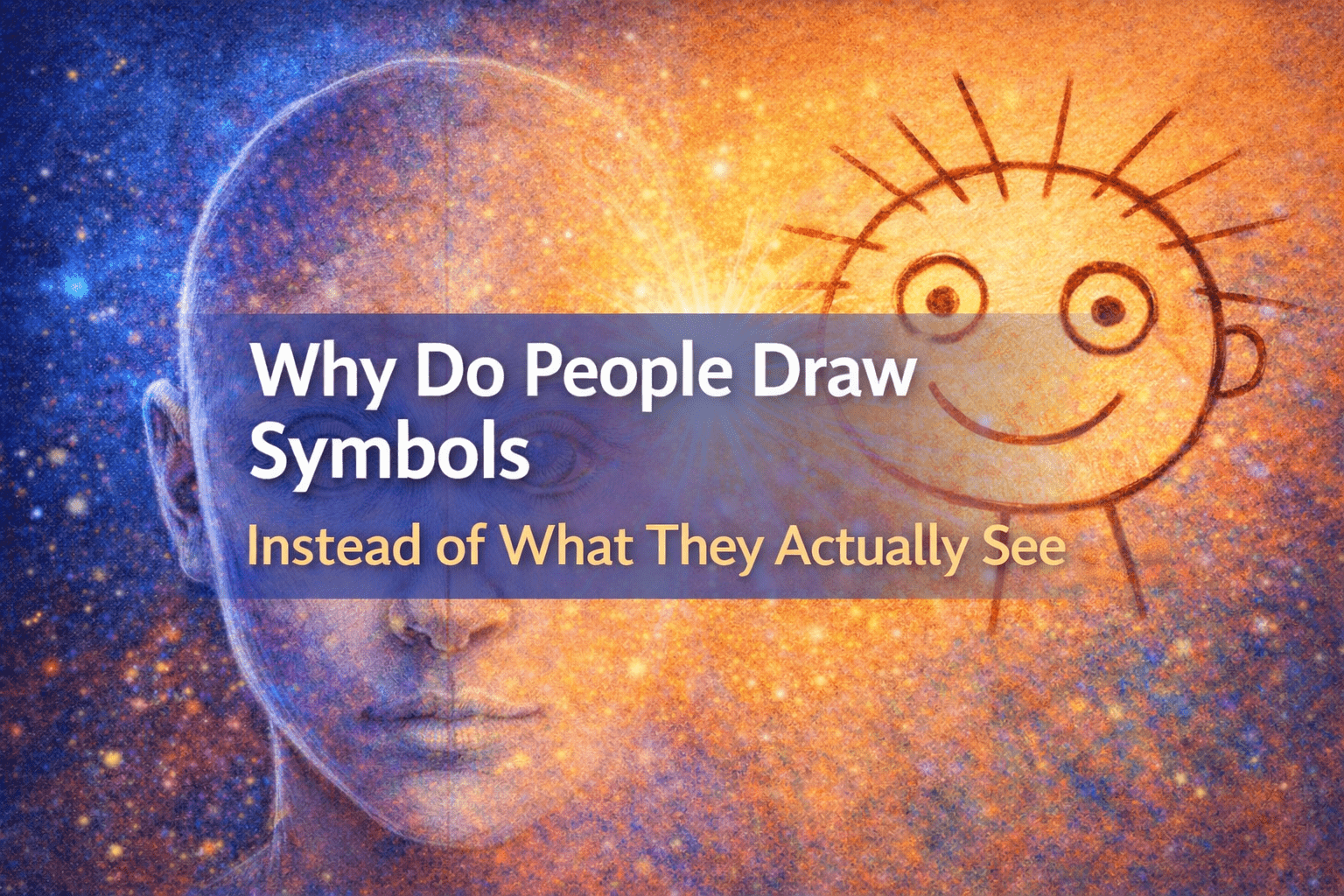
A person may appear as a circle with lines for arms and legs. The sun becomes a circle with radiating lines. A house becomes a square topped with a triangle.
These drawings communicate ideas clearly even though they contain very little visual detail. The image functions as a visual concept rather than a realistic depiction.
Over time these symbolic systems become stable. Unless observational drawing skills are developed later, the symbolic vocabulary established during childhood often continues into adulthood.
This explains why many adults still draw houses, trees, and people using the same simplified formulas they developed years earlier.
Many art teachers, myself included in my previous career, encounter the same moment when working with beginners. When children are asked to draw self-portraits or portraits of classmates, the eyes are almost always placed near the top of the head. The drawings look natural to the students, and very few notice anything unusual.
The surprise comes during a simple measuring exercise. When the distance from the chin to the top of the head is divided in half, the eyes appear almost exactly at the midpoint. For many students this is genuinely unexpected. The discovery often produces a moment of disbelief, followed by laughter as they compare their drawings with the actual proportions in the mirror.
What seemed obvious a few minutes earlier turns out to be inaccurate. The drawing reflected the student’s internal idea of a face rather than the visual structure in front of them.
Moments like this reveal how easily the brain replaces observation with interpretation.
Why Symbols Work So Well for Memory
Symbols are efficient for the brain. A simplified visual form contains just enough information to identify something quickly.
Research in cognitive psychology shows that graphic symbols are often remembered more easily than words describing the same idea. For example, the symbol “$” is typically recalled more reliably than the written word “dollar.”
Symbols activate both visual and verbal memory systems. When someone sees a symbol, the visual shape triggers the associated concept immediately.
This dual coding strengthens recognition and recall. In everyday life this efficiency is extremely useful because it allows people to identify objects quickly and communicate ideas rapidly.
When people draw from memory rather than careful observation, the brain naturally retrieves these efficient symbolic representations.
Recognition and the Visual System
Modern neuroscience provides additional insight into why symbolic drawing appears so frequently.
The visual system includes specialised pathways that process different aspects of visual information. One pathway focuses on identifying objects and determining what they are. Another pathway processes spatial relationships and visually guided actions.
Object recognition plays a central role in everyday life. Recognising faces, tools, and potential dangers must happen quickly.
Because of this, recognition processes often dominate visual perception. When drawing begins without careful observation, the recognition system strongly influences the image produced on the page. The drawing reflects the recognised identity of the object rather than the detailed spatial relationships visible in the scene.
Predictive Perception
Cognitive science increasingly describes perception as a predictive process. The brain constantly generates expectations about the environment based on past experience.
Incoming sensory information is compared with these expectations. The brain updates its internal model as new information becomes available.
This predictive system allows people to move through familiar environments efficiently. Objects and patterns can be recognised almost instantly.
The same mechanism influences drawing. The internal model associated with an object contributes strongly to the image that appears on the page.
In this sense, the drawing reflects the brain’s predicted structure of the object rather than a measured analysis of the visual scene.
How Mental Schemas Shape Everyday Experience
The mechanisms that simplify visual perception also influence how people interpret everyday situations.
Schemas organise expectations about events, relationships, and even our own identity. When familiar patterns appear, the brain often retrieves a stored interpretation instead of analysing the situation in detail.
This process helps the mind navigate a complex world without becoming overwhelmed. At the same time, it narrows our field of view. Subtle changes in our environment or our reactions may pass unnoticed when attention is guided by established expectations.
Training observation gradually weakens this automatic filtering. Through drawing, attentional training, or contemplative practices, people develop the ability to notice details that normally remain outside awareness.
As perception becomes more precise, the brain becomes less dependent on automatic summaries and more responsive to the conditions of the present moment.
A Simple Observation Exercise
You can experience this shift in perception with a short experiment.
Look at the nearest chair or table.
Most people focus on the solid structure of the object: the legs, the seat, the surface.
Now shift your attention to the spaces between the parts of the object. Notice the shapes formed by the empty air between the legs or underneath the surface.
These shapes are known as negative space.
Many people find that these shapes suddenly appear more complex and interesting than the object itself. This happens because the brain has fewer stored symbols for negative space.
By shifting attention away from the labelled object and toward the surrounding shapes, observation becomes more direct. Artists frequently use this technique to reduce the influence of symbolic thinking and improve accuracy in drawing.
Observational Drawing and Attention
Learning to draw observationally involves training attention toward visual relationships rather than conceptual labels.
Artists learn to notice angles, proportions, edges, and the distribution of light across surfaces. Instead of thinking in terms of objects, they analyse the spatial patterns within the visual field.
Drawing teachers such as Betty Edwards popularised this approach by encouraging students to move beyond verbal labelling and focus on what is actually visible.
Modern neuroscience describes this process differently, yet the experience remains familiar to many artists. As attention settles on visual relationships, the influence of symbolic schemas gradually weakens.
Over time observational drawing becomes a method for analysing the structure of what is visible.
How Training Your Eye Changes the Way You See
The tendency to draw symbols instead of observed forms offers insight into how perception functions more broadly.
The brain constructs an interpretation of the world that prioritises recognition, prediction, and efficiency. This interpretation works well for everyday navigation, yet it filters out large amounts of visual information.
Practices that cultivate observation expand the range of information that enters awareness. Drawing exercises, attentional training, and contemplative practices all strengthen this sensitivity.
As perception becomes more refined, people begin to notice patterns and relationships that previously remained outside awareness.
In this sense, drawing is not only an artistic skill. It is also a method for training attention.
Conclusion
When people draw simplified symbols instead of the structures visible before them, they are seeing the brain’s efficiency mechanisms at work.
Schemas support rapid recognition and efficient memory. Predictive perception helps the brain interpret sensory input quickly. Recognition systems guide behaviour in environments that require fast decisions.
Observational drawing gradually strengthens attention to the spatial relationships present within the visual field. As these relationships become clearer, drawings begin to reflect the structure of the scene with greater accuracy.
Through this process drawing becomes more than a technical skill. It becomes a practical method for retraining perception and exploring how the mind interprets reality. Understanding why people draw symbols instead of what they actually see reveals how the brain simplifies perception.
More ways to stay connected:
Subscribe to Energy, Consciousness & The Self newsletter
