
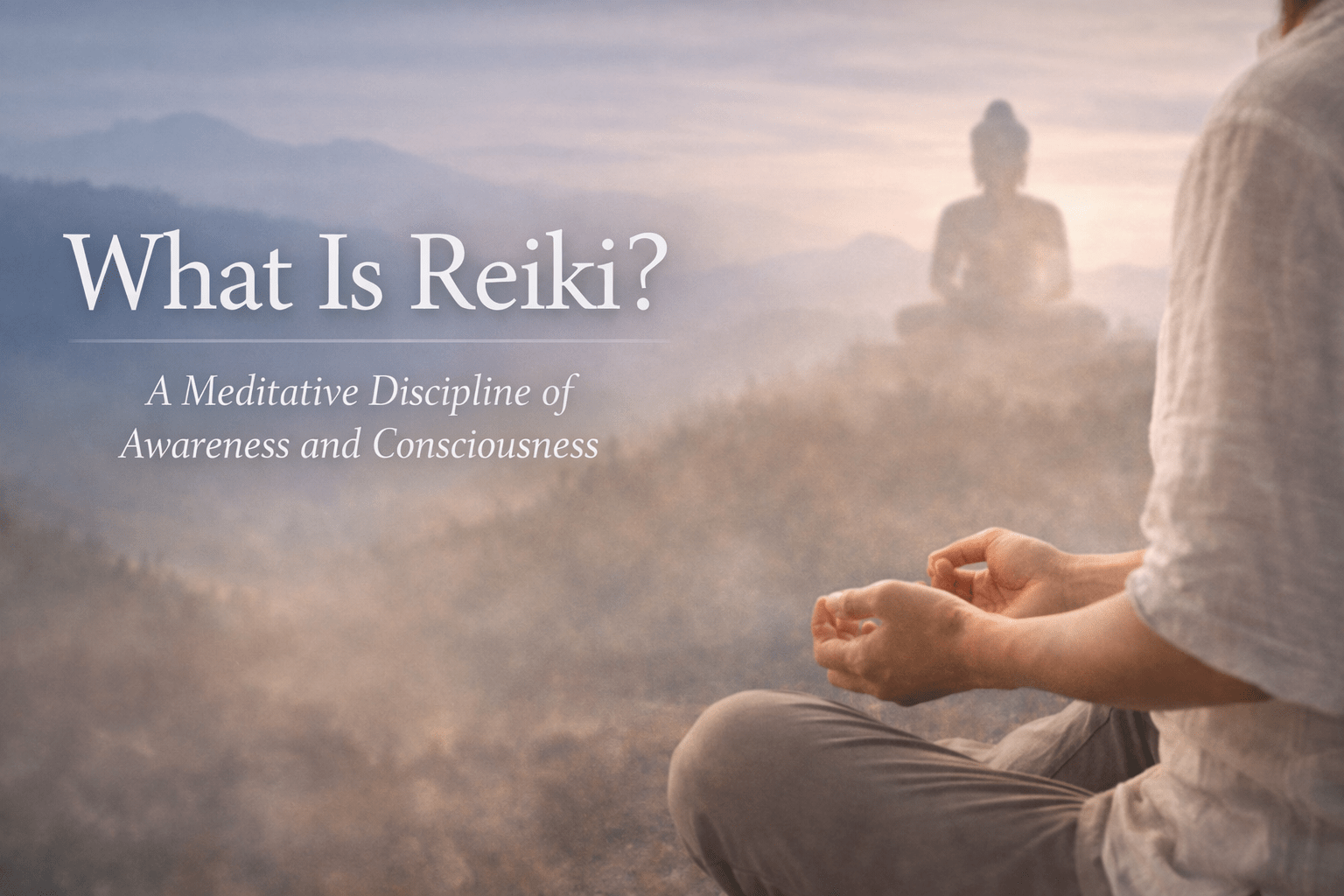
What Is Reiki?
A Meditative Discipline of Awareness and Consciousness
Reiki is usually introduced as a healing method. Practitioners place their hands on or near the body to support relaxation and restore balance, and the practice is commonly described as a form of energy healing.
This explanation captures part of the system, yet it does not fully describe what Reiki is.
At a deeper level Reiki functions as a discipline for training awareness. The hands-on aspect of the practice provides a structure through which attention becomes steady, the mind grows quiet, and subtle aspects of experience begin to reveal themselves. When approached in this way Reiki begins to resemble a contemplative practice concerned with consciousness rather than a technique directed toward symptoms.
After many years of practising and teaching Reiki it becomes increasingly clear that the system operates as a form of awareness training expressed through the body.
What Reiki Actually Is
Reiki is a structured practice that combines touch, attention, and awareness.
During a session the practitioner places their hands lightly on or above the body while maintaining a calm and attentive state. As attention settles, the body relaxes, breathing slows, and the nervous system gradually moves toward balance.
Many people first encounter Reiki through treatments intended to support wellbeing. Within the full system, however, these sessions serve another purpose. They create conditions in which attention can stabilise and perception can deepen. While these sessions support wellbeing, they are part of a broader lineage and practice. The historical development of these methods within the Buddho system provides the structural foundation for how this awareness is actually trained and passed down.
Through repeated practice the practitioner learns to remain present without mental interference and becomes increasingly sensitive to subtle changes within the body and the surrounding field of experience.
With time the practice reveals itself as a discipline concerned with cultivating awareness.
Meditation with the Hands
The outward form of Reiki practice is deliberately simple.
The practitioner places their hands gently on or above the body and remains still. There is no manipulation of muscles and no attempt to control the process through physical technique.
From the outside very little appears to be happening.
Internally the practitioner engages in a process closely related to meditation. Breathing slows, muscular tension softens, and the continuous stream of internal commentary gradually becomes quieter.
The hands become an anchor for awareness. Sensations such as warmth, subtle movement, or changes in pressure become easier to perceive as attention steadies.
Over time many practitioners recognise that Reiki functions as a form of meditation expressed through touch. The body becomes the field within which awareness learns to rest.
Stepping the Mind Back
A central principle in deeper Reiki practice involves allowing the analytical mind to step back from the process.
The mind normally approaches situations by analysing, interpreting, and attempting to correct what appears to be wrong. This habit of intervention can make subtle processes difficult to perceive.
Reiki practice cultivates a different relationship with experience. The practitioner remains attentive while allowing the impulse to control the situation to soften. Awareness stays present while mental commentary gradually recedes.
As this shift occurs the body often enters a deeper state of calm. Breathing becomes slower and more regular, and the nervous system begins to settle.
Within this quieter environment sensations that were previously hidden beneath mental activity begin to appear more clearly.
Observation replaces intervention.
The Practitioner Is Not the Source
A common misunderstanding about Reiki concerns the role of the practitioner.
Popular explanations sometimes suggest that the practitioner actively sends energy into another person. Traditional understanding describes the process differently.
The practitioner does not generate the energy. Training allows the practitioner to become sufficiently calm and receptive for the natural movement of life energy to occur without interference.
As the mind becomes still and attention stabilises, the distinction between “doing Reiki” and simply being present begins to soften. The practitioner rests within the shared field of awareness created by the session.
Within that state the body’s own regulatory intelligence becomes more apparent. Balance begins to restore itself through processes that unfold naturally rather than through deliberate effort.
Presence becomes the central element of the practice.
The Recipient as a Mirror for Awareness
As practitioners deepen their understanding of Reiki, they often discover that the interaction between practitioner and recipient serves another purpose.
The presence of another person becomes a mirror through which the practitioner observes their own state of awareness.
If tension arises in the practitioner’s body or if the mind begins to strain or attempt to force an outcome, these reactions reveal that attention has drifted away from stillness. The session therefore becomes an opportunity to return to balance and to re-establish calm, attentive presence.
In this way the interaction benefits both people involved. The recipient receives the conditions for relaxation and regulation, while the practitioner refines their own ability to remain centred and aware.
The relationship becomes a shared field of attention rather than a one-directional act of intervention.
Energy and the Nervous System
Practitioners frequently describe sensations that arise during Reiki practice as experiences of energy. These sensations may appear as warmth, gentle movement, tingling, or shifts in pressure within the hands.
Such sensations often arise when the mind becomes quiet and awareness settles into the body.
From a physiological perspective these experiences commonly accompany a shift in the nervous system toward parasympathetic regulation. Muscular tension softens, breathing deepens, and the body enters a state associated with rest and restoration.
Remaining attentive to these sensations stabilises awareness. In this way energy perception functions similarly to the breath in many meditation traditions. It provides a natural focus through which attention can remain steady while the body and mind settle.
When Awareness Becomes Still
Occasionally Reiki sessions reveal how profoundly awareness can settle when both practitioner and recipient enter a deeply attentive state.
A Reiki student once came to see me for a treatment shortly before travelling from Egypt to New York for an important meeting. She was a senior executive carrying a great deal of pressure and hoped the session would help her feel calmer before the journey.
The treatment began in the usual way. She lay on the treatment table while I settled into the meditative attention that accompanies Reiki practice.
Within only a few minutes something unusual occurred.
The sense of two separate minds gradually dissolved. For a brief moment it felt as if there was only a single field of awareness shared between us. Even the idea of “mind” seemed to disappear, leaving only clear awareness.
The experience lasted only a short time before ordinary perception returned and the familiar sense of practitioner and recipient reappeared.
When I attempted to continue the treatment it became clear that nothing further was needed. The stillness in the room was complete, and the session ended after only a few minutes.
When she sat up from the treatment table she placed a finger to her lips and whispered quietly, “Shh… my mind is like a sheet of glass. There are no thoughts on it.”
She remained sitting in silence for several minutes, resting in that clarity.
Experiences like this illustrate how Reiki practice can lead attention into profound stillness when both practitioner and recipient allow awareness to settle completely.
Dwelling in Emptiness
As practice deepens many practitioners discover that Reiki naturally leads toward a state described in contemplative traditions as emptiness.
In this context emptiness refers to awareness free from the continuous commentary of thought. Ordinarily the mind remains occupied with interpretation, memory, and anticipation. This activity fragments attention and prevents deeper stillness from appearing.
When the practitioner allows the mind to quiet, awareness opens into a spacious and receptive condition. Thoughts may arise yet they pass without being followed. Sensations appear and dissolve within observation.
Within this open clarity the body and nervous system often reorganise themselves. Processes previously constrained by tension or mental agitation find space to move toward balance.
Parallels with Shingon and Vajrayana Buddhism
The deeper structure of Reiki becomes much clearer when viewed alongside the esoteric Buddhist traditions that formed part of Mikao Usui’s cultural environment.
Usui lived in Japan during a period when Shingon Buddhism and related esoteric traditions were widely present. These systems integrate meditation with physical gestures, symbolic language, and energy awareness.
Within these traditions physical forms support the stabilisation of consciousness. Ritual gestures, mantras, and visualisations create conditions in which awareness can deepen and become steady.
Within Reiki, this same principle appears through the use of symbolic forms, often misunderstood when separated from the structure they belong to.
Reiki follows a similar pattern. Hand placements act as anchors for attention, while symbols and mantras introduced in advanced training resemble the symbolic language used in esoteric Buddhist practice.
Both systems guide practitioners toward the cultivation of spacious awareness within which body and mind organise themselves around stillness.
Empowerment and Attunement
Another parallel between Reiki and esoteric Buddhist traditions appears in the process of empowerment.
In Reiki this process is known as attunement or reiju. During the attunement the teacher performs a brief ritual intended to awaken the student’s sensitivity to the energetic dimension of the practice.
Viewed through the lens of contemplative traditions the purpose becomes easier to understand.
Empowerment rituals in Vajrayana and Shingon establish a direct experiential relationship between the practitioner and the practice. They prepare the student to enter the discipline with a different quality of perception.
The Reiki attunement functions in a comparable way. The process does not give the practitioner something new. It opens perception so that the meditative aspects of the system can unfold more clearly.
From Technique to Presence
Beginners often approach Reiki as a technique that must be performed correctly. Attention focuses on hand positions and the question of whether the practitioner is producing the desired effect.
With continued practice the emphasis gradually shifts.
The practitioner begins to recognise that the quality of awareness shapes the entire experience. When attention becomes steady and the mind grows quiet, the practice unfolds naturally. The hands remain still while awareness rests gently within the field of experience.
Presence becomes more significant than technique.
Reiki as a Training in Awareness
Although Reiki is frequently introduced as a healing method, its deeper significance lies in the cultivation of awareness.
Through regular practice the nervous system becomes calmer, perception becomes more refined, and attention learns to remain steady without effort. The practitioner experiences the body and mind with increasing clarity.
The hands remain in contact with the body. Breathing slows. Awareness settles.
Within that stillness the body gains a greater capacity to organise itself toward balance. Many practitioners eventually recognise that healing often appears as a natural consequence of this alignment. When attention stabilises and the nervous system settles, the body’s own regulatory processes are able to function more freely.
Reiki therefore holds value beyond its therapeutic applications. It provides a practical method for cultivating stillness, refining awareness, and exploring the nature of awareness and experience itself.
Related Articles:
What is Awareness & Can It Be Trained?
Why Reiki Training Costs Vary So Widely
Is Reiki Jin Kei Do the Right Fit for You?
How Reiki Jin Kei Do Compares to Other Reiki Systems
Online Reiki Training vs In-Person Reiki: What Actually Makes the Difference?
Best Reiki Training: 5 Signs of a High-Quality Course (+ Red Flags to Avoid)
Reiki Training Reviews: What Students Say After Learning with Steve Gooch
More ways to stay connected:
Subscribe to Energy, Consciousness & The Self newsletter
