What Are the Reiki Symbols?
Reiki symbols are one of the most misunderstood parts of the system. People often present them as mysterious objects with inherent power, or they expand them into collections of forms that claim to do everything from healing to protection to manifestation. That isn’t how Reiki works, and that isn’t what the symbols are for.
To understand what Reiki symbols actually are, you have to place them within the structure of the training they belong to. Once people separate them from that structure, they misinterpret them very quickly. People turn them into objects of projection rather than elements within a disciplined method. The issue isn’t that the symbols are difficult to understand. The issue is that people usually explain them outside the context that gives them meaning.
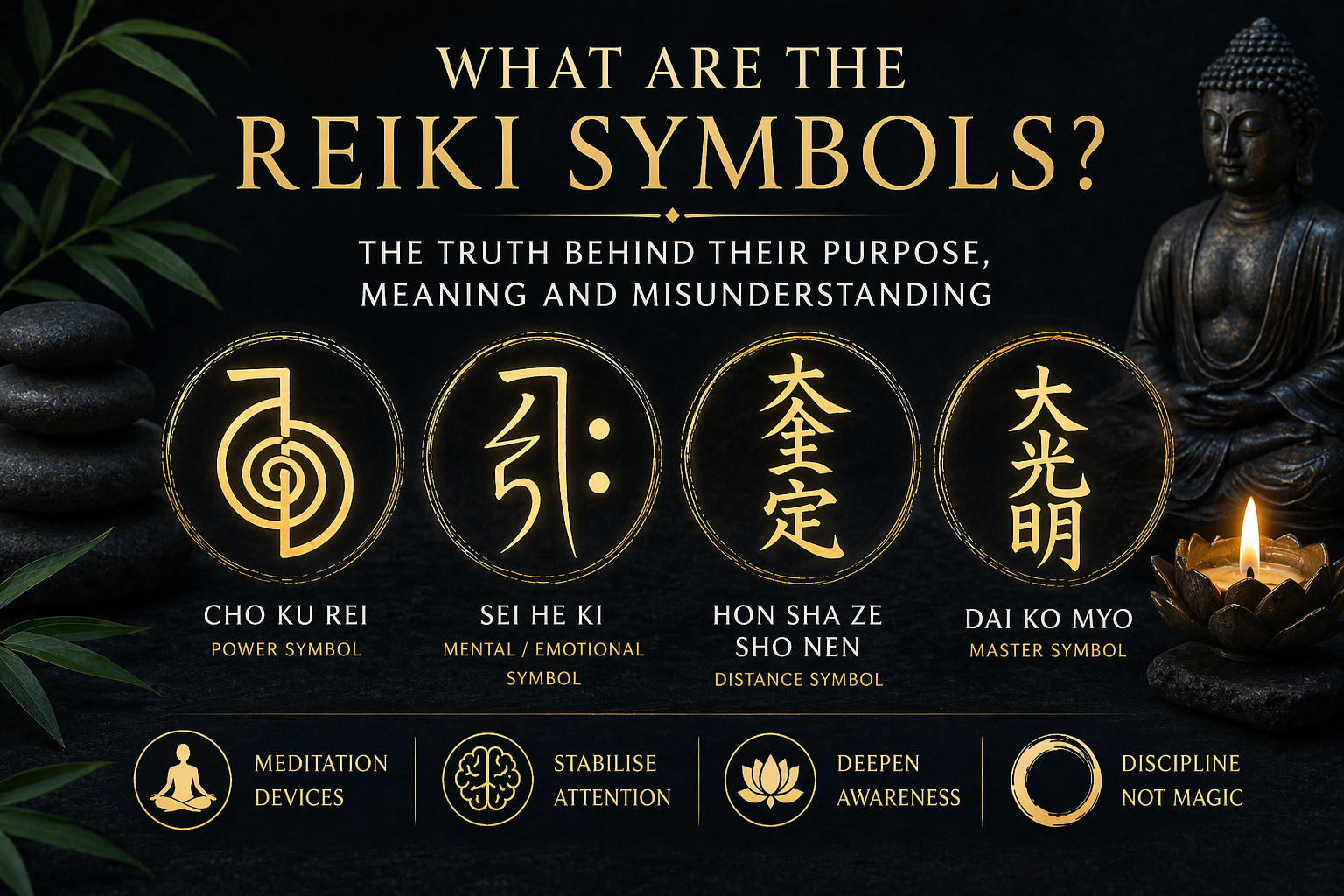
The central point is simple and needs to be stated clearly. Reiki symbols are meditation devices. Practitioners use them to stabilise attention, deepen awareness, and support the development of concentration. Everything else that people say about them either builds on that or moves away from it. If people miss that point, they distort everything that follows.
The Four Commonly Taught Forms
In most modern Reiki teaching structures, teachers use four forms: Chokurei, Seiheiki, Hon Sha Ze Sho Nen, and Dai Ko Myo. People often group these together and treat them as a single category, as if they were a uniform set of tools. They aren’t.
They differ in structure, and that difference matters. It affects how people use them, how people understand them, and how they function within practice. When people ignore that distinction, the system loses precision and people reduce the symbols to general-purpose spiritual accessories. That reduction changes the way people practise.
It also changes the way people understand Reiki itself. If people treat the symbols as simple tools for producing effects, then the system starts to look like a collection of techniques rather than a discipline of awareness.
If you’re approaching the symbols in that way, you’re already starting from the wrong position. It means you’re looking at outcome before understanding process, and treating structure as if it were decoration rather than the core of the practice. That orientation doesn’t just limit your understanding of the symbols, it limits your entire engagement with Reiki.
Two Symbols and Two Kanji-Based Forms
The first distinction is structural.
Abstract Symbols
Chokurei and Seiheiki are abstract symbols. They aren’t written language, and they don’t represent words or phrases. They’re constructed forms practitioners use within the system as objects of focus. Because they carry no linguistic meaning, they don’t engage the mind through interpretation. The practitioner doesn’t have to translate or analyse them. Practitioners bring attention directly into contact with form and stabilise it through that engagement.
This gives them a very specific function in meditation. They allow the mind to settle without being pulled into conceptual thinking. The practitioner doesn’t work with meaning. The practitioner works with structure. That makes them particularly effective as anchors for attention.
This is also why more than one abstract form can exist within the system. Chokurei and Seiheiki both support concentration, but they do not organise attention in exactly the same way. Their different structures create different qualities of focus and different energetic responses. One symbol would be enough if the only purpose were to hold attention in a general way, but the system uses different forms because each one shapes the field of attention differently.
This also means that their effectiveness doesn’t depend on belief, interpretation, or intellectual understanding. Their function is immediate and direct. They work at the level of perception, not explanation. If practitioners treat them as something they need to “understand” before they can use them, they have already misunderstood their role.
Kanji-Based Forms
Hon Sha Ze Sho Nen and Dai Ko Myo are different. They’re Japanese kanji. They’re written forms of language and carry meaning in that sense. When practitioners use them in practice, that meaning isn’t incidental. It informs the way attention is directed and the way the practitioner engages with them.
This creates a functional split within the system. The abstract forms stabilise attention without introducing conceptual content. The kanji forms introduce direction through meaning while still operating within the same disciplined framework.
If practitioners ignore this distinction, they treat all four forms as if they function in the same way. That leads to a flattened understanding of the system and removes the precision built into it. Once practitioners lose that precision, they no longer use the symbols correctly, even if they use them frequently. Repetition without understanding doesn’t produce depth; it produces habit.
The Misunderstanding About Sanskrit
A common claim in Western Reiki teaching is that the symbols come from Sanskrit. Teachers have repeated this explanation widely, and you still find it in some teaching today.
It isn’t correct.
Chokurei and Seiheiki don’t come from Sanskrit or from any written language. Practitioners use them as constructed forms within the system. Hon Sha Ze Sho Nen and Dai Ko Myo are Japanese kanji.
The idea that all four symbols come from Sanskrit doesn’t come from the forms themselves. It comes from incorrect teaching that people accepted and passed on. Once the claim took hold, teachers kept repeating it, often without direct knowledge of either Sanskrit or Japanese.
In many cases, teachers didn’t base this on direct knowledge at all. Teachers repeated what they had been told, students accepted it without question, and the explanation spread. Because most people didn’t know either Sanskrit or Japanese, they couldn’t challenge it. What began as a simple error became “fact” through repetition.
The forms themselves are clear. Two are non-linguistic constructions. Two are Japanese kanji. Treating them as if they share a single linguistic origin is simply inaccurate.
More importantly, this misunderstanding isn’t harmless. It reinforces the idea that the symbols are ancient, mysterious objects with hidden origins, rather than practical tools within a clearly structured system. That shift in perception changes how people approach them. Instead of working with them directly, people begin to project meaning onto them. That projection replaces practice, and once that happens, the symbols stop functioning as they’re intended.
The Mount Kurama Story and Symbol Misinterpretation
A related misunderstanding appears in the story about the founder of the Reiki system, Mikao Usui and his experience on Mount Kurama where he is reported to have first felt the Reiki energy and the healing aspects of the system first came in. It is often claimed that he saw the Reiki symbols during this experience. That version of the story does not hold up.
In its more consistent form, the account describes a visionary experience involving light and symbolic forms, sometimes described as Sanskrit or Siddham characters. It does not describe the specific symbols now taught in Reiki training.
The idea that Usui directly “received the Reiki symbols” is a later interpretation. It projects the modern teaching structure back onto an earlier account. This is another example of how explanation has replaced observation.
Whether or not any visionary experience occurred is not the point here. The point is that the symbols, as people now teach them, belong to a structured system of training. They are not fragments of a spontaneous revelation in the form people often currently present.
Reiki Symbols as Meditation Devices
Reiki symbols are meditation devices. That’s their primary function, and you need to understand it at the outset.
They aren’t objects that produce an effect, nor are they mechanisms for influencing other people or tools for manipulating energy. They’re forms practitioners use to stabilise attention, reduce mental drift, and deepen awareness within a disciplined method of practice.
This does not mean the symbols are energetically inert. Different forms can produce different felt qualities in practice because form, attention, intention, and awareness interact. The point is that the energetic effect arises through that interaction, not because the symbol operates as an independent object with power of its own.
Within Reiki, the hands already act as an anchor for awareness. Through repeated practice, attention becomes steadier, the analysing mind begins to quieten, and more subtle aspects of experience begin to emerge. The system builds this in from the beginning.
The symbols extend that process. They provide a defined structure for attention to engage with. Instead of moving between thoughts and distractions, practitioners bring the mind into a sustained relationship with a single form. Over time, that continuity of attention allows awareness to stabilise more deeply.
This is where their value lies. Not in producing an outcome, but in supporting a condition of mind in which clarity and stability can develop.
This also means that if they’re approached with the expectation that they should “do something,” their function is already being misunderstood. They don’t create the state. They support the development of the state. Trying to force an outcome through them interferes with the very process they’re designed to support.
This also clarifies a common confusion around “energy.” The sensations people describe are real, but they are not evidence that the symbols are generating or directing energy as an external force. They are the felt experience of changes in attention and awareness. At a deeper level, what is being experienced can be understood as consciousness manifesting through form. The symbols do not create that. They provide a structure within which it becomes perceptible.
How Symbols Function in Meditation
Once this is understood, the next step is how they’re actually used in practice.
When used correctly, the symbols function as objects of concentration and awareness. A practitioner draws the symbol, looks at it, internalises it, and returns attention to it repeatedly. The symbol becomes a fixed point that interrupts the usual movement of the mind. Instead of being carried away by thought, attention is brought back to the same form again and again.
Because the first two symbols are non-linguistic, they can be used without triggering interpretation. The mind doesn’t need to understand them. It can rest in them. This allows concentration to develop with less interference from the thinking process.
The kanji forms function differently. Because they carry meaning, they direct attention through both form and concept. The practitioner is engaging with both structure and meaning at the same time. This adds another layer to the practice.
In both cases, the movement is inward. The symbols aren’t there to project power outward or to produce effects. They’re there to refine the practitioner’s own state of awareness.
As this stabilisation deepens, perception changes. Attention becomes less reactive, less fragmented, and less dependent on external stimulus. This is the actual developmental function of the symbols within the system. If that shift isn’t happening, then the symbols are being used superficially, regardless of how often they’re applied.
Gaze, Repetition, and Internalisation
The symbols are worked with directly through gaze and repetition.
A symbol may be drawn and placed in front of the practitioner, then used as a visual focus in meditation. The gaze rests on it, and attention is returned to it repeatedly. This interrupts the usual tendency of the mind to move continuously from one thought to another.
Over time, the form is internalised. The practitioner no longer needs to rely on an external image. The symbol can be brought to mind inwardly and used as a point of return.
Repetition is essential. The value of the symbols doesn’t come from occasional use. It comes from sustained engagement. Depth develops through familiarity and continuity, not through novelty.
This is also where discipline enters the practice. Without repetition, the symbols remain superficial. With repetition, they become integrated into awareness. Without that integration, they remain external objects. With it, they become part of how attention functions.
Mantra and the Symbols
Mantra is often used alongside the symbols. It isn’t an optional addition but part of the same process of stabilising attention.
Repetition of the associated phrase reinforces continuity of awareness and supports one-pointedness. Form and sound work together. One stabilises attention visually. The other stabilises it through repetition.
This integration is important. The symbols don’t function in isolation. They’re part of a broader method that includes form, sound, attention, and awareness.
When this is understood, the symbols are no longer seen as separate tools. They’re part of a unified process of training the mind. Treating them as isolated techniques breaks that unity and reduces their effectiveness.
The Role of Symbols in Healing Contexts
Reiki symbols do appear in hands-on practice. That’s part of how the system is expressed.
However, their role there is secondary, and often overstated. When symbols are treated primarily as healing tools, their function is misunderstood at a fundamental level.
If you understand symbols only as additions to a treatment, you’re already missing their primary role.
More importantly, this misunderstanding changes how the practitioner approaches the practice itself. Attention becomes externally directed. The practitioner begins trying to produce results rather than stabilise awareness. The focus shifts from perception to intervention.
That shift alters the entire orientation of practice. It reinforces the assumption that the practitioner knows what needs to happen and can make it happen, strengthening the habit of doing rather than observing. In doing so, it pulls the mind further into activity rather than allowing it to settle into clarity.
Over time, this doesn’t deepen practice, it prevents it. The practitioner becomes more focused on outcomes and less capable of sustaining awareness. The symbols become part of that outward movement instead of supporting the inward one.
Their function doesn’t change depending on context. They stabilise awareness. Any outcome that follows arises from the quality of that awareness, not from the symbol acting independently.
Why Misunderstanding Leads to Symbol Inflation
When symbols are treated as tools for producing effects, it becomes easy to assume that more symbols will produce more results.
This leads to the creation and accumulation of additional symbols. Systems expand. New forms are introduced. The original structure is lost.
This doesn’t deepen practice. It creates distraction.
More importantly, it reflects a particular mindset. It reflects a search for novelty rather than depth, for additional techniques rather than deeper understanding. It reflects a discomfort with repetition and a lack of engagement with the actual demands of meditation.
Instead of staying with a small number of forms and allowing them to deepen, the practitioner moves on to something new. This creates the illusion of progress while preventing actual development.
Over time, this leads to fragmentation. The practice becomes a collection of disconnected techniques rather than a coherent system. Attention becomes more scattered, not less. The symbols multiply, but depth does not.
If symbols are understood as meditation devices, then adding more of them doesn’t improve anything. Depth comes from sustained engagement with a small number of forms. Without that, the system becomes diluted.
In many cases, these additional symbols are not discoveries at all. They are inventions. Presenting them as equivalent to the original forms does not expand the system, it breaks its coherence.
The Claim That “Any Symbol Works”
A common claim is that any symbol can be used, or that new symbols can be created and will function in the same way.
There is a reason some forms appear to “work.” The way lines and space are arranged affects how attention settles. Certain structures are easier for the mind to engage with and stabilise around. This is not unique to Reiki. It appears in art, design, and perception more broadly. The fact that form influences experience does not make all forms equivalent within a system.
This is where the energetic question becomes important. A newly invented form may produce a felt shift because form affects attention and attention affects energetic perception. That does not make the form a Reiki symbol. It only shows that symbols, shapes, and structures can influence experience. Reiki symbols have meaning because they belong to a transmitted method, not simply because they generate sensation.
A coherent shape may stabilise attention. A person may experience sensation while using it. That doesn’t make it part of Reiki.
The reasoning behind this claim is flawed. It confuses effect with meaning. It assumes that because something produces a sensation, it therefore holds the same place within a structured system.
The symbols used in Reiki aren’t arbitrary. Their function is defined by their place within a structured method. Removing that structure removes their meaning within the system.
If any symbol were truly equivalent, then the structure of Reiki would no longer matter. The system would collapse into personal interpretation. At that point, there would be no standard, no discipline, and no continuity of practice. It would no longer be Reiki in any meaningful sense.
What remains in that situation isn’t freedom, it’s confusion. The appearance of flexibility replaces the reality of structure, and the practice loses its depth as a result.
This way of thinking also reveals something else. It shows that people are not using the symbols as meditation devices at all. They are treating them as tools for producing effects. At that level, people no longer even engage with the underlying function of the symbols.
Dai Ko Myo in Context
People often describe Dai Ko Myo as the Master symbol, but that description is limited.
Modern teaching also often leaves out an important historical point. Dai Ko Myo does not appear in the same way across all lineages, and evidence suggests that Western Reiki teaching formalised and emphasised it as a fourth “symbol”, rather than treating it as part of a fixed original set in Japan.
This matters because it highlights something people often overlook. People have not transmitted the structure of Reiki as a single, unchanging system. Instead, practitioners and teachers have interpreted it, organised it, and in some cases expanded it as it moved into different cultural contexts. When people treat the four forms as if they were always a fixed, unified set, they ignore that development.
Recognising this does not reduce the importance of Dai Ko Myo. It clarifies its place, showing that it is not simply “another symbol” alongside the others. Instead, it reflects a later stage of organisation and teaching, pointing toward a deeper level of integration within the system rather than functioning as a basic tool within it.
Rather than being the final item in a set, it represents a shift in level.
A Shift in Level
That shift isn’t about complexity or additional technique. It reflects a change in how people understand and embody the system. Practice moves from application to integration, from using techniques to stabilising awareness at a deeper level.
This is the point at which the practitioner no longer relies on structure in the same way, because they have already internalised the function of the practice. The symbol reflects that shift rather than creating it.
In some teachings, people understand it as a phrase with layered meaning associated with clarity and illumination. Its function reflects a deeper level of integration within the system.
Understanding this prevents people from reducing it to just another technique, and it places it within the developmental progression it actually represents.
Do You Need Symbols to Practise Reiki?
You can practise Reiki without symbols.
At the foundational level, the system is already complete as a discipline of awareness, breath, touch, and direct experience. Teachers introduce symbols later because they refine that practice, not because something essential is missing.
Without that foundation, people tend to use them mechanically. With it, they become precise tools for stabilising attention.
If teachers introduce them too early or without context, people treat them as something to apply rather than something to work with. That difference determines whether they deepen practice or distract from it.
Are Reiki Symbols Religious?
Reiki symbols can appear unfamiliar, particularly to those from religious backgrounds that do not use similar forms.
They aren’t objects of worship. They aren’t devotional acts. They’re functional elements within a discipline of awareness training.
Their use doesn’t require belief. It requires practice and direct experience. Treating them as religious objects creates unnecessary resistance and shifts attention away from their actual function.
Frequently Asked Questions
Do Reiki symbols have power on their own?
No. Reiki symbols don’t possess inherent power as independent objects. Their value comes from how they’re used within a disciplined practice. Without that engagement, they’re simply forms that carry no function within the system.
What is their primary purpose?
Their primary purpose is to stabilise attention and deepen awareness. They reduce mental distraction, develop concentration, and support meditative practice. Their function is internal, not external.
Can they be used in healing?
They can appear in a healing context, but that isn’t their primary role. When they’re treated mainly as healing tools, their function is misunderstood. Their role in any context is to stabilise awareness, and any outcome arises from that, not from the symbol itself.
Are all Reiki symbols the same?
No. Two are abstract forms and two are Japanese kanji. This distinction affects how they function in practice and determines how they should be used within the system.
Are they derived from Sanskrit?
No. The abstract symbols aren’t derived from any written language, and the others are Japanese kanji. The Sanskrit explanation is a repeated misunderstanding, not a reflection of the forms themselves.
Can new symbols be created?
New shapes can be created, but that doesn’t make them part of Reiki. Reiki symbols have a defined role within a structured system. Without that structure, a form may affect attention but doesn’t carry the same meaning or function.
Do you need symbols to practise Reiki?
No. Reiki can be practised without symbols. They’re introduced to refine and deepen practice, not to make it possible.
The Bottom Line
Reiki symbols are meditation devices practitioners use to stabilise attention and deepen awareness.
People often present them as tools for producing effects, but that framing is secondary and incomplete. In many cases, it reflects a misunderstanding of how the system works.
Their real value lies in how they refine the practitioner’s state of awareness.
If practitioners treat them as techniques for producing results, they will use them superficially. If practitioners use them as part of a disciplined method of awareness training, they become precise and effective.
That distinction is not minor. It defines the difference between practising Reiki as a system and imitating it as a set of techniques.
Related Articles:
Why Reiki Training Costs Vary So Widely
Is Reiki Jin Kei Do the Right Fit for You?
How Reiki Jin Kei Do Compares to Other Reiki Systems
Best Reiki Training: 5 Signs of a High-Quality Course (+ Red Flags to Avoid)
Reiki Training Reviews: What Students Say After Learning with Steve Gooch
More ways to stay connected:
Subscribe to Energy, Consciousness & The Self newsletter
