
Can Drawing Change the Way Your Brain Processes Information?
Yes, drawing can change the way your brain processes information. It trains attention, perception, visual memory, spatial judgement and the connection between seeing and action.
Most people think drawing depends on artistic talent, as though some people are simply born with it and others aren’t. But drawing is much more interesting than that. At its deepest level, drawing trains the mind to see more accurately.
When you draw, you have to slow down. You have to look again. You have to notice shape, edge, distance, proportion, space, shadow and relationship. You begin to see the difference between what’s actually in front of you and what your mind assumes is there.
That shift matters because the brain constantly simplifies experience. It turns the world into symbols, categories and shortcuts. That helps us move through daily life, but it also means we often stop seeing clearly. In this article, “changing the way your brain processes information” means training attention, perception, visual encoding, spatial judgement and awareness. Drawing interrupts the habit of automatic interpretation and brings us back into direct observation.
Quick answer
Drawing can change the way your brain processes information because it trains the brain to observe more accurately.
It strengthens attention, memory, spatial awareness and visual thinking. It also helps you notice the difference between what you actually see and what your mind assumes is there.
You don’t need artistic talent to benefit from drawing. You need curiosity, patience and the willingness to look more closely.
Key takeaways
Drawing trains perception by slowing down the mind’s habit of labelling too quickly.
It can support memory because it engages visual, spatial, conceptual and motor processing at the same time.
It helps you notice the difference between direct observation and assumption.
It can work as an awareness practice, especially for people who find seated meditation difficult.
You don’t need artistic talent to benefit from it. The value comes from the quality of attention you bring to the act of drawing.
The rest of this article explains how that happens and gives you simple exercises you can try for yourself.
Why drawing is more than an artistic skill
Drawing is usually treated as a creative skill, and of course it is. But it’s also a cognitive skill.
To draw something, you need to observe it. Then you need to understand its form. Then you need to translate what you see into marks on paper. That simple act involves perception, attention, motor control, spatial awareness, memory, judgement and correction.
Drawing usually begins with sight, but it can also train other forms of perception. When you draw from touch, memory or feeling, you begin to see that drawing is a way of translating experience into form.
This is why drawing can be powerful even when the drawing itself looks rough or unfinished. A beginner who draws badly may still train the brain very effectively. The value doesn’t only sit in the finished image. It sits in the act of looking, comparing, adjusting and seeing with more precision.
This is where drawing becomes relevant to awareness and consciousness. It gives you a practical way to observe how your mind works. You begin to notice how quickly the mind labels things, how often it fills in gaps, and how strongly it prefers familiar symbols over fresh perception.
How the brain simplifies what it sees
The brain doesn’t process the world like a camera. It interprets, filters and simplifies.
When you look at a chair, you rarely see it as a collection of angles, spaces, shadows and relationships. You see “chair.” Once the label appears, the mind often stops looking closely.
That’s efficient. You don’t need to study every chair you pass during the day. But this same efficiency becomes a problem when you want to draw, observe deeply, meditate, make art, or become more conscious of your own perception.
The mind replaces direct seeing with stored knowledge.
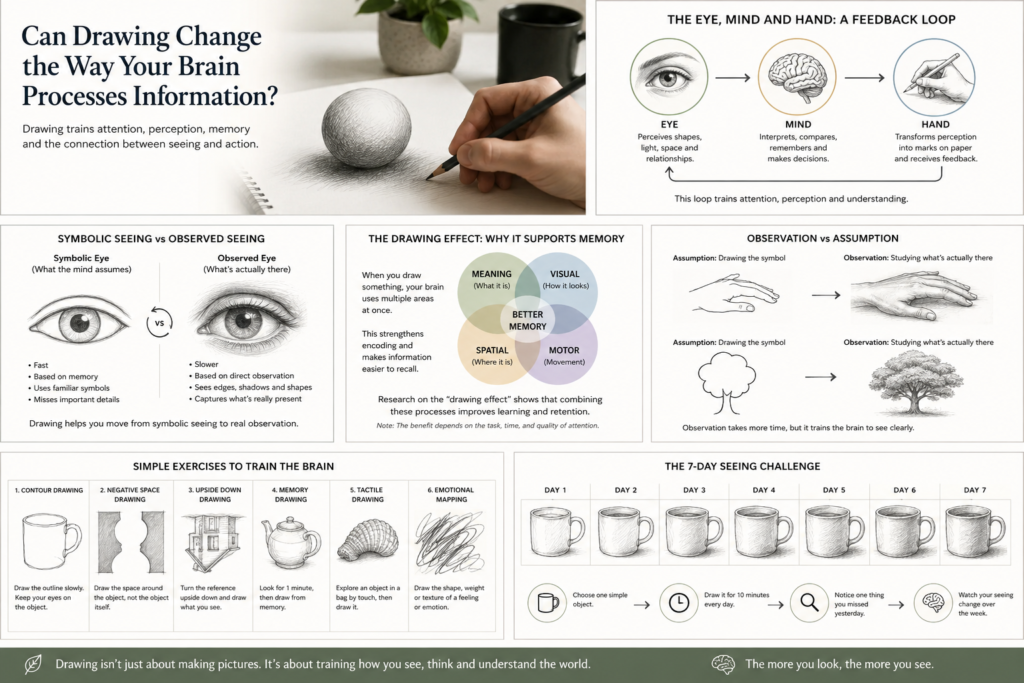
This is why beginners often draw what they think an object looks like, rather than what’s actually there. A child draws an eye as an almond shape with a circle inside. Many adults continue doing the same thing. They draw the symbol of an eye, the symbol of a hand, the symbol of a tree.
Drawing asks for something different. It asks you to pause the symbol-making habit and return to the visual facts in front of you.
Where’s the edge? How long is that angle? How much space sits between these two forms? Where does the shadow actually begin? What shape does the space around the object make?
These questions begin the process of trained observation.
The cost of living through mental shortcuts
Mental shortcuts help you move through life quickly. They allow you to recognise objects, make decisions, navigate spaces and respond without analysing every detail.
But there’s a cost.
If you always see through shortcuts, you start missing the freshness of experience. You stop noticing subtle details. You rely on old categories. You make assumptions before you’ve really looked.
This affects more than drawing.
It can affect how you listen to people. It can affect how you interpret situations. It can affect how quickly you judge, react, dismiss, defend or repeat an old pattern.
In visual terms, you draw the idea of the object rather than the object itself. In life, you may respond to the idea of a person, situation or feeling rather than what’s actually present.
Drawing exposes this habit in a very direct way. If you assume too much, the page shows you. If you rush, the page shows you. If you replace observation with memory, the page shows you.
That makes drawing useful. It gives you immediate feedback on the quality of your attention.
What Betty Edwards teaches about learning to see
Betty Edwards became famous for Drawing on the Right Side of the Brain. We need to handle the language of “right brain” and “left brain” carefully, because modern neuroscience gives us a more complex picture than the older popular split between analytical left brain and creative right brain.
Even so, the practical value of Edwards’ work remains important.
Her central teaching is that realistic drawing depends on learning to see differently. She breaks drawing down into trainable perceptual skills, including seeing edges, spaces, relationships, light, shadow and the whole form.
That approach is useful because it moves drawing away from the idea of mysterious talent and into the field of trainable perception. You learn to see edges. You learn to see negative space. You learn to see proportion. You learn to see the actual relationship between forms.
This is why drawing can feel so strange at first. You’re learning how to override the mind’s habit of labelling too quickly.
Take a chair as a simple example. Most people try to draw “a chair.” The mind immediately produces a concept. Four legs. Seat. Back. Familiar object.
But if you draw the spaces between the legs, the angles formed by the seat, the relationship between the back and the floor, and the shadows beneath it, something changes. The chair becomes a field of relationships. The mind has to observe rather than assume.
That’s a cognitive shift.
Why most people struggle with drawing
Drawing can feel frustrating because it exposes the gap between assumption and observation.
You may think you know what a hand looks like until you try to draw one. You may think you understand a face until you try to place the features accurately. You may think you’re looking carefully, then realise you’ve missed the most obvious relationships in front of you.
That frustration is useful.
It shows you where the mind has been operating on stored symbols. It shows you where attention is weak. It shows you where perception is vague.
Many people stop drawing at this point because they think the frustration means they have no talent. In reality, it often means the training has begun.
The mind is learning to process information differently. That can feel awkward at first.
Observation compared with assumption
The difference between observation and assumption becomes obvious the moment you start drawing.
Assumption rushes to the answer. It says, “I know what this is.”
Observation slows the process down. It asks, “What’s actually here?”
That small shift changes the whole drawing process.
Assumption draws the symbol of an eye. Observation studies the curve of the eyelid, the shadow under the brow, the shape of the iris, the highlight on the surface, the fold of the skin and the unevenness of the forms.
Assumption draws a hand as five sausage-like fingers. Observation studies the angles, knuckles, tendons, shadows, spaces and proportions.
Assumption works from memory. Observation works from contact.
This is one of the most important benefits of drawing. It trains you to recognise the moment when the mind stops looking and starts inventing. Once you notice that, you can return to direct seeing.
Drawing trains attention
Drawing is attention made visible.
When you draw, every mark shows where your attention has gone. If you rush, the drawing usually shows it. If you assume, the drawing shows it. If you actually look, compare and adjust, the drawing begins to carry that deeper observation.
This is one reason drawing can support awareness practice.
Meditation often trains attention through the breath, body, sound, sensation or open awareness. Drawing trains attention through visual relationship. The object becomes the focus. The paper gives feedback. The hand becomes the bridge between perception and form.
This can be especially useful for people who struggle with seated meditation. Drawing gives the mind something active to do while still requiring presence.
You’re giving the mind a precise task. Look. Compare. Move. Correct. Look again.
Over time, this can change how you experience the world. You may begin to notice more detail in ordinary objects. You may see subtle changes in light. You may become more sensitive to posture, expression, space and atmosphere. Drawing can train a more refined quality of attention that carries into the rest of life.
Drawing compared with meditation
Drawing and meditation both train attention, but they do it in different ways.
Meditation often asks you to sit, feel, observe and return. You may focus on the breath, the body, sound, sensation, thought, or the open field of awareness.
Drawing asks you to observe visual reality through the eye, mind and hand. You focus on edge, proportion, angle, shadow, space and relationship. When the mind wanders or assumes, the drawing reflects that immediately.
This makes drawing especially useful for people who find stillness difficult. Some people struggle when they sit and watch the breath. Their mind becomes restless, agitated or dull. Drawing gives attention a task. It keeps awareness engaged through action.
That doesn’t make drawing easier. In some ways, it can be just as demanding as meditation. You still have to return again and again. You still have to notice distraction. You still have to catch the moment when the mind replaces reality with a concept.
The difference is that drawing gives you a visible record of your attention. You can see where you looked carefully. You can see where you guessed. You can see where the mind took over.
Drawing can improve memory
Cognitive psychology gives us another important reason to take drawing seriously.
Researchers have studied what is often called the “drawing effect.” This research suggests that drawing can improve memory because it combines several types of processing at once. When you draw something, you engage meaning, visual form, spatial structure and physical movement.
This doesn’t mean drawing improves memory in every situation. The benefit depends on the task, the time available, the level of attention and whether the drawing helps the brain organise the information more clearly.
In plain English, drawing helps because it gets more of the system involved.
If you write the word “apple,” you’re mainly using language. If you draw an apple, you have to think about what an apple is, picture it, simplify it, create a visual form, move your hand and produce a physical mark. Your brain has more ways to encode the information.
This is why drawing can help with learning.
Students often remember diagrams better than lists. People remember maps more easily when they sketch them. Complex ideas become clearer when someone draws them out. Even a rough sketch can make information easier to understand because the brain works visually, spatially and physically at the same time.
The drawing doesn’t need to be beautiful. It needs to make the information active.
Drawing makes thinking visible
Drawing also makes thinking visible.
A thought is internal. A perception is internal. A memory is internal. But once you draw it, something private becomes visible. You can look at it. You can change it. You can compare it with what you intended. You can share it with someone else.
This is one reason drawing has always played an important role in science, design, architecture, teaching, spiritual symbolism, anatomy, engineering and planning. Drawing allows the mind to externalise structure.
You can draw a face. You can draw a building. You can draw a system. You can draw a meditation posture. You can draw the relationship between ideas. You can draw an emotional state.
Once it becomes visible, it becomes easier to understand.
This isn’t limited to artists. A rough diagram can reveal confusion. A simple sketch can clarify a decision. A visual map can show relationships that would remain vague in language.
Drawing gives thought a body.
Drawing, spatial awareness and embodied thinking
Howard Gardner’s theory of multiple intelligences gives us a useful lens for thinking about drawing, even though the theory itself remains debated. His model includes spatial intelligence, which relates to the ability to work with visual and spatial relationships. It also includes bodily intelligence, which relates to the skilled use of the body.
Drawing sits naturally between those two.
It requires spatial intelligence because you’re working with shape, proportion, orientation, distance and visual relationship. It requires bodily intelligence because your hand has to respond to what the eye sees and the mind understands.
This is why drawing is more than a creative activity. It’s a form of embodied cognition.
The senses gather information. The mind compares. The body responds. The page reflects the process back to you.
That loop is extremely valuable. It means drawing can help you discover what you know, what you don’t know, and what you haven’t yet seen clearly.
Who this approach is best for
Drawing as awareness training can help anyone who wants to see more clearly.
It’s especially useful if you want to improve attention, deepen observation, strengthen memory, develop spatial awareness, think more visually, or become more conscious of how your mind interprets experience.
It can also help people who feel disconnected from creativity. Many adults stopped drawing years ago because someone told them they were bad at art, or because they compared themselves with more skilled artists. That early judgement can shut down a natural form of exploration.
This approach gives people a way back in. The goal isn’t to produce a perfect picture. The goal is to train perception.
It’s less suitable if you want quick drawing tricks, instant artistic confidence, or a simple formula for producing impressive pictures. This approach asks you to slow down and observe honestly.
That honesty is part of its value.
Can drawing change consciousness?
It depends what we mean by consciousness.
If we mean basic awareness, then drawing can absolutely change the quality of awareness. It teaches you to become more present with visual experience.
If we mean spiritual awakening, drawing alone isn’t a complete path. But it can support the same kind of perceptual refinement that contemplative practices develop.
This is a personal example rather than scientific proof, but it illustrates the point clearly. In my own meditation practice, I’ve seen again and again that perception changes when the mind becomes still. During a deep meditative state, I opened my eyes and perceived subtle energetic movement around a person with unusual clarity. The perception was vivid and immediate, but the moment the thought “Wow” appeared, it vanished. That experience taught me that subtle perception depends on mental stillness.
Drawing trains a grounded version of this same principle.
When you stop imposing ideas onto what you see, perception sharpens. When the mind becomes less noisy, the visual field becomes more detailed. When attention stabilises, more information becomes available.
Drawing and meditation are different practices. Drawing works through visual form and motor action. Meditation works more directly through awareness itself. But they overlap in one important place. Both reveal how much the mind interferes with perception.
Do you need artistic talent to benefit from drawing?
No. You don’t need artistic talent to benefit from drawing.
If your goal is to produce professional artwork, then skill, practice and craft matter. But if your goal is to train perception and awareness, even simple drawing exercises can be valuable.
You can draw a cup. You can draw your hand. You can draw the outline of a leaf. You can draw the negative space between two objects. You can draw a simple object upside down from a reference image. You can draw the same object every day for a week and notice how your seeing changes.
The quality of attention matters more than the quality of the finished picture.
This is important because many adults carry shame around drawing. They decided early in life that they were “bad at art,” and then they stopped. That’s a loss, because drawing is one of the simplest ways to retrain perception.
You don’t need to become an artist to benefit from it.
You need to be willing to look.
A simple drawing toolkit for training the brain
You can use simple drawing exercises to train the brain without needing advanced artistic skill.
These exercises work best when you treat them as awareness practices. The aim isn’t to create a polished picture. The aim is to study how you see.
Contour drawing
Choose a simple object and draw its outline slowly. Keep your eyes mostly on the object rather than the paper. Let the hand follow the eye.
This trains visual attention and reduces the urge to draw from memory. It also shows you how quickly the mind wants to take over and draw what it already knows.
Negative space drawing
Instead of drawing the object, draw the space around it.
For example, if you’re drawing a chair, focus on the shapes between the legs and around the back. This helps break the mind’s habit of labelling the object too quickly.
Negative space drawing is powerful because it forces the brain to stop thinking “chair” and start seeing shape, edge and relationship.
Upside down drawing
Take a reference image and turn it upside down. Then copy the shapes exactly as you see them.
This makes it harder for the mind to name the object. Because the image becomes less familiar, you have to observe lines, angles and relationships more carefully.
This exercise often surprises people because the drawing may come out better than expected. The mind interferes less because it can’t rely so easily on familiar labels.
Memory drawing
Look at an object for one minute. Then hide it and draw what you remember. After that, look again and compare your drawing with the object.
This trains visual memory and reveals what your attention actually registered.
You may discover that you remembered the general idea but missed the specific proportions, angles or shadows. That discovery is useful. It shows you what your mind selected and what it ignored.
Tactile drawing
Place a small object inside an opaque bag. Choose something with a clear shape, texture or surface quality, such as a key, shell, stone, pine cone, small toy, coin, seed pod or piece of jewellery.
Put one hand inside the bag and explore the object by touch. Don’t look at it. Feel its weight, edges, temperature, texture, curves, corners and proportions. Notice whether it feels smooth, rough, hard, soft, flat, rounded, hollow, dense, sharp or irregular.
Then draw the object from touch alone.
This gives the brain a very different processing task from ordinary visual drawing.
This exercise trains a different kind of observation. Instead of using the eyes to gather information, you use the hands. The brain has to build an internal model of the object through tactile perception, then translate that model into marks on paper.
The drawing may look strange, and that’s part of the value. You’re not trying to produce an accurate visual copy. You’re studying how the mind constructs form when it can’t rely on sight.
Tactile drawing can reveal how much perception depends on active exploration. You feel, compare, remember, imagine and draw. That makes the exercise especially useful for developing spatial awareness, sensory attention and embodied cognition.
Emotional mapping
Draw the shape, weight or texture of a feeling without trying to make a recognisable picture.
For example, anxiety might appear as sharp lines, pressure, spirals or repeated marks. Sadness might appear as heaviness, downward movement or empty space. Calm might appear as open form, rhythm or balance.
This exercise helps make internal experience visible. It can also help you reflect on feelings without needing to analyse them immediately.
The 7-Day Seeing Challenge
A simple way to start is to draw the same object every day for seven days.
Choose something ordinary. A cup, a key, a leaf, a shoe, a candle, a plant pot or your own hand will work well.
Each day, spend ten minutes drawing it. Don’t try to make a beautiful picture. Look carefully. Notice one thing you missed the day before. Pay attention to edge, space, proportion, shadow and relationship. On one of the seven days, try drawing the object by touch before you look at it again.
By the end of the week, you may notice that your drawings change. More importantly, you may notice that your seeing changes.
You may become less rushed. You may catch assumptions more quickly. You may notice details that were always there but never fully registered.
That’s the real value of the exercise.
Try the 7-Day Seeing Challenge this week. Choose one simple object, draw it for ten minutes a day, and notice how your perception changes by the end of the week.
What drawing teaches us about the mind
Drawing teaches us that seeing is active.
The same is true of perception more broadly. We don’t only see the world. We participate in shaping the version of the world we experience.
We don’t simply receive the world. We interpret it. We simplify it. We name it. We turn it into familiar patterns.
That helps us function, but it can also make us less conscious.
Drawing slows the process down. It shows us how quickly we assume. It shows us how hard it can be to observe without interference. It shows us how much information becomes available when attention becomes more precise.
This is why drawing belongs in any serious conversation about awareness.
It’s practical. It’s embodied. It’s testable. You can see the result on the page. You can compare yesterday’s seeing with today’s seeing. You can watch perception become more refined over time.
Drawing trains the brain by training the relationship between eye, mind and hand.
It teaches the mind to look before it labels.
It teaches the eye to stay with what’s actually present.
It teaches the body to respond with sensitivity.
Over time, it can change the way you process information because it changes the way you attend to the world.
Final thoughts
Drawing can change the way your brain processes information because it trains you to see more directly.
It strengthens attention, supports memory, develops spatial intelligence and makes thought visible. It also reveals something deeper. Much of what we call seeing is assumption. Drawing helps us notice that assumption while it’s happening.
You don’t need to be a professional artist. You don’t need perfect technique. You don’t need natural talent.
You need paper, a pencil and the willingness to look again.
That’s where drawing becomes more than art. It becomes a practical way to train awareness, perception and the mind itself.
More ways to stay connected:
Subscribe to Energy, Consciousness & The Self newsletter
