
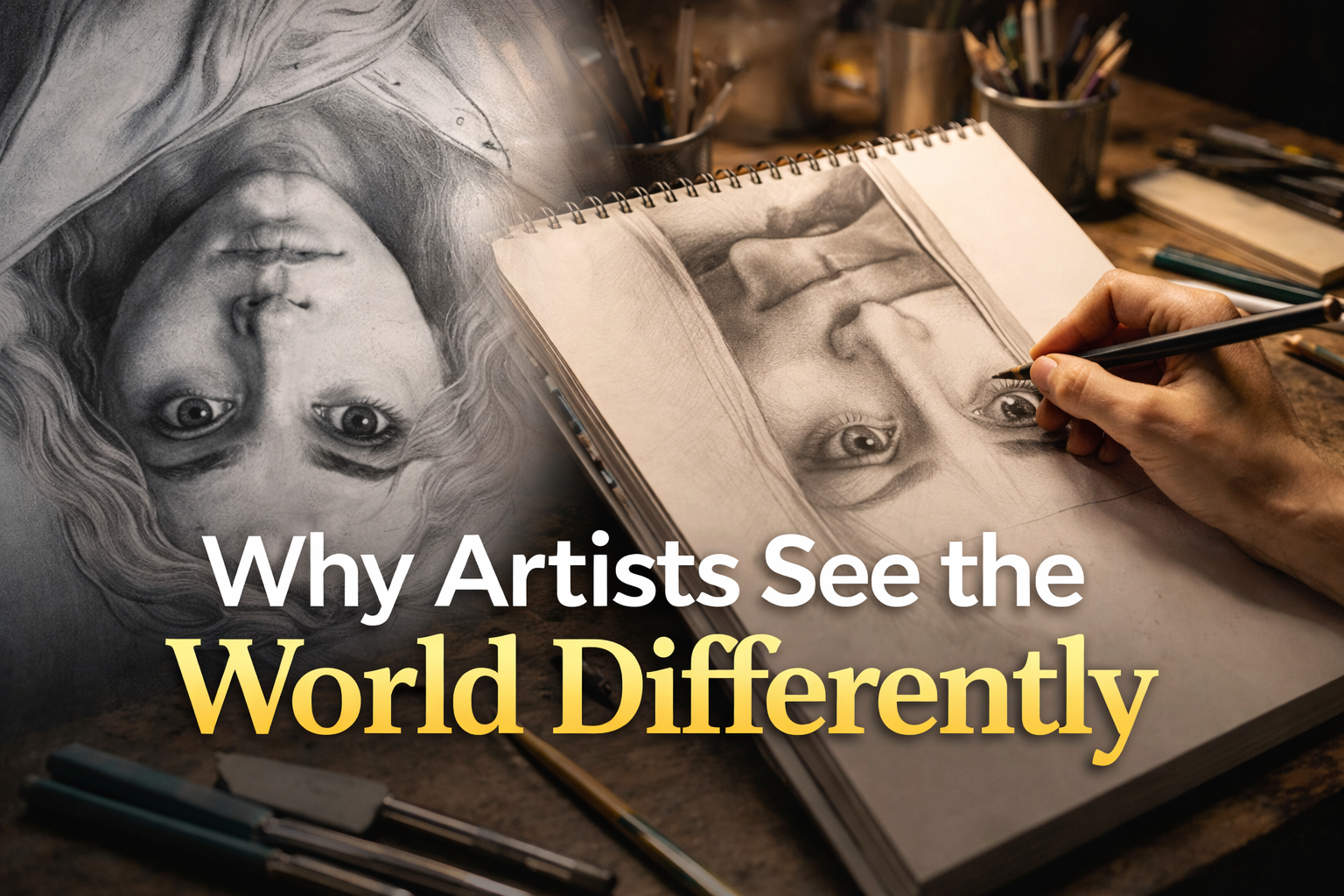
Why Artists See the World Differently
It’s not talent. It’s perception.
When people look at a skilled artist’s work, the assumption is that they are naturally gifted, that they have access to something others don’t. That assumption feels justified because the difference in output can be extreme. However, it’s also fundamentally wrong.
Artists are not seeing a different world. They are seeing the same world with less interference. The difference is not ability in the hand, it is organisation of perception. It is also important to understand that the gap between artist and non-artist is not fixed. It can be trained.
What that means in practice is simple. If you’ve ever sat down to draw and found that what appears on the page looks flat, distorted, or childlike compared to what you are looking at, the issue is not your ability. It’s that you are drawing from recognition instead of observation. Until that changes, the results won’t.
This short video explains the core idea in a few minutes. You can watch it below, then continue with the full article.
Most people are not seeing what’s in front of them
What most people call seeing is actually recognition. The moment the eyes land on something, the brain applies a label and fills in the rest from memory. A face becomes “eyes, nose, mouth.” A tree becomes “trunk, branches, leaves.” Once that label is applied, observation stops and is replaced by assumption.
This is how the brain is designed to operate. From a cognitive perspective, perception is largely top down. Researchers such as Richard Gregory demonstrated that what we experience visually is shaped by expectation and prior knowledge before we’re even aware of it.
The result is efficient, but it’s not accurate. Most people aren’t responding to what’s there. They’re responding to a constructed version of it.
Artists interrupt the construction process
Artists train themselves to stop that automatic collapse into recognition. Instead of allowing the brain to reduce what they see into familiar categories, they hold attention on what’s actually present. They track edges, angles, proportions, spatial relationships, and tonal variation without immediately converting those observations into concepts.
This was demonstrated clearly in the work of Betty Edwards. When people are guided to stop naming and start observing, their drawing improves almost immediately. That speed of change is important. It shows that the limitation was never technical. It was always perceptual.
Accurate perception produces accurate output. The hand executes what perception provides. Without accurate perception, technique simply reinforces error.
In practical terms, this is the difference most people never see clearly. The default approach relies on recognition. You look at something, label it, and draw what you think it should look like. That process is fast and familiar, but it produces distortion. The trained approach relies on observation. You track edges, angles, and relationships as they actually appear. That process feels slower and less natural at first, but it produces accuracy.
Most art training doesn’t fail because it lacks technique. It fails because it never addresses perception directly.
A demonstration used by trained artists
There is a reason many highly skilled artists use what looks like a strange method when working from reference images. They will turn a photograph upside down before they start drawing.
At first glance, this seems unnecessary. In practice, it changes everything.
When the image is upright, the brain immediately recognises what it’s looking at. A face is seen as eyes, nose, mouth. The moment that happens, the drawing process shifts from observation to memory. The artist starts drawing what they think a face should look like, not what is actually there.
When the image is inverted, recognition breaks down. The brain can no longer easily label what it’s seeing. What remains are shapes, angles, tonal shifts, and spatial relationships. The artist is forced into direct observation.
Lines are followed as they appear, not as they are assumed. Proportions are measured against what is actually visible, not what feels correct. The result is that accuracy increases, often dramatically, even in relatively inexperienced hands.
This is a way of bypassing the normal perceptual process and forcing the brain to operate differently.
Once you understand this, the difference between recognition and observation stops being theoretical. It becomes visible on the page.
Why beginners struggle
When someone says they can’t draw, what they’re usually describing is inaccurate perception. They attempt to draw what they believe is there, rather than what’s actually there. The result is predictable. They produce symbolic versions of objects, standardised features, and distorted proportions.
This is why exercises like drawing an image upside down are so effective. By disrupting recognition, the brain is forced out of its habitual process. It can no longer rely on stored representations, so it begins to process raw visual information instead. For a brief period, perception becomes more accurate, and the drawing reflects that change.
Accurate perception initially feels unnatural. It conflicts with how the brain prefers to operate. That discomfort is a sign that the process is working.
What is actually being trained
At a deeper level, artists are not just learning to draw. They are training attention. They are learning to sustain focus on what is present without drifting into interpretation. This is a cognitive skill, not a purely visual one.
The work of Anders Ericsson provides a useful framework here. High level performance is built through deliberate practice, which involves focused attention, feedback, and continuous correction. In drawing, that process is applied directly to perception. The artist is refining how they see, not just how they move.
This is why improvement can be rapid when the training is correct. The underlying system being developed is perceptual control.
The link to awareness isn’t superficial
This shift isn’t unique to art. It is the same underlying mechanism trained in meditation and other awareness based practices. In each case, the individual is learning to reduce the dominance of automatic mental processes and remain with direct experience. What changes isn’t the method, but the object of attention.
A meditator might focus on breath or bodily sensation. An artist focuses on form, space, and light. In both cases, the process involves stabilising attention and reducing conceptual interference. The mechanism is identical. Conceptual overlay is reduced, direct perception increases.
When mental activity reduces, perception becomes more direct. When it increases again, perception collapses back into interpretation. Artists learn to manage that shift deliberately through visual attention.
The wider implication
If perception can be altered in drawing, it can be altered anywhere. The same processes that distort what you see in front of you also shape how you interpret situations, how you respond to other people, and how you relate to your own thoughts.
Most people are not engaging with reality directly. They are engaging with a filtered construction built from memory and expectation. Artists expose that construction very clearly. More importantly, they demonstrate that it can be interrupted and reorganised.
This becomes obvious in everyday situations. If you label someone as “difficult”, your perception of them becomes fixed. You stop observing what they’re actually doing and start filtering everything through that label. If that label is removed, even temporarily, different details become visible. Tone changes, behaviour shifts, and the interaction itself alters as a result. Nothing external has changed. The structure of perception has.
What this means in practice
Developing this kind of perception doesn’t require artistic ambition. It requires a change in how attention is used. The starting point is straightforward. Take any object and remove the label. Instead of naming it, observe its structure. Notice edges, relative proportions, spatial relationships, and how light interacts with the surface.
Hold attention there for longer than feels natural. The tendency to revert to naming will be strong. That is the habitual process reasserting itself. With repetition, the ability to remain in direct observation stabilises, and the clarity of perception increases.
This is the same mechanism whether you’re drawing, observing thought, or working within any system that uses awareness as its primary tool.
Most people notice a shift very quickly once they apply this properly. Within a single session, perception can change enough to produce visibly different results. What takes longer is stabilising that shift so it becomes consistent rather than occasional. That comes from repetition.
Final point
What you call reality is constructed. The brain simplifies, labels, and replaces direct perception with interpretation. Artists aren’t gifted with a different kind of vision. They have trained themselves to reduce that process and see more directly.
In doing so, they expose something most people never question. The way you experience the world isn’t fixed. It can be dismantled, refined, and rebuilt. That’s the difference most people never realise they have control over.
Next step
If you want to take this further, start by training this directly. Use structured observation exercises that force you out of recognition and into perception. This is the foundation of drawing, and it’s also the foundation of awareness-based training more broadly. The method changes depending on the context. The mechanism does not.
More ways to stay connected:
Subscribe to Energy, Consciousness & The Self newsletter
