Can Christians Practise Reiki?
Traditional Reiki, Christianity, and New Age Confusion
Many Christians feel drawn to Reiki because it appears gentle, compassionate, and healing. At the same time, many feel cautious. They may have heard that Reiki is New Age, spiritually unsafe, incompatible with Christianity, or connected with angels, spirit guides, symbols, or unseen forces.
The question is understandable: Can Christians practise Reiki?
The answer depends on what kind of Reiki someone is learning, how the teacher explains it, what’s been added around it, and how it sits with that person’s conscience and church tradition.
The real question beneath it is whether someone is learning traditional Reiki or a modern adaptation with added beliefs. That distinction shapes everything that follows.
The short answer
Traditional Reiki is a Japanese system of healing and spiritual development. It doesn’t require religious conversion, worship of Mikao Usui, or abandonment of Christianity.
Some Christians practise Reiki and find that it supports healing, stillness, compassion, and prayerfulness. Others feel it conflicts with their faith and choose not to practise it.
The United States Conference of Catholic Bishops has issued a strong statement opposing Reiki in Catholic institutions. Catholics should seek guidance within their own Catholic context before proceeding.
Traditional Reiki doesn’t include angels, spirit guides, ascended masters, or channelling. Those are later additions that use the Reiki name. They change the conversation entirely.
What do Catholic authorities say about Reiki?
In 2009, the Committee on Doctrine of the United States Conference of Catholic Bishops, or USCCB, issued guidance on Reiki as an alternative therapy. The statement rejects the use of Reiki in Catholic institutions and ministries in the United States, including retreat centres, hospitals, and chaplaincy settings.
That statement gives a clear US Catholic position. It reflects wider Catholic concerns about healing, prayer, superstition, New Age spirituality, and the difference between Christian grace and spiritual technique.
It’s also US focused. I haven’t found a universal Vatican statement specifically addressing Reiki, and not every Catholic bishops’ conference around the world appears to have issued an equivalent ruling. Catholics outside the United States should seek guidance from their own priest, bishop, diocese, or Catholic authority.
For non-Catholic Christians, the picture is less uniform. Some churches have clear healing ministries based on prayer, anointing, laying on of hands, pastoral care, and sacrament, but they may not have a formal ruling specifically on Reiki. In those cases, the question becomes one of theology, conscience, pastoral guidance, and what’s actually being taught.
The question of Reiki being offered by a church or Catholic institution is different from the question of whether an individual Christian privately explores Reiki, so readers should keep those two issues separate.
A Catholic priest who loved Reiki
Some years ago, while I was teaching in Egypt, I taught Reiki to a retired German Catholic priest.
He was a well-known figure in Germany. Although retired, he remained active in pastoral support, covering for other priests when they were ill or unavailable, and continuing to serve the Catholic community around him.
He completed Reiki Level 1, Level 2, and Level 3 with me.
“What you’ve taught me is exactly the same as what I was taught during my own training as a priest.”
That stayed with me as it was very powerful.
He entered into the practice in a serious way, doing Reiki every morning alongside his prayers and bringing the quality of that practice into his church life and pastoral work. He even spoke about it in connection with communion. For him, Reiki wasn’t a separate belief system competing with Christianity. It became part of the prayerful and pastoral rhythm he already lived by.
This story shows why the lived experience of Reiki among individual Christians can be more nuanced than a simple yes or no. For this priest, Reiki didn’t pull him away from Christianity. It resonated with something he already knew from his own training as a priest.
Can Reiki deepen someone’s existing faith?
In my experience, yes, it can.
During the years I taught Reiki in Egypt, something happened several times that I found deeply meaningful. Students from different religious backgrounds, mostly Muslim, and sometimes Christian, told me that after learning Reiki and returning to their own prayers, they felt a connection to God for the first time in their lives.
These were people who’d grown up within strong faith traditions. Reiki seemed to open something experiential in them. It allowed them to feel what they’d previously believed but had never experienced as a lived reality.
For them, Reiki made prayer feel alive. It deepened the religion they already had.
I don’t present that as a rule. I don’t tell people that Reiki will definitely make them feel closer to God. But I’ve seen it happen enough times to take it seriously.
In a country like Egypt, where religion is woven deeply into daily life, Reiki often enters a person’s existing spiritual world rather than replacing it. For some people, it becomes a way of feeling divine love more directly. That doesn’t settle the theological debate, but it matters personally and pastorally.
Why the type of Reiki you encounter changes everything
Before asking whether Reiki is compatible with Christianity, we need to clarify what Reiki actually means.
Reiki is a Japanese system associated with Mikao Usui, who lived in Japan in the late nineteenth and early twentieth centuries. He developed the system commonly known as Usui Reiki Ryōhō, usually translated as the Usui Reiki Healing Method.
The system includes hands-on healing, self-practice, meditation, precepts, spiritual discipline, and personal development. In a Reiki treatment, the practitioner places their hands lightly on or near the body and allows Reiki to flow. In Reiki self-practice, the practitioner uses the same connection with Reiki to develop presence, clarity, compassion, and inner stability.
This is where confusion begins.
Some people use the word Reiki to mean traditional Reiki. Others use it for modern systems that add angels, spirit guides, ascended masters, channelling, psychic messages, or other New Age frameworks. Those additions change the conversation entirely for Christians.
A Christian may have no difficulty with compassionate healing, stillness, self-practice, and spiritual discipline. The same Christian may have serious concerns about spirit contact, channelling, or a teacher’s personal New Age theology.
So the better question isn’t simply, “Is Reiki compatible with Christianity?” The better question is: What exactly is being taught?
Why Reiki is both healing and spiritual development
Some people describe Reiki only as a healing therapy. Others describe it only as a spiritual path. Both miss part of the picture.
Reiki works as both. The healing practice and the spiritual development practice support each other. When a practitioner gives Reiki to another person, the energy may support physical, emotional, mental, or spiritual healing. When the practitioner uses Reiki for self-practice, meditation, and inner development, they gradually become more present, stable, compassionate, and clear. That inner development affects the quality of healing they offer to others.
So Reiki isn’t simply something a practitioner does with their hands. It’s also something that changes the practitioner.
This matters for Christians because Reiki shouldn’t be reduced to a simple hands-on therapy with no spiritual dimension. Nor should it be exaggerated into a separate religion. Traditional Reiki is a spiritual healing system, and a Christian considering it needs to understand both sides.
That’s one reason some Christians find Reiki meaningful: they recognise in it a movement toward stillness, service, healing presence, and compassion. It’s also one reason some feel cautious. They want to know whether this spiritual development sits comfortably with their relationship with God, their conscience, and their church tradition. That’s a fair question.
Does Reiki force a belief system on you?
When I was training as a Reiki teacher, my own teacher gave me a teaching that’s stayed with me.
He said that a good Reiki teacher passes on the clear essence at the core of the system. It’s like giving someone a clear glass of water. Once they receive it, they can add their own flavour to it if they wish.
A Christian may understand Reiki through their relationship with God. A Muslim may understand it through divine mercy. A Buddhist may understand it through compassion and awareness. A person with no religion may simply experience it as healing presence or life energy.
The teacher’s job is to pass on the clear essence, not to fill the glass with their own personal beliefs before handing it to the student. Once a teacher adds their own flavour first, the student receives the teacher’s interpretation rather than the clear essence of the system. That’s where confusion often begins and all of the modern problems with Reiki arise.
Traditional Reiki should pass on the clear essence of the system, not the teacher’s personal spiritual beliefs.
This is why I’m cautious about Reiki being mixed with angels, spirit guides, ascended masters, channelling, or other added frameworks. Those things may belong to someone’s personal spirituality, but they don’t belong to traditional Reiki itself.
A Christian should be able to learn traditional Reiki without being asked to adopt someone else’s New Age beliefs, religious language, or personal theology.
The five main concerns Christians have about Reiki
Christian concerns about Reiki usually centre on five main areas.
1. The language of universal life energy
Some Christians worry that this sounds impersonal, vague, or too close to a worldview where God and creation blur together. In Christianity, God is personal, transcendent, creative, loving, and distinct from creation.
A Reiki teacher who presents universal energy as an impersonal field replacing God will naturally raise concern. A teacher who leaves room for the student’s own faith reduces that concern, but the student still needs to decide whether the framework sits clearly with their Christianity.
2. The attunement process
An attunement is the initiation process used in Reiki training. During an attunement, the Reiki teacher opens or strengthens the student’s connection to Reiki so that the student can practise self-treatment and offer Reiki to others.
Because this is a spiritual process, some Christians naturally want to know what’s being transmitted and whether they should receive it. That’s a reasonable question, and a serious teacher should be able to explain it clearly.
3. The use of symbols
Reiki symbols often get described badly or very bizarrely online, which can make them sound strange or threatening. In traditional Reiki, the symbols are meditation devices. They help the practitioner develop concentration, stabilise attention, and connect more clearly with specific qualities of Reiki. They’re not objects of worship, magical signs, or replacements for prayer.
4. New Age additions
The way many people mix Reiki language with angels, spirit guides, ascended masters, channelling, or psychic messages makes Reiki appear very different from traditional Reiki. This is perhaps the most common source of Christian concern, and it’s worth being clear: if those things appear in a class, they’re not traditional Reiki. They’ve been added later and are not representative of the still active dissemination of traditional Reiki teachings.
5. Whether Reiki replaces prayer with technique
This is perhaps the deepest theological concern, and it deserves more attention than it often receives.
Within Christian theology, healing is not usually understood as a technique the practitioner controls. It is understood as an act of prayer, trust, and surrender to God. The person offering healing prayer does not manipulate healing energy. They intercede, anoint, bless, and hold the sick person before God in prayer.
Some Reiki teaching can sound very different. Some teachers speak as though the practitioner is running energy through their hands in a way that produces specific effects. If Reiki is presented as a skill the practitioner wields rather than a practice of receptive presence, a Christian thinking carefully about theology will rightly question it.
However, traditional Reiki, taught carefully, is not about control. Practitioners are taught to remain open, receptive, and non-attached to outcomes. They allow Reiki to flow; they do not (or should not attempt to) direct or force it.
That distinction matters. When Reiki is presented as control over healing energy, it will understandably concern many Christians. When it is taught as receptive presence, surrender, and non-attachment to outcome, the comparison becomes more nuanced.
The concern is real, but it applies strongly to how Reiki is taught, not only to the name Reiki itself.
Do Reiki symbols conflict with Christian faith?
In traditional Reiki, the symbols are meditation devices. Their primary function is to train concentration, stabilise attention, and deepen the practitioner’s relationship with specific qualities of Reiki. They’re part of a one-pointed concentration practice: the practitioner focuses the mind through the symbol and becomes more attuned to a specific quality of the energy.
Those qualities may include mental and emotional clarity, compassion, wisdom, presence, or a stronger connection with the healing function of Reiki. The symbols are also used in healing practice, but their deeper purpose is meditative.
A Christian doesn’t need to accept a vague or fearful explanation of Reiki symbols. They should ask how the teacher uses them, and whether they’re being taught as meditation tools within traditional Reiki practice. That question usually gives a clear indication of the type of teacher and training being offered.
Reiki vs Christian laying on of hands: what’s the actual difference?
Reiki and Christian laying on of hands can look similar from the outside. Both may involve touch, compassion, silence, healing, comfort, prayer, and care.
But they’re not identical.
In Christian practice, laying on of hands is usually an act of prayer, blessing, pastoral care, or sacramental ministry. The person offering the prayer seeks healing from God. The practice sits inside Christian worship, pastoral care, or personal prayer.
In Reiki, the practitioner has received an attunement and allows Reiki to flow through the hands. Some practitioners understand that energy as divine love. Others describe it as universal life energy. Others focus on the experience of the practice.
So the outer form may look similar while the inner explanation differs. For Christians, that difference matters. The question isn’t only, “Does this involve touch?” The deeper question is, “What do I believe is happening here?”
Traditional Reiki vs modern Reiki-derived adaptations
Many Christian concerns come from seeing Reiki mixed with later spiritual additions. The table below shows some of the key differences.
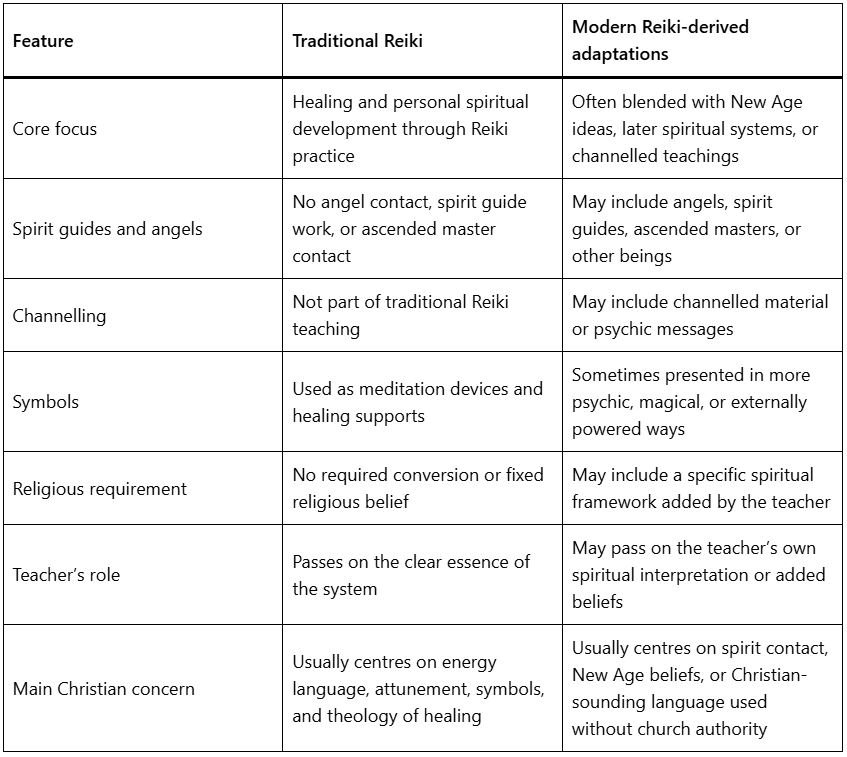
This distinction matters. If a Christian rejects spirit guide work, angel contact, or channelling, that doesn’t necessarily mean they’ve rejected traditional Reiki. They may have rejected something that was added later.
When people expect angels and ascended masters in Reiki
I once taught a Reiki Level 1 class in Cairo where this confusion became very clear.
Partway through the first morning, one of the students asked when we’d be learning how to connect with guardian angels. I told her plainly that we wouldn’t be doing that because it wasn’t part of Reiki.
A little later, she asked when we’d be connecting with ascended masters. Again, I told her we wouldn’t, because it had nothing to do with the class I was teaching.
She stayed for the first day but didn’t return for the second.
That moment stayed with me because it showed how confused the public understanding of Reiki had become. She’d clearly been exposed to a version of spirituality where Reiki had been mixed with New Age material, and she assumed those things belonged in a Reiki class. They don’t.
For Christians, this is an important distinction. If something feels spiritually incompatible, ask whether it’s actually traditional Reiki or whether it’s a later addition using the Reiki name.
What about Holy Fire Reiki and other named systems?
Holy Fire Reiki is a modern Reiki-derived system that uses language some people associate with Christian spirituality, such as “holy” and purification by divine energy. Some Christians may find that language more acceptable. Others may find it more concerning, because Christian-sounding terminology can create the impression that a practice has religious authority when it may not.
A practice using words such as “holy,” “divine,” or “Christ consciousness” doesn’t automatically become Christian in a doctrinal sense. Christians still need to ask what the teacher actually teaches, where the practice came from, what spiritual framework surrounds it, and whether it fits their conscience.
The same applies to Angel Reiki, Lightarian Reiki, Karuna Reiki, and other Reiki-derived systems. Traditional Reiki has its own foundation. Later systems may use the Reiki name, but they often add teachings, practices, or spiritual claims that aren’t part of traditional Reiki. For a Christian, that distinction can completely change the conversation.
Is Reiki safe for Christians?
For Christians, the first safety question is whether the teacher is actually teaching traditional Reiki, or whether they’re teaching a modern New Age adaptation using the Reiki name.
A Christian considering Reiki should ask direct questions before attending a class. They should ask whether the teacher includes spirit guides, angel contact, ascended masters, or channelling. They should also ask how the teacher understands Reiki, and whether they present it as a replacement for prayer, worship, scripture, church, or relationship with God.
A good Reiki teacher should respect the student’s Christian faith. They shouldn’t mock it, challenge it, or try to replace it with another belief system.
From a healthcare perspective, Reiki should always be treated as complementary. It should never replace medical diagnosis, treatment, medication, emergency care, psychotherapy, or other professional support. Reiki may support relaxation, peace, emotional processing, and spiritual resilience. A practitioner shouldn’t sell it as a guaranteed cure. That point is especially important in Christian settings, where vulnerable people may be looking for hope. Hope matters. False certainty harms.
The Christian student’s Reiki checklist
Before enrolling in a Reiki course, ask the teacher these questions directly.
Are you teaching traditional Reiki or a modern Reiki-derived adaptation?
Traditional Reiki is very different from systems that include angels, ascended masters, spirit guides, or channelling. Make sure you know which you’re enrolling in.
Do you include spirit guides, angels, ascended masters, or channelling?
If the answer is yes, you’re looking at a modern adaptation using the Reiki name, not traditional Reiki.
How do you define Reiki energy?
Some teachers present Reiki as universal life energy, while others understand it as divine love or explain it through a New Age framework. Listen carefully to the language they use.
Do I need to adopt any belief system to learn Reiki?
A traditional Reiki teacher should pass on the clear essence of the system and leave room for your own conscience and faith.
Will Reiki replace my prayer life or Christian faith?
A responsible teacher should never present Reiki as a replacement for prayer, worship, scripture, church, or your relationship with God.
Do you make healing promises?
Be cautious of any teacher who promises cures or tells you to use Reiki instead of proper medical or psychological care.
Does my own conscience feel clear?
Some Christians can practise Reiki with peace. Others cannot. If you feel spiritually conflicted, don’t override that feeling because someone else says Reiki is harmless.
Does my church tradition give guidance?
If you’re Catholic, know about the USCCB statement and seek guidance within your own Catholic context. If you belong to another Christian tradition, speak with a trusted priest, minister, pastor, or spiritual director if you’re unsure.
Frequently asked questions
Does Reiki involve spirit guides or angels?
Traditional Reiki does not involve spirit guides, angel contact, ascended masters, or channelling. If those things appear in a class, they have been added later through a modern Reiki-derived adaptation. This distinction matters especially for Christians, because many concerns about Reiki are actually concerns about those later additions.
Can a Catholic attend a Reiki class?
The USCCB statement advises against Reiki in Catholic institutions and ministries in the United States. For personal use, Catholics should seek guidance from their own priest, bishop, or spiritual director. The picture varies by country and context.
What is the difference between Reiki and Christian prayer healing?
Christian healing centres on prayer, trust in God, and pastoral or sacramental ministry. Reiki centres on an attunement-based practice of allowing energy to flow through the hands. The outer form can look similar. The inner theological framework is different. A Christian engaging with Reiki needs to decide whether both can sit together within their faith.
Does the type of Reiki teacher matter?
Very much so. A teacher who mixes Reiki with spirit guides, angel contact, or New Age theology is offering a very different experience from a teacher who keeps to traditional Reiki. The teacher’s approach, language, and what they include or exclude are the most important factors for a Christian to investigate.
Can Reiki harm you spiritually?
Christians who feel that Reiki would compromise their spiritual integrity shouldn’t practise it. Conscience matters. For those who do explore traditional Reiki, the most important safeguards are choosing a grounded teacher, being clear about what is and isn’t included, and remaining in conversation with their church community and spiritual guides.
So, can Christians practise Reiki?
Some Christians practise Reiki and find that it supports healing, compassion, stillness, prayerfulness, and spiritual growth.
Some Christians decide that Reiki conflicts with their faith and choose not to practise it.
The United States Conference of Catholic Bishops has issued a strong US-focused statement against Reiki in Catholic institutions, and Catholics should seek guidance within their own church context. Other Christian traditions may not have a specific Reiki ruling, but they still tend to centre healing in prayer, sacrament, pastoral care, and trust in God.
Christians should understand what’s actually being taught and distinguish traditional Reiki from modern Reiki-derived systems that include angels, spirit guides, ascended masters, or channelling. They should also understand that Reiki is both a healing modality and a spiritual development practice, and that those two dimensions belong together.
My own experience is that Reiki, when taught clearly and responsibly, doesn’t need to pull people away from God. I’ve seen it deepen people’s existing faith, including Muslims and Christians who returned to prayer with a stronger felt connection to the divine. I also taught a well-known retired Catholic priest who loved Reiki and told me that what I’d taught him was exactly the same as what he’d been taught during his own training as a priest.
The debate isn’t settled by one person’s experience. But it does show that the relationship between Reiki and Christianity is more complex than a simple yes or no.
A Christian considering Reiki should look for a teacher who is honest, grounded, respectful, and clear about what traditional Reiki is and what’s been added around it. That’s where real discernment begins.
Want to ask about Reiki as a Christian?
If you’re a Christian considering Reiki training, you’re welcome to ask questions before making any decision. A serious Reiki teacher should be able to explain what’s taught, what’s not taught, and how traditional Reiki differs from modern New Age adaptations.
Contact me here: steve @stevegooch.co
Read more about Reiki Level 1 training here: Reiki Jin Kei Do Training
Related Articles:
Why Reiki Training Costs Vary So Widely
Is Reiki Jin Kei Do the Right Fit for You?
How Reiki Jin Kei Do Compares to Other Reiki Systems
Best Reiki Training: 5 Signs of a High-Quality Course (+ Red Flags to Avoid)
Reiki Training Reviews: What Students Say After Learning with Steve Gooch
More ways to stay connected:
Subscribe to Energy, Consciousness & The Self newsletter
