
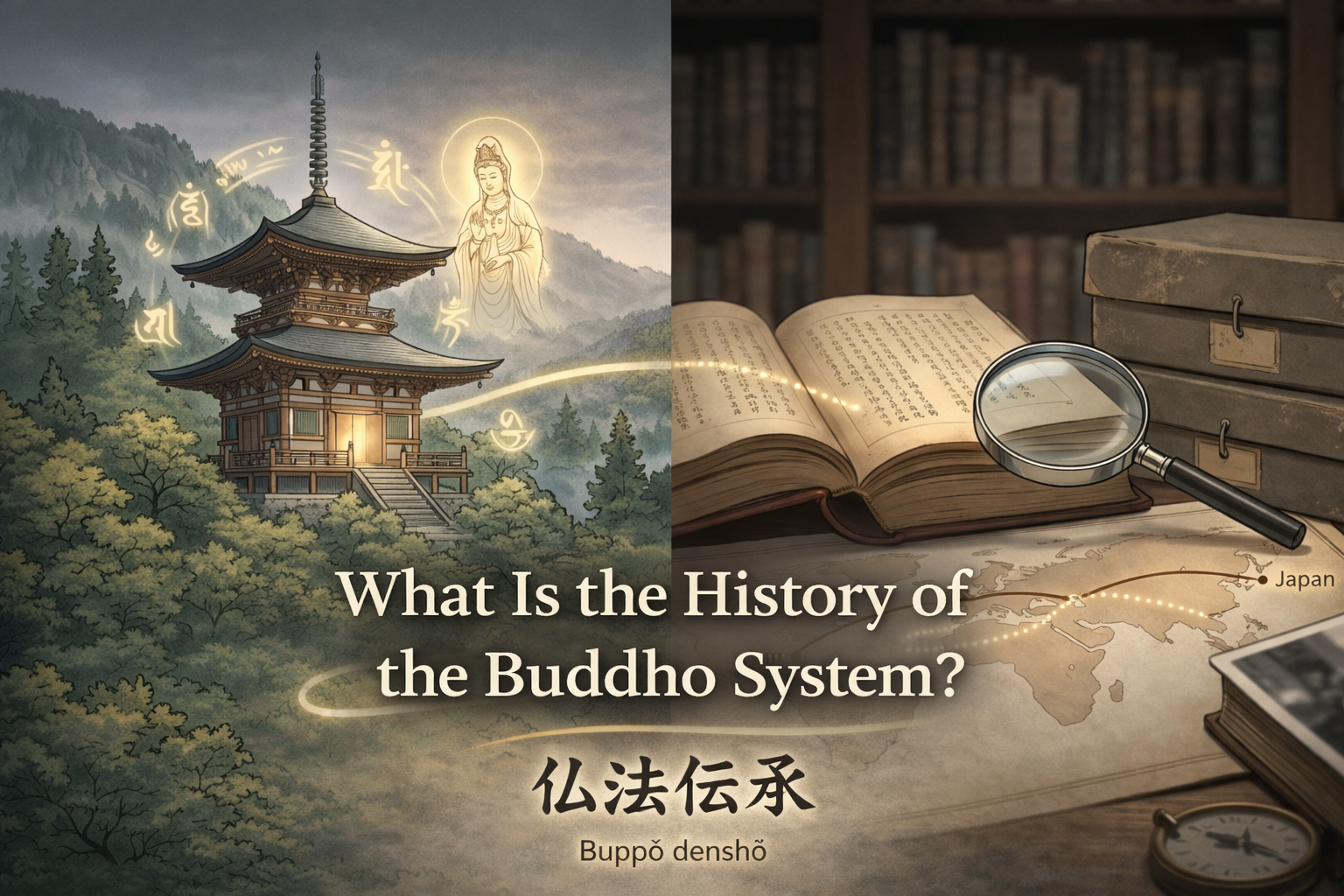
What Is the History of the Buddho System?
Short Answer
No independently verified historical record confirms Buddho as an established Buddhist system within recognised traditions.
We can trace its modern transmission through the Reiki Jin Kei Do lineage, particularly through Seiji Takamori and Dr. Ranga Premaratna. This part of its history sits within living memory, and practitioners can follow it through direct teaching relationships.
At the same time, teachers widely repeat origin narratives that link Buddho to Mt. Kurama and describe its transmission across India, Tibet, China, and Japan. Independent historical evidence does not currently support these accounts. They belong to lineage teaching rather than verifiable historical record.
To understand Buddho clearly, you need to separate what can be confirmed from what the lineage teaches.
The Claims That Are Commonly Taught
Within Buddho teaching, several key origin accounts appear consistently and shape how practitioners understand the system.
Teachers describe Mikao Usui as having practised Buddho during his retreat on Mt. Kurama. They present Buddho as connected to Avalokiteshvara and describe it as a deeper layer of Buddhist practice. Many accounts describe a transmission that moved through India, Tibet, China, and Japan before reaching its current form. Some teachings also describe Seiji Takamori as having received training connected to older traditions, including references to study or institutional links in India. Practitioners also describe Buddho as underlying Reiki at a deeper structural level.
These accounts form the core narrative that most practitioners are taught. To assess them properly, they need to be stated clearly and then examined in terms of what is currently documented and what is not.
What Can Actually Be Verified
The most reliable reference point for Buddho lies in its modern transmission. The Reiki Jin Kei Do lineage passed the system, as it is practised today, through Seiji Takamori and Dr. Ranga Premaratna. Practitioners can trace this transmission through direct teaching relationships. In Reiki-based systems, this process includes formal initiation through attunements, while Buddho itself includes a series of empowerments. Within the lineage, these are understood as related processes, and it is sometimes claimed that Reiki attunements derive from these empowerment structures, although this has not currently been established through independently verified historical documentation.
Even within this recent history, the picture is not completely fixed. Early accounts do not always agree on how teachers structured or presented the system. One example often discussed concerns the existence of a photograph of Seiji Takamori. Many people state that no photograph exists, yet at least one early student reports that he was shown a photograph during a Reiki training in the United States. This does not resolve the issue, but it shows that even recent history relies on recollection rather than a settled documentary record.
Beyond this modern transmission, there is currently no independently verified body of historical documentation that establishes Buddho as a defined system within recognised Buddhist traditions. No major Buddhist school, including Tibetan, Zen, Tendai, or Shingon, formally records Buddho as a distinct lineage. There is also no independently verified documentation confirming that Mikao Usui practised Buddho as a defined system.
This does not indicate contradiction. It reflects the current absence of confirmed historical documentation.
The Mt. Kurama Account
Many teachings present the idea that Mikao Usui practised Buddho during his retreat on Mt. Kurama as a central part of the system’s origin.
Within the lineage, this follows a clear internal logic. Mt. Kurama has long-standing associations with Avalokiteshvara. Buddho centres on the cultivation and embodiment of Avalokiteshvara. Reiki, within this framework, reflects similar principles and, it’s claimed, also has a relationship to Avalokiteshvara. Based on this, teachers describe Usui’s practice as corresponding to, or being, Buddho.
This reasoning is internally consistent and forms part of the lineage understanding of the system.
At present, no independently verified historical documents or contemporary records identify Usui’s practice on Mt. Kurama as Buddho. This places the account within lineage teaching and ongoing investigation rather than confirmed historical record.
The India to Japan Transmission Narrative
Many accounts describe Buddho as a system that moved through India, Tibet, China, and Japan over time. This narrative aligns with how established Buddhist traditions describe their own development and provides a coherent framework for understanding the system’s depth.
At present, no independently verified historical documentation traces Buddho as a defined system along this path. There are no widely recognised texts, institutional records, or formally documented lineages that identify Buddho within these traditions.
Research within the lineage has begun to explore elements of this history, and some findings point toward possible connections, but these remain incomplete and not yet established as fully verified historical documentation.
Seiji Takamori and Claims of Training in India
Some teachings describe Seiji Takamori as having received training connected to older traditions, including references to study or institutional involvement in India. These accounts contribute to how practitioners understand the depth and origin of the system.
At present, there are no independently verified academic or institutional records that confirm these details. As with other aspects of the system’s history, this places these accounts within lineage teaching and ongoing research rather than established historical record.
Avalokiteshvara and the Structure of the System
Avalokiteshvara forms a clear and established part of Buddho. The teachings include direct references, and the structure of the system consistently reflects compassion-based cultivation aligned with Avalokiteshvara traditions. This connection is explicit within the system.
What remains under investigation is not the presence of Avalokiteshvara within Buddho, but how this relationship situates historically within recognised Buddhist lineages. The structure aligns closely with known traditions, but formal historical documentation linking Buddho itself to those lineages has not yet been established.
What the Evidence Suggests
The available evidence points to Buddho taking shape through modern transmission while drawing on multiple influences.
These include Buddhist meditation and compassion practices, Vajrayana-style approaches to energy and embodiment, Japanese esoteric frameworks, and elements of yogic and embodied training. This explains why the system resonates strongly with established traditions while remaining distinct in its current form.
At the same time, ongoing research within the lineage continues to explore and clarify its historical background.
Why the History Remains Incomplete
Several factors contribute to the current state of the historical record. There are no publicly available primary documents that fully establish the system’s origins. Early practitioner accounts do not always align in detail. Some materials are reported to have been lost. The system also appears to have been introduced and structured gradually over time rather than presented in a fixed, fully defined form from the outset.
These factors do not invalidate the system. They define the current limits of the historical record.
Is Buddho a Recognised Buddhist Lineage?
Buddho is not currently recognised as a formal lineage within established Buddhist traditions.
At the same time, its components clearly align with practices found across those traditions. Compassion-based work aligns with Avalokiteshvara. Energy-based practices resemble Vajrayana systems. Structured awareness practices reflect aspects of Japanese esoteric Buddhism.
Practitioners have also observed that Buddho symbols are not recognised by monks or lamas when shown to them. This indicates that while the system sits within the broader landscape of Buddhist practice, it is not formally identified within existing institutional lineages.
What This Means in Practice
If you are looking for a system with a fully documented and independently verified historical lineage, Buddho does not currently meet that standard.
If you approach it as a system of practice, the focus changes. The relevant question becomes whether the system develops awareness, refines perception, and produces consistent results in direct experience. Different systems develop awareness in different ways, whether through meditation, structured observation, or energy-based practices. At that point, the more relevant question is whether this specific lineage and training approach are the right fit for you.
That is where its value is determined.
The Clean Way to Understand It
You need to hold two perspectives clearly.
The lineage perspective presents Buddho as part of a deeper stream of practice connected to Avalokiteshvara, Mt. Kurama, and the roots of Reiki. The historical perspective reflects the current state of documentation, which confirms the modern transmission while leaving earlier origins under ongoing investigation.
Keeping these perspectives distinct allows the system to be understood without confusion.
Where to Go Next
If you want to understand how Buddho is actually practised, the next step is:
What Is the Buddho System and How Is It Practised?
This is where the system moves from historical context into direct experience.
Related Articles:
What Is the Buddho System and How Is It Practiced?
Why Do People Draw Symbols Instead of What They See?
How Reiki Jin Kei Do Compares to Other Reiki Systems
How Do Reiki Attunements Work?
More ways to stay connected:
Subscribe to Energy, Consciousness & The Self newsletter
