

How Reiki Jin Kei Do Compares to Other Reiki Systems
For Seekers Who Want Depth, Not Just a Healing Technique
Today, the word Reiki describes a broad spectrum of systems, some rooted in Japanese spiritual practice, others filtered through New Age cosmology, angelic channels, or fast-track video certification.
If you’re exploring Reiki and want more than just another modality, if you’re looking for discipline, depth, and a tradition you can grow with, this guide will help you understand how Reiki Jin Kei Do (RJKD) stands apart.
A Map of the Reiki Landscape
To make sense of the variety, we can group Reiki systems into three tiers:
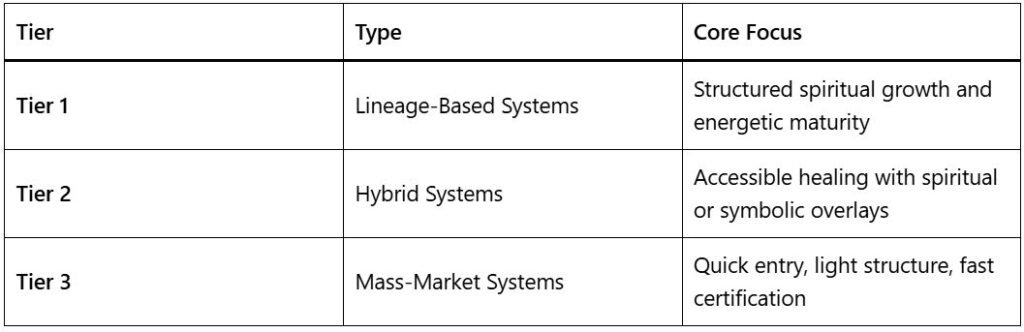
Reiki Jin Kei Do sits firmly in Tier 1, offering a long-term, meditative path grounded in authentic transmission and inner transformation.
Reiki Jin Kei Do (RJKD)
- Primary Focus
Reiki Jin Kei Do (RJKD) is a path of personal spiritual development rather than a technique-based healing system. The system’s primary aim is the inner maturation of the practitioner, with healing seen as a natural by-product of presence, clarity, and compassion, not as something done to someone.
This maturation is cultivated through:
- Clarity of awareness
- Compassionate presence
- Wisdom through self-observation
- Energetic sensitivity refined through practice
- Lineage and Structure
RJKD traces its lineage through Usui → Hayashi → Seiji Takamori, a Zen monk → Dr Ranga Premaratna, who carries the lineage today down to his students and then on to their students.
The influence of Seiji Takamori is particularly significant. His Zen background introduced a monastic orientation, structured meditation, and the principle of dwelling in emptiness, a profound non-intervention stance similar to Shingon healing practices, where the practitioner learns to get out of the way and rest in spacious awareness. RJKD maintains this as a foundational spiritual principle: you do not manipulate energy, you simply become present to it.
Core Components of Practice
- Unlike many systems that focus primarily on hands-on healing or channelling techniques, RJKD offers a structured inner training system that includes:
- Six Point Meditation – for stabilising awareness, grounding attention, and opening subtle perception
- MindCheck – an awareness tool for maintaining presence, clarity, and emotional responsibility in everyday life
- Meditation on Symbols – to develop samatha (calm abiding) and energetic refinement through repeated contemplative focus
- Purifying Breaths – used to clear energetic residue and enhance internal receptivity
- Dwelling in Emptiness – the cultivated art of non-doing, echoing Buddhist healing disciplines where presence itself is transformative
- Energetic Progression – the development of perception and sensitivity over time, rather than instant “activation” or mastery
- Empowerment and Transmission (Denju)
Empowerment in RJKD is a conscious energetic transmission, not a symbolic act or mystical download. Practitioners are trained to understand:- What an empowerment actually transmits
- How it shifts their energetic field and perception
- Why repeated empowerments integrate deeper changes over time
This distinguishes RJKD from systems that use attunements as one-time “activations” or channellings. Here, empowerment is understood as a precise, intentional alignment with the lineage’s specific energetic quality.
Training Format
- While traditionally taught in person, RJKD recognises that remote empowerments are entirely in keeping with the esoteric roots of its Buddhist lineage. In schools such as Shingon and Vajrayana Buddhism, non-local transmission has long been part of authentic spiritual training, where the power of intention, clarity of transmission, and depth of relationship are what matter. In the same spirit, RJKD can be taught online by teachers who honour the system’s energetic precision and meditative foundations. There are no automated courses or fast-tracked certifications. Training remains progressive, relational, and grounded in direct practice, whether in person or online.
- Positioning: RJKD is not a “style” of Reiki, it is a disciplined spiritual path for those willing to engage in sustained inner cultivation. It doesn’t add tools to your kit. It reshapes how you live, perceive, and relate to energy, healing, and service.
Tier 1: Traditional Lineage-Based Systems
These systems preserve the core teachings, meditative foundations, and transmission lineages that trace directly back to Mikao Usui. Their focus is on personal transformation through disciplined inner practice, rather than technique accumulation or symbolic overlays. Tier 1 systems are rare, often taught in-person or under close mentorship, and are best suited to those seeking serious spiritual development and not simply healing techniques.
Jikiden Reiki
- Focus: Physical healing and purity of original teachings
- Lineage: Hayashi → Chiyoko Yamaguchi
- Key Traits: Hands-on techniques, Byosen scanning, no added symbols
- RJKD Perspective: RJKD shares a respect for tradition but adds a structured spiritual path and meditative depth.
Komyo ReikiDo
- Focus: Mind-body-spirit unity through spiritual practice
- Lineage: Hayashi → Yamaguchi → Hyakuten Inamoto
- Key Traits: Founded by a Buddhist monk, emphasises Do (spiritual path)
- RJKD Perspective: Both systems honour spiritual growth, but RJKD uses a stricter symbolic framework and energetic training model.
Gendai Reiki-ho
- Focus: Usui Reiki for the modern world
- Lineage: Hiroshi Doi (member of the Usui Reiki Ryoho Gakkai)
- Key Traits: Balances authenticity with accessibility
- RJKD Perspective: RJKD retains spiritual rigour, while Gendai simplifies for broader appeal.
A Practitioner’s Experience Comparing Two Lineage-Based Systems
I have had students come to me who previously trained in Jikiden Reiki and wanted to understand how Reiki Jin Kei Do differs in practice and orientation. One such student completed Reiki Jin Kei Do training after her earlier Jikiden experience because she was looking for something more than a hands-on healing method.
What she found was not a contradiction of what she had learned before, but a shift in emphasis. Reiki Jin Kei Do placed far greater weight on meditation, inner development, and the practitioner’s own spiritual maturation. For her, this provided a more expansive and authoritative framework for Reiki as a personal path, rather than primarily a therapeutic technique.
I have heard similar reflections from other practitioners trained in different Reiki traditions. What they often describe is not that one system “works” and another doesn’t, but that Reiki Jin Kei Do addresses a different need, a need for depth, structure, and sustained personal development alongside healing practice.
Tier 2: Hybrid & Symbolic Systems
Hybrid systems blend Reiki with additional philosophies, energetic maps, or symbolic structures. These systems are often well-meaning and creative but may lack the internal rigour and meditative foundation of Tier 1 systems. They tend to appeal to those seeking flexibility or spiritual variety over disciplined personal cultivation.
Kundlini Reiki
- Focus: Awakening life-force through crown-to-base energy flow
- Founder: Ole Gabrielsen
- Key Traits: No symbols, remote attunement, rapid progression
- RJKD Perspective: RJKD builds subtle energetic capacity slowly and safely; no forced activation or shortcuts.
Reiki Plus
- Focus: Reiki integrated with spiritual wellbeing and expanded personal connection
- Key Traits: Focuses on holistic use of Reiki for emotional, mental, and spiritual balance
- RJKD Perspective: RJKD prioritises disciplined practice and lineage transmission over general spiritual integration or wellness framing.
Rainbow Reiki
- Focus: Energetic healing with added spiritual coaching tools
- Founder: Walter Lübeck
- Key Traits: Combines Reiki with karmic clearing and psychic elements
- RJKD Perspective: RJKD excludes psychic manipulation, favouring presence and universal energy without intervention.
Tier 3: Mass-Market & Channelled Systems
Holy Fire® / Karuna Reiki®
- Focus: Divine energy and intuitive healing
- Founder: William Lee Rand
- Key Traits: Channelled ignitions, spiritual evolution themes
- RJKD Perspective: RJKD maintains teacher-student lineage and avoids channelling or spiritual branding.
Seichim / Sekhem / Sekhmet Reiki
- Focus: Emotional and spiritual healing rooted in Egyptian archetypes
- Founder: Patrick Zeigler
- Lineage: Channelled experience in the Great Pyramid (1980)
- Key Traits: Channelling of goddess energy (often Sekhmet or Isis), integration with Reiki, strong emotional focus, symbolic overlays
- RJKD Perspective: While Seichim centres on channelling divine feminine energy, RJKD avoids intermediary beings or archetypes. It emphasises direct, unfiltered experience of universal energy through meditation and empowerment, not spiritual hierarchies.
Angelic Reiki
- Focus: Healing through angelic consciousness
- Founder: Kevin Core
- Key Traits: Attunements via archangels like Metatron, ceremony-rich
- RJKD Perspective: RJKD removes intermediaries and focuses on the direct experience of universal energy.
Lightarian Reiki
- Focus: Ascension energy and vibrational expansion
- Lineage: Channelled from Ascended Masters
- Key Traits: Remote delivery, frequency-focused, no physical lineage
- RJKD Perspective: RJKD roots itself in disciplined energetic development, not metaphysical hierarchy or channelling.
Online Reiki (e.g., Udemy)
- Focus: Affordability, speed, self-certification
- Traits: Pre-recorded, no live teacher support
- RJKD Perspective: RJKD requires committed practice, direct mentorship, and in-person transmission.
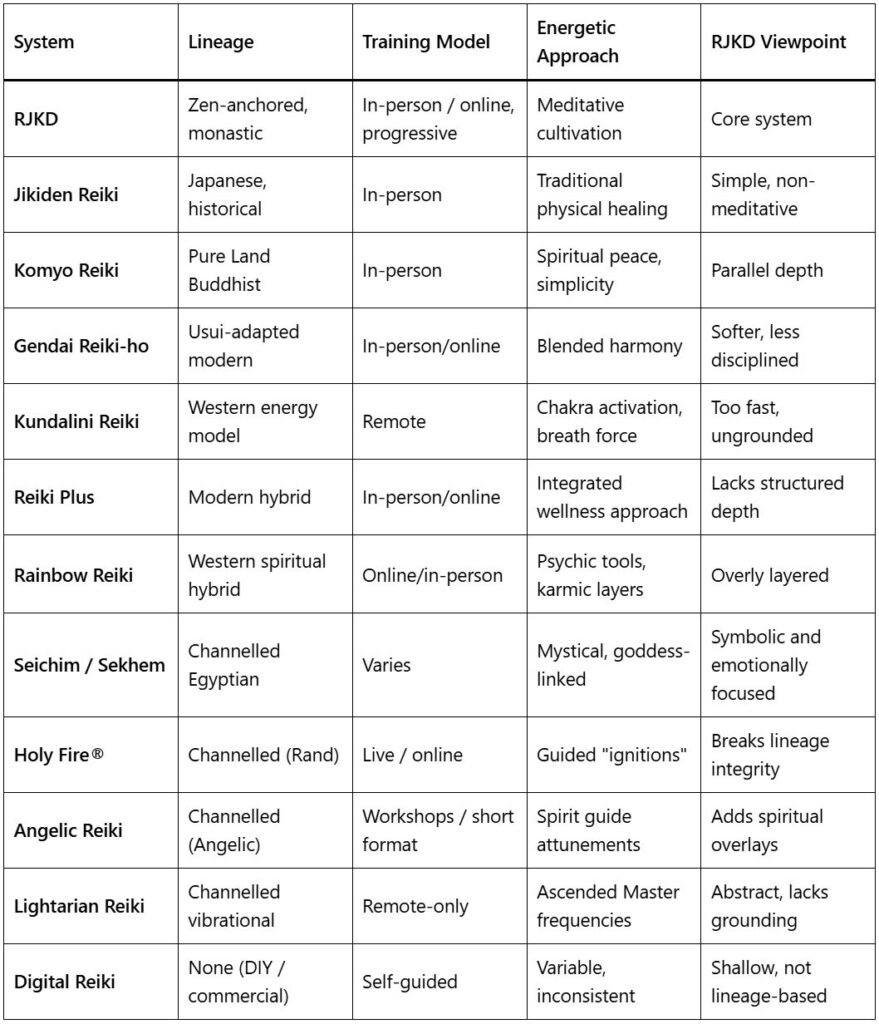
Summary Table
Why RJKD Offers Something Different
Many systems can teach you how to place your hands and call in energy. But only a few will train you in how to listen. How to show up, surrender, and allow healing to emerge from clarity and compassion.
Reiki Jin Kei Do isn’t interested in angels, entities, frequencies, or fast-track awakenings.
It’s a practice. It’s a path. And for the right person, it’s a home.
Ready to Go Deeper?
If you’re still exploring, there’s no rush. But if you want to know whether RJKD is right for you, your next step is simple:
Check Your Fit:
Read “Is Reiki Jin Kei Do the Right Fit for You?” to see if your goals align with the system’s quiet power and meditative path. It might give you exactly the clarity you’ve been looking for.
If You’re Comparing Training Paths
If you’re reading this because you’re actively comparing different ways of learning Reiki, the next step is simply to see how Reiki Jin Kei Do is actually taught in practice.
I’ve laid out how the training is structured, what the emphasis is in class, and how people usually begin here:
There’s no expectation to decide anything at this point. This is just a way of grounding the comparison in what the training experience is actually like.
Related Articles:
Why Reiki Training Costs Vary So Widely
Is Reiki Jin Kei Do the Right Fit for You?
Online Reiki Training vs In-Person Reiki: What Actually Makes the Difference?
Best Reiki Training: 5 Signs of a High-Quality Course (+ Red Flags to Avoid)
Reiki Training Reviews: What Students Say After Learning with Steve Gooch
Other ways to stay connected:
Subscribe to Energy, Consciousness & The Self newsletter
