
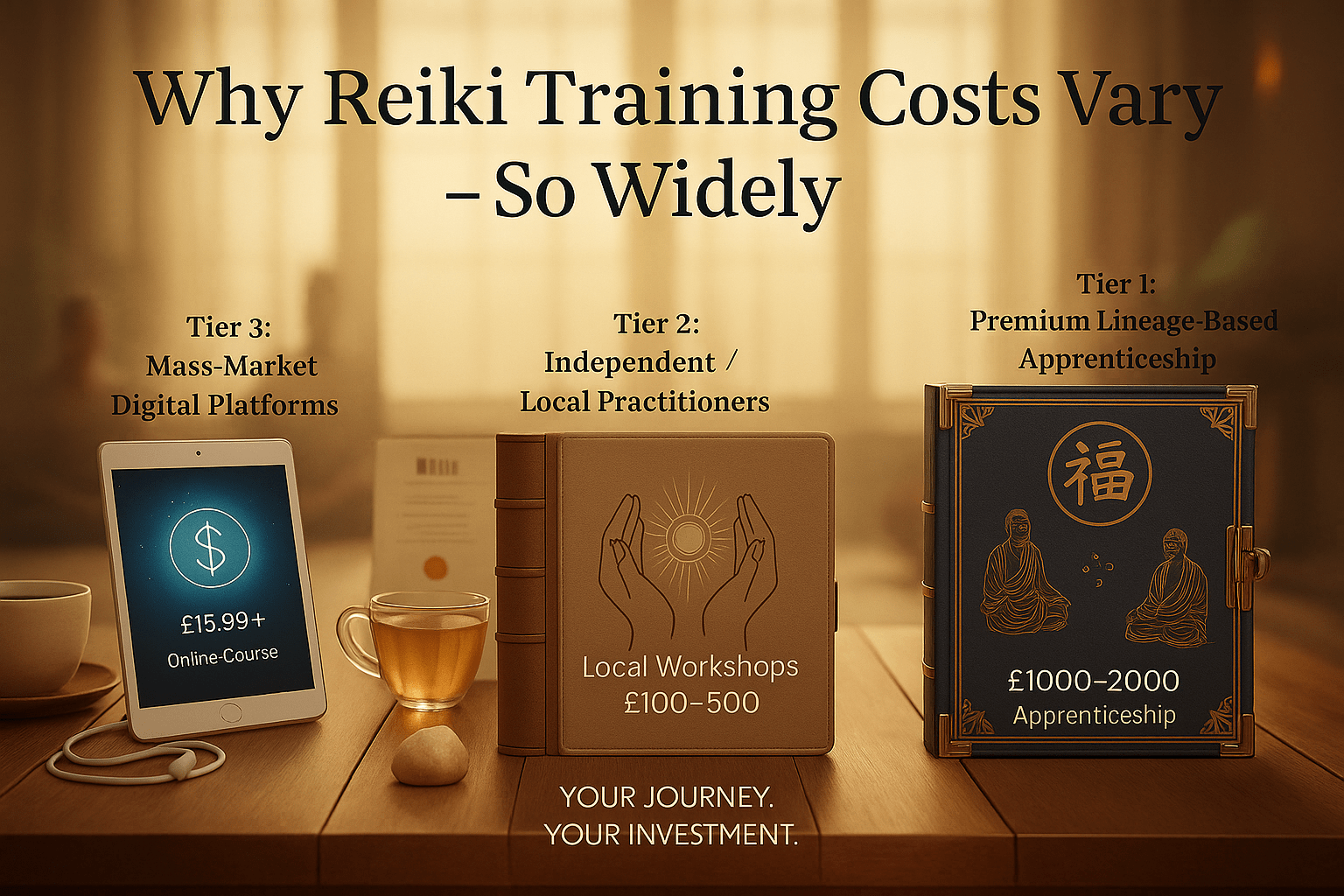
Why Reiki Training Costs Vary So Widely – And What That Means for You
We answer common questions about Reiki training costs, show you typical price ranges by tier, and link to real-world examples.
Search for Reiki training online and you’ll quickly notice a very wide variety of price points. Prices are in fact, all over the place.
Some courses cost less than a Netflix subscription. Others run into the hundreds, or sometimes, thousands of pounds. Some promise a Reiki Master’s certificate in a weekend (or less). Others span months, even years. So, what are you paying for?
This guide explores what justifies the various price tags so that you can choose the kind of training that aligns with your own goals, your values and intentions in taking up the practice.
All prices are listed in GBP (£) for consistency. Original course prices in other currencies have been converted at the mid-market exchange rate as of February 2026. This standardisation is intended to aid clear comparison across international offerings.
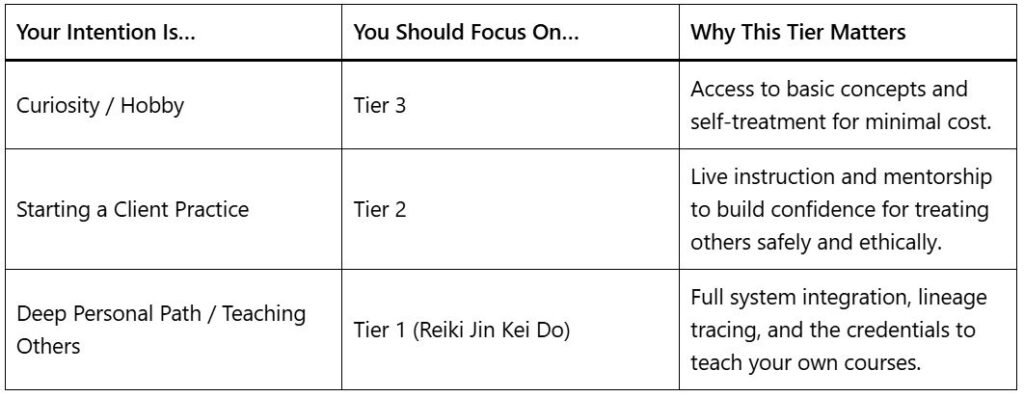
Which Training Path Matches Your Intent?
Use this guide to identify which type of Reiki training may suit you based on what you’re hoping to get from it.
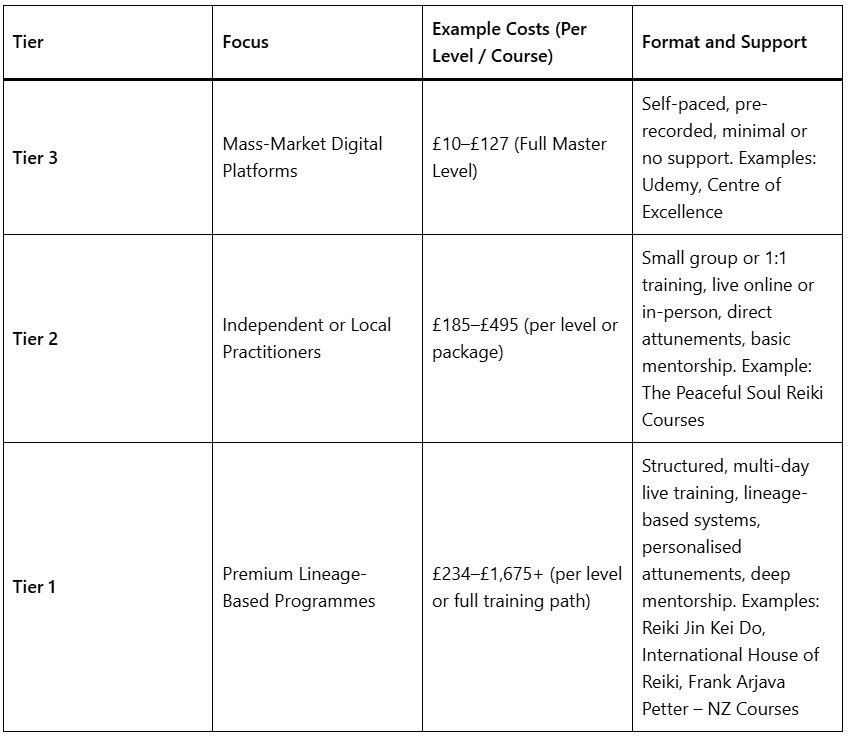
The Reiki Training Market: A Tiered Structure
Not all Reiki training is created equal. The market tends to divide into three very distinct tiers, each reflecting specific philosophies and outcomes:
What You Actually Get at Each Tier
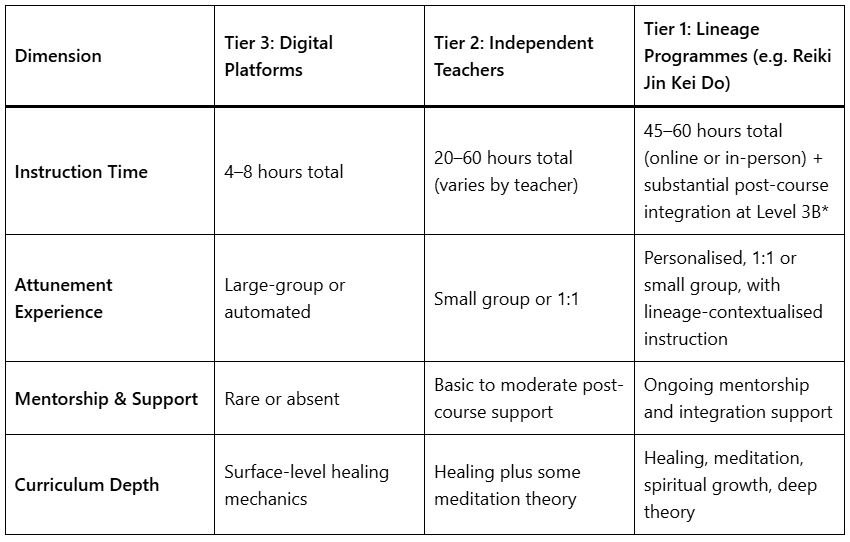
*At Level 3B, students are required to complete significant post-training assignments and self-led integration before certification is awarded. This is supported through Q&A and quality checks.
The Financial Return on Training
For many students, Reiki training isn’t just personal, it’s a professional investment. If you’re planning to offer sessions or eventually teach, even a part-time practice can offset the cost of training surprisingly quickly.
Let’s look at typical ranges:
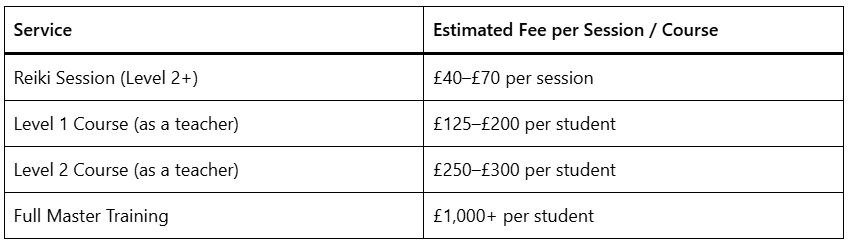
If you complete Level 1 and 2 with a total investment of around £435, you could recoup that in 6–10 client sessions. As a teacher, one or two well-attended workshops could return your full investment and more.
Even if you don’t plan to teach, having a well-structured and supported training helps you deliver better client results, which builds your confidence, credibility, and referrals, important if you’re looking to grow a practice.
Reiki Training Providers – Price, Levels & Format Comparison (All Prices in GBP)
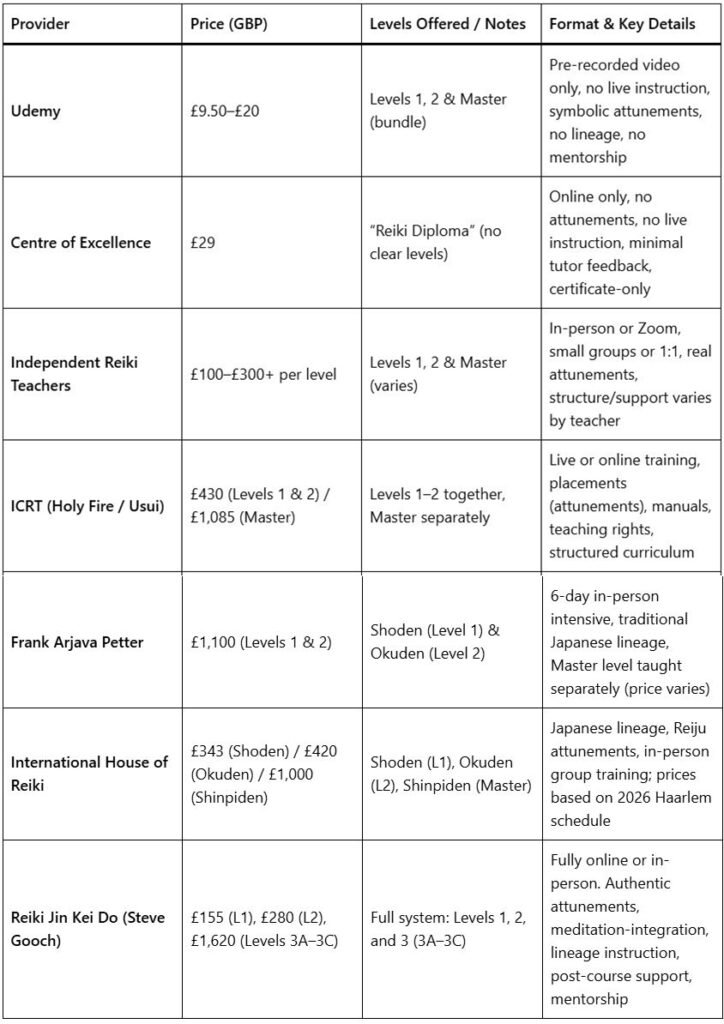
Notes: • Courses labelled “Master” or bundled offerings (e.g., Udemy, Centre of Excellence) usually prioritise accessibility over experiential depth, personal guidance, or lineage practice. These can be suitable for casual learners but may not meet the needs of those seeking comprehensive or traditional training.
• Lineage-based systems such as Reiki Jin Kei Do or the International House of Reiki integrate meditation, spiritual development, and ongoing practice support, which contributes to higher pricing.
The Hidden Costs of Cheaper Training
While many low-cost or mass-market Reiki courses look appealing at first glance, the upfront price often doesn’t reflect the full cost of becoming a competent, confident practitioner.
Here are a few hidden costs to consider:
- Re-training Fees: Many students who start with £20–£150 self-paced courses later realise they lack practical skills or depth and then pay again for higher-quality training.
- Ongoing CPD or Workshops: Lower-tier courses may not meet the standards for certain continuing professional development schemes, requiring additional study later.
- Lack of Certification Credibility: Some certificate-only courses (especially online “master” levels) may not be recognised by insurance providers or governing bodies.
- Business Setup Costs: If you’re planning to charge for sessions, you’ll likely need insurance, professional materials, and practitioner-level knowledge. Skimping on training can lead to professional limitations or reputational risks.
One often overlooked factor is professional legitimacy. Many budget or certificate-only Reiki courses don’t meet the standards required by insurers or professional associations, such as 20+ hours of live instruction per level, verified attunements, and teacher accountability. Without these, students may be unable to practise legally in some regions or may be forced to retrain later, increasing both time and financial investment. What starts as a budget-friendly option can quickly become more expensive when retraining or lost opportunities are factored in.
Sometimes Less Is More: A Lesson in Simplicity
Several years ago, I trained a woman named Hanna through Reiki Levels 1 and 2. As part of her ongoing development, we set up a weekly exchange, she would give me a Reiki treatment, and I would give her one in return.
In the sessions I gave her, I often drew on everything I had learned over the years, not just Reiki Levels 1 and 2, but also Level 3 and my Buddho training. I used symbols, visualisations, refined hand placements, mantras, and subtle energetic techniques. These treatments were effective, and Hanna regularly commented on how deep and powerful they felt.
Then one week, I was completely exhausted.
By the time Hanna arrived, I was really tired and had little ability to do anything elaborate. I decided to give her the most basic Reiki treatment possible. No techniques beyond standard hand positions and no effort to refine or enhance the process in any way. Just simple, hands-on Reiki – a Reiki Level 1 approach .
I wasn’t expecting much from it.
When the session ended, Hanna looked genuinely surprised. She told me it was one of the most powerful treatments she had ever received.
That moment changed how I understood value in Reiki training. It wasn’t the breadth of techniques or the complexity of what I was doing that made the difference. It was the clarity of presence and the simplicity of the practice itself.
This is one reason why higher-quality training doesn’t always look impressive on paper, and why more techniques don’t automatically translate into better results. Depth, integration, and understanding often matter far more than accumulation.
What Makes Reiki Jin Kei Do Different?
- Total Hours: 45–60 hours total for all three levels (online or in-person) + substantial post-course integration at Level 3B (usually 6 months to a year).
- Structure: Each level is standalone and complete, yet part of a coherent developmental path.
- Delivery: Fully online or fully in-person. No hybrid model. Attunements are contextual, live, and explained in depth.
- Materials: Manuals, treatment demo videos, meditation recordings, extensive post-training support materials.
- Depth: Goes beyond healing techniques to integrate meditation and spiritual development.
- Spiritual Context: Not just a therapeutic model. This system explores Reiki as a spiritual container, a practice for inner change.
- Teacher Time Commitment: Tier 1 programmes like Reiki Jin Kei Do are not scalable mass courses. Your fee directly covers the cost of small-group learning, live attunements with contextual explanation, and the teacher’s time in offering continued mentorship and integration guidance, especially at Level 3B, where personal development and readiness are assessed over time.
The Cost of Choosing Poorly
- Many students who take quick, inexpensive Reiki training later report feeling unprepared, unable to explain what they have learned, unsure how to treat others, or unclear on what Reiki really is. Some receive “Master” certificates in a weekend but lack confidence to work with real clients or students.
- In many cases, this leads to retraining and doubling their original investment. Here’s how that might look:
- Scenario 1: You complete two online courses for about £30 each (Level 1 and Level 2) but find you are unable to confidently use Reiki in real-world settings. Six months later, you decide to retrain, paying £155 for Level 1 and £280 for Level 2. Your total spend becomes £495, compared to £435 had you chosen a structured programme from the beginning.
- Scenario 2: You receive a “Master” certificate online for £100. When you try to get insurance or teach, you find that your credentials are not recognised. You end up taking a full training programme over again, paying £600–£1,600 more and restarting from scratch.
A Real Example of What Fast, Low-Cost Training Can Create
In the early days of my teaching, I ran a Reiki support group for students to practise together and ask questions. At one meeting, one of my students invited a friend who had a serious foot injury. Her foot was in plaster due to either a broken ankle or a torn ligament. She received Reiki during the group and found it helpful, particularly in easing the pain. The experience left her interested in learning Reiki herself.
She went on to train elsewhere. Her Reiki Level 1 training took place on a Saturday morning. Reiki Level 2 followed on Saturday afternoon. By the end of Sunday, she had been given a Reiki Master certificate.
At the next Reiki support group, she returned confused and genuinely puzzled. She told me she did not understand why, now that she was a Reiki Master, her foot was still in plaster and had not healed overnight. She was not being flippant. There was just no framework for how Reiki works or how healing unfolds.
What had been missing from her training was understanding. She had received certificates, but not context, depth, or realistic expectations. Without that grounding, the title itself created confusion rather than competence.
You can read further real-world outcomes and student experiences in Reiki Training Reviews: What Students Say After Learning with Steve Gooch.
Time, energy, and confidence are part of the investment. Choosing well at the start often saves more than just money.
What About Variant or Faith-Aligned Reiki Systems?
Some training paths adapt Reiki to align with symbolic, metaphysical, or religious themes. These systems often vary widely in format, content, and price.
Examples:
- Angelic Reiki – Combines Reiki with angelic healing and channelling practices
- Holy Fire® Reiki – A spontaneous-healing oriented system from ICRT
- Crystal Reiki / Money Reiki – Focused on specific intentions such as crystal work or abundance
- Kundalini Reiki – Merges simplified Reiki with Eastern energy systems
- Ascension Reiki / Lightarian Reiki – Centres around soul evolution and high-vibration energetics
Some practitioners also adapt Reiki to their religious worldview:
- Christian Reiki – Frames Reiki as divine or Christ-aligned energy; often replaces Japanese terminology and symbols
- Islamic Reiki / Allah Reiki – Aligns practices with Islamic principles, language, and cosmology; usually replaces the traditional Reiki symbols
These models are generally designed for intuitive connection, spiritual symbolism, or faith compatibility. Training is often offered via pre-recorded courses or weekend seminars, and prices typically fall into the low- to mid-range. While they may resonate with specific spiritual beliefs, they often offer less instructional depth, limited lineage tracing, and minimal long-term mentorship compared to traditional Reiki schools.
Final Checklist: Questions to Ask Before You Choose
- Does the training include personal, focused attunements (Reiju)?
- Is it part of a lineage with verifiable teachers?
- How many hours of instruction are included, and how are they delivered?
- Is post-training mentorship offered?
- Will your certification be recognised if you wish to practice professionally?
If you’re still weighing these questions, Is Reiki Jin Kei Do the right fit for you? can help clarify whether this style of training matches your aims.
Final Thought
Choosing Reiki training isn’t just about price. It’s about the kind of relationship you want with the system.
- Are you seeking a quick technique to try? Or a discipline to live with?
- Do you want access? Or transformation?
Your investment should match your intention.
Choose accordingly.
Reference Providers (For Comparison Only)
The providers listed below are included to support transparency and reader research. These are not endorsements or affiliate links. They represent a sample of the range of Reiki training formats currently available (links checked December 2025).
- Udemy – Reiki Level 1, 2 & Master (bundle example)
- Centre of Excellence – Reiki 1 & 2 Diploma Course
- The Peaceful Soul – Reiki Courses & Price List (UK)
- International House of Reiki – Reiki Courses (Shoden, Okuden, Shinpiden)
(IHoR Example Shoden Course Cost) - International Center for Reiki Training (ICRT) – Usui/Holy Fire® III & other classes
- Frank Arjava Petter – Shoden & Okuden (NZ Jikiden-style training)
- Reiki Jin Kei Do – Training with Steve Gooch
All links open in a new tab. You are encouraged to compare course details, structure, and instructor support before enrolling in any programme.
What the Training Actually Looks Like
If you’re reading this because you’re weighing up the cost of Reiki training, it can help to see what that cost actually relates to in practice.
I’ve laid out how Reiki Jin Kei Do is taught, how classes are structured, and what people usually experience when they begin training here:
There’s no expectation to decide anything at this point. This is simply a way to place the costs you’ve just read about into a real teaching context.
Related Articles:
Is Reiki Jin Kei Do the Right Fit for You?
How Reiki Jin Kei Do Compares to Other Reiki Systems
Online Reiki Training vs In-Person Reiki: What Actually Makes the Difference?
Best Reiki Training: 5 Signs of a High-Quality Course (+ Red Flags to Avoid)
Reiki Training Reviews: What Students Say After Learning with Steve Gooch
Other ways to stay connected:
Subscribe to Energy, Consciousness & The Self newsletter
