
How Is the Abundant Self Different from Therapy, Coaching and Other Personal Development Programmes?
If you’re comparing The Abundant Self vs therapy and coaching, the central differences concern purpose, scope, structure and level of support.
The Abundant Self is a seven-to-eight-month guided group programme for people who want to understand recurring patterns and develop greater stability, clarity and alignment. It combines meditation, body and emotional awareness, reflective enquiry, identity-focused practices and contemporary energy-based modalities across four connected phases.
Therapy commonly helps people explore emotional difficulties, relationships, past experiences and mental health concerns. Coaching usually supports goals, decisions, strategy and action, while personal development programmes often concentrate on a particular method or area of growth.
Each approach offers a distinct form of support, and many practitioners draw on overlapping methods. Your current needs, preferred format and desired outcome will help you choose the most suitable option.
The Abundant Self vs Therapy: The Main Differences
The following table summarises the main differences between these approaches. Therapy, coaching and personal development each include a wide range of methods, so the practitioner’s training, scope and approach also matter.
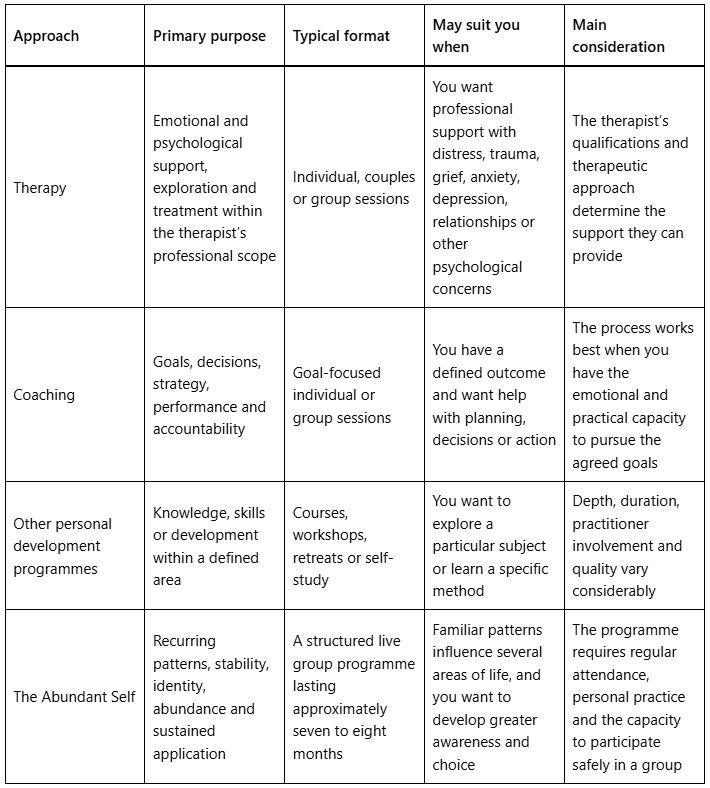
Many therapists explore beliefs, identity, behaviour and bodily responses. Some coaches address confidence, habits and emotional patterns, and some personal development programmes provide a sustained, integrated process.
The central distinction lies in each service’s main purpose, professional scope and structure. The Abundant Self provides guided personal development, while counsellors and psychotherapists provide therapy within the scope of their training and professional competence. Appropriately qualified healthcare professionals assess and diagnose mental health conditions.
What Makes the Abundant Self Different?
The Abundant Self focuses on patterns that influence a person’s choices after intellectual understanding has already developed. Participants examine how beliefs, emotions, physical responses, habitual behaviour and established identities interact.
You may understand why you accept commitments that leave you resentful and want to establish clearer boundaries. Perhaps you recognise your professional value and want to feel more comfortable stating an appropriate fee. You might also have a sound strategy and find that fear, guilt or self-doubt affects your ability to follow it.
These responses can develop quickly. Physical tension, a familiar emotion or an immediate expectation may arise before you’ve consciously considered the situation. Through regular practice, you’ll learn to notice these responses earlier, understand what maintains them and make choices that reflect your present values and intentions.
The programme’s main distinction comes from its combination of methods and sustained application. Participants explore the same pattern through meditation, body awareness, emotional observation, reflective writing, identity enquiry and energetic practice. They then apply their developing awareness to relationships, financial decisions, boundaries, professional situations and everyday choices.
Why Does The Abundant Self Last Seven to Eight Months?
The Abundant Self usually runs for seven to eight months, with planned breaks shaping the precise duration. This timetable gives participants repeated opportunities to apply the practices in daily life.
A session may help someone recognise a pattern clearly. Later situations reveal how that pattern affects a conversation, decision, relationship, boundary or opportunity. Continued practice builds familiarity with these responses and supports deliberate choices.
The programme includes regular two-hour group sessions, extended six-hour intensive sessions and personal practice between meetings. This level of participation suits people who want a sustained process and can give it consistent attention.
What Are the Four Phases of The Abundant Self?
The programme follows four connected phases, and each one develops capacities that support the next stage. Earlier practices remain available throughout the programme, giving participants a growing collection of familiar resources.
Phase One: Reconnect
Phase One develops presence, stability and awareness. Participants use meditation, breathing and body-focused practices to recognise their current physical, emotional and mental state with greater accuracy.
This foundation supports the deeper enquiry that follows. Greater steadiness helps participants remain present when difficult emotions, beliefs or familiar reactions arise during later phases.
Phase Two: Reveal
Phase Two examines the beliefs, emotional habits, conditioned responses and personal narratives that influence perception and behaviour. Participants learn to recognise these patterns through bodily sensations, emotions and thoughts as they occur.
The principal energetic empowerment also takes place during this phase. It supports sustained presence, energetic coherence and the practices that follow. This is the most intensive of the Phases and where most attendees first start to understand the deeper mechanisms governing their behaviour and responses in the present moment.
Phase Three: Realign
Phase Three explores how established patterns have influenced identity, decisions and expectations. Participants clarify the qualities, values and intentions they want to express, then practise making choices from that clearer point of reference.
Reflective, meditative, symbolic and embodied methods connect awareness with behaviour. Together, these practices help participants develop greater consistency in how they relate to themselves, other people and their future direction.
Phase Four: Embody and Expand
Phase Four concentrates on application and continuity. Participants use the capacities developed in the earlier phases within relationships, money, boundaries, confidence, creativity, purpose and other areas of daily life.
They continue using familiar practices whenever established responses reappear. This phase also develops habits, intentions and forms of self-commitment that support ongoing stability, coherence and purposeful action.
What Practices Does The Abundant Self Use?
The programme brings together several complementary forms of practice. Their sequence helps participants develop awareness first, then apply it to patterns, identity and decisions.
- Meditation and breathing
- Body and emotional awareness
- Reflective writing and structured enquiry
- Exploration of beliefs and identity
- Visual, creative and symbolic exercises
- Contemporary energy-based modalities
- Guided group discussion
- Personal application between sessions
A participant might identify a belief through reflective writing, recognise its physical and emotional effects during meditation and observe its influence during a real conversation. Exploring one pattern in several ways can reveal how it operates across different parts of life.
Beginners receive guidance in the foundational practices, which makes previous meditation experience optional. Every participant benefits from enough time and capacity to practise between sessions and engage with their own experience.
How Do the Energy-Based Empowerments Function?
The Abundant Self includes energetic empowerments informed by principles found within esoteric Buddhism. They draw particularly on the Three Mysteries described in Shingon Buddhism: body, speech and mind.
Throughout the four phases, participants consider how bodily responses, words, attention and intention interact as parts of a single experience. The programme’s meditative, vocal, physical and reflective practices apply this principle in different ways.
Each empowerment aims to awaken or reveal capacities already present within the participant. It also prepares them for subsequent practices and integration. The principal empowerment takes place in Phase Two after participants complete the foundational awareness and stabilisation practices in Phase One, and they can revisit its recording during the later phases.
Participants usually sit quietly while receiving an empowerment. Some report physical sensations, emotions, imagery, calm or changes in awareness, while others recognise the effects gradually through later practice and everyday responses. Individual experiences vary.
Steve developed these empowerments for The Abundant Self as contemporary personal development practices. Their purpose centres on personal practice, energetic coherence and integration within the programme. Buddhist lineage initiation and authorisation belong to their own traditional contexts, while The Abundant Self operates within a contemporary personal development setting.
Can I Combine The Abundant Self and Therapy?
Therapy provides a confidential relationship in which a trained professional helps someone explore thoughts, feelings, behaviour, relationships and difficult experiences. Different therapeutic approaches may focus on past events, present difficulties, thought and behaviour patterns, emotional regulation, relationships or personal development.
The Abundant Self also explores beliefs, emotions, identity and behaviour through a structured group programme. Its scope centres on personal development through meditation, reflective practices and energetic empowerments. Counsellors, psychotherapists and qualified healthcare professionals provide the corresponding levels of therapeutic and clinical care.
Therapy or appropriate clinical support should take priority during periods of serious psychological or emotional difficulty. The following circumstances call for professional or clinical care:
- Acute emotional distress
- A mental health crisis
- Suicidal thoughts
- Severe or destabilising trauma symptoms
- A condition that requires clinical assessment or treatment
- Reactions that require professional support during meditation or reflective practice
If you or someone else is in immediate danger, call 999 or go to A&E. For urgent mental health support in England, use NHS 111 online or call 111 and select the mental health option. Samaritans provides confidential support across the UK and Ireland on 116 123, while readers elsewhere can contact their local emergency or crisis-support service.
Some people take part in The Abundant Self and therapy at the same time. The Abundant Self and therapy can complement each other when each serves a clear purpose. Your therapist can help you consider whether The Abundant Self suits your current circumstances, especially when therapy involves trauma, intense emotional material or significant instability. You’ll also benefit from considering the combined demands on your time, energy and emotional capacity.
How Is The Abundant Self Different from Coaching?
Coaching commonly helps people define goals, make decisions, develop strategies and maintain accountability. It can support business development, career change, leadership, performance or the completion of a specific project.
The Abundant Self concentrates on recurring internal responses that influence several goals or areas of life. You may have a sound business strategy while visibility triggers fear of judgement. Increased income could produce guilt or unease, while setting a boundary may activate anxiety about rejection. Rest can also bring up a belief that personal value depends on constant productivity.
Coaching may suit you when you mainly need direction, strategy, decisions or accountability. The Abundant Self may suit you when familiar emotional, behavioural and identity-based patterns continue to affect your choices across different situations.
Some people combine coaching with The Abundant Self. The aims, schedule and personal demands of each process will help you decide whether that combination feels useful and manageable.
How Is It Different from Other Personal Development Programmes?
Personal development includes many subjects and formats. A short course may teach meditation, confidence, communication, leadership, habits, manifestation or financial planning. Workshops and self-paced courses can provide an accessible way to learn one method or address a defined interest.
The Abundant Self provides a live, connected process across four phases. Regular group sessions, extended intensives, personal practice and continued application give participants time to examine patterns across several areas of life.
This depth involves a substantial commitment of time, attention and money. A focused programme may suit you more closely when you want introductory information, one practical method or support with a narrowly defined concern.
How Does The Abundant Self Approach Abundance?
The programme explores abundance across money, opportunity, support, purpose, creativity, connection and the capacity to receive. It examines the internal responses that influence how someone relates to these areas.
A person may consciously want greater abundance while responding to opportunities with hesitation or self-doubt. Visibility can activate fear of criticism, and receiving support may create guilt. Success can also feel connected with pressure, responsibility or the risk of rejection.
Participants identify these associations and observe how they influence decisions. They also develop clearer awareness of their values, strengths, needs and intentions. This awareness gives them a more stable basis for choices about money, relationships, career, creativity, service and personal direction.
These internal responses form part of a person’s abundance mindset and influence what they notice, accept and act upon. An abundance archetype can help someone recognise which of these responses most strongly influences their choices across different areas of life.
What Have Participants Experienced?
Participant feedback describes increased awareness, stability and choice in everyday situations. Jorge had already practised mindfulness and breath awareness before joining. After Phase One, he described experiencing “more space between what I experience and how I respond.”
As the programme progressed, Jorge reported greater trust in his awareness and direction. Dalia Juchem described the programme as thoughtfully structured, with each stage building on the previous one. She credited it with helping her reclaim “clarity and a grounded sense of self.”
These accounts describe individual experiences. Each participant’s circumstances, engagement and consistency of practice will influence their experience and results.
Who Is The Abundant Self Suitable For?
The programme may suit you when several of the following statements reflect your current position. Your readiness for regular practice and group participation matters as much as your interest in the subject.
- Similar emotional or behavioural patterns continue to recur
- You understand many of your patterns and still experience their influence
- You want greater stability, clarity and consistency
- You’ve explored therapy, coaching, meditation or personal development previously
- You feel ready to examine beliefs, emotional responses and established identity
- You can attend regular live sessions and practise between meetings
- You feel comfortable learning and sharing within a group
- You want to explore abundance across several areas of life
The programme particularly suits people who value sustained practice and want time to apply what they learn in daily situations. Participants also need the emotional stability and personal capacity required for reflective group learning.
What Should You Consider Before Joining?
An informed decision includes the programme’s format, scope and level of commitment. The following considerations will help you assess how closely it matches your needs:
- Therapy and clinical services provide psychological treatment, diagnosis and crisis support
- The seven-to-eight-month timetable calls for sustained attendance and personal practice
- The group format gives participants shared learning and a different level of individual attention from one-to-one services
- Scheduled live sessions suit people who can reserve regular time for participation
- The programme explores several areas of life, while specialist courses concentrate on one defined goal
- The energetic empowerments draw on an esoteric Buddhist foundation
- Personal outcomes reflect each participant’s circumstances, engagement and consistency of practice
These considerations form an important part of the comparison. Your preferred form of support, available time and willingness to engage consistently will guide your choice.
How Much Does The Abundant Self Cost?
The current fee for the complete programme is £999, which covers the guided group sessions, extended intensive sessions and participation across all four phases. This price reflects a sustained programme delivered over seven to eight months.
Your decision also involves time for live sessions, personal practice and application between meetings. A shorter course, one-to-one coaching arrangement or self-paced resource may provide strong value when you have one specific goal or limited availability.
How Do You Choose the Right Approach?
Begin with the main issue you want to address and the level of support it requires. A clear description of your current needs will help you compare The Abundant Self and therapy with coaching and other approaches.
Choose therapy when you want professional support with psychological distress, trauma, mental health concerns, difficult experiences or relationships. The therapist’s qualifications and relevant experience will help you assess their suitability.
Select coaching when you have a defined goal and want strategy, planning, decisions or accountability. A focused personal development programme may suit you when you want to learn a particular method or explore one area of growth.
Consider The Abundant Self when recurring patterns influence several areas of your life and you want a sustained process that combines meditation, body and emotional awareness, reflective enquiry, identity-focused practices and contemporary energy-based modalities. Its live group format and seven-to-eight-month duration suit people who value regular guidance and continued application.
Before committing to any approach, ask about the practitioner’s qualifications, methods, professional boundaries, format, time requirements, costs and realistic outcomes. These questions will help you assess how closely the service matches your current needs.
Find Out More About The Abundant Self
The full programme page explains the four phases, session structure, current dates and payment options. You can also arrange a free clarity call to discuss your circumstances and ask questions before deciding whether to join.
Explore The Abundant Self programme
Related Articles:
What Is The Abundant Self Programme?
Who Is The Abundant Self Programme For?
More ways to stay connected:
Subscribe to Energy, Consciousness & The Self newsletter
