
Can Reiki Help with Anxiety and Stress?
It’s 2 AM, and your mind is spinning with relentless ‘what ifs.’ You toss and turn, replaying stressful conversations or situations from the day. Your jaw is clenched, your chest feels heavy, and the more you try to relax, the more tense you become.
If that sounds familiar, you’re not alone. Chronic anxiety and stress can feel like a mental maze with no way out. And often, the more you try to find a way out, the more the anxiety and stress build. You might have tried deep breathing, mindfulness apps, or numbing your mind with another episode of your favourite show. These might provide temporary relief but in the long run, nothing seems to reduce the chaos.
What if there was a way to gently soothe your system without effort or force? A way to reset your mind and body without trying to control it? That’s where Reiki healing comes in.
Reiki is a gentle, non-invasive practice that creates a space for your body to naturally release tension and realign itself, without directing or forcing specific outcomes. Let’s explore how Reiki might provide support for anxiety and stress.
How Reiki Helps
Reiki is not a magic cure or a quick fix. It doesn’t aim to ‘fix’ anxiety or ‘make’ the body calm down. Instead, it creates a neutral, open space where your body can naturally decide what it needs to release or realign. This is a similar principle to the one that explains how a Reiki attunement works.
When we’re stressed, the sympathetic nervous system takes over, triggering the fight-or-flight response. Reiki offers a gentle way to shift from this reactive state to the parasympathetic mode: the rest-and-restore state.
Imagine it like this: It’s like when you walk into a noisy room, and someone turns down the volume to a soft, calming hum in the background. Reiki creates that kind of energetic quiet, allowing the body to release all the accumulated tension.
During a Reiki session, you might experience:
- A softening of tension in the shoulders, jaw, or stomach
- A slowing down of racing thoughts
- A feeling of emotional release or unwinding
- A deeper, fuller breath
- A sense of being more grounded and centered
Client Story: Sarah’s Experience with Reiki
Sarah, a 34-year-old financial consultant, couldn’t remember the last time she’d slept through the night. Every night, her mind replayed stressful conversations with her boss from the preceding day. Her jaw would be clenched tight and her mind spinning with ‘what ifs.’
After her first Reiki session, she described the experience as ‘deeply calming and helped me get the best night’s sleep I’ve had in a long time.’ It was as though a tight band around her chest had suddenly loosened. Over the next few sessions, Sarah noticed subtle but profound shifts: She found that her shoulders felt lighter, her thoughts were less urgent, and she began to drift off to sleep more easily on a regular basis, without needing to numb herself with mindless scrolling.
For Sarah, the real impact wasn’t that Reiki ‘fixed’ her anxiety but that it gave her a safe, neutral space where her body could let go of what it was holding onto, without effort, analysis, or force. It’s important to note that Reiki can’t be ‘forced’ to solve a particular problem. It can’t be made to focus on a particular issue. A good practitioner will remove themselves from the healing equation and allow the energy to do what is needed – whatever that might be. But one of the commonest experiences from receiving Reiki is that the recipient feels calm, relaxed and at peace.
How Many Reiki Sessions Are Needed for Anxiety Relief?
There’s no fixed number of Reiki sessions for managing stress or anxiety because Reiki is non-directive. The energy will address whatever is most pressing in that moment, not necessarily what the client, or in fact the practitioner, thinks they need.
Many practitioners recommend starting with three to five sessions to allow the body to adjust and for patterns to begin releasing. However, some may notice subtle shifts after just one session. The more experienced the practitioner, the less sessions could be needed.
Reiki is rarely about quick fixes. Fundamentally, Reiki is taking you on a learning journey to resolve the underlying reasons behind your problem. In this case: anxiety. With enough exposure to Reiki treatments, the energy should lead you to a place where anxiety doesn’t need resolving, it simply doesn’t arise in the first place. This can be a long journey however and for this, learning Reiki and using it for self-application is recommended.
Questions to Consider:
- Are you open to letting go of what the body and mind decides to release?
- Are you integrating other forms of support like therapy, journaling, or self-Reiki?
- Are you looking for immediate relaxation or long-term stress management?
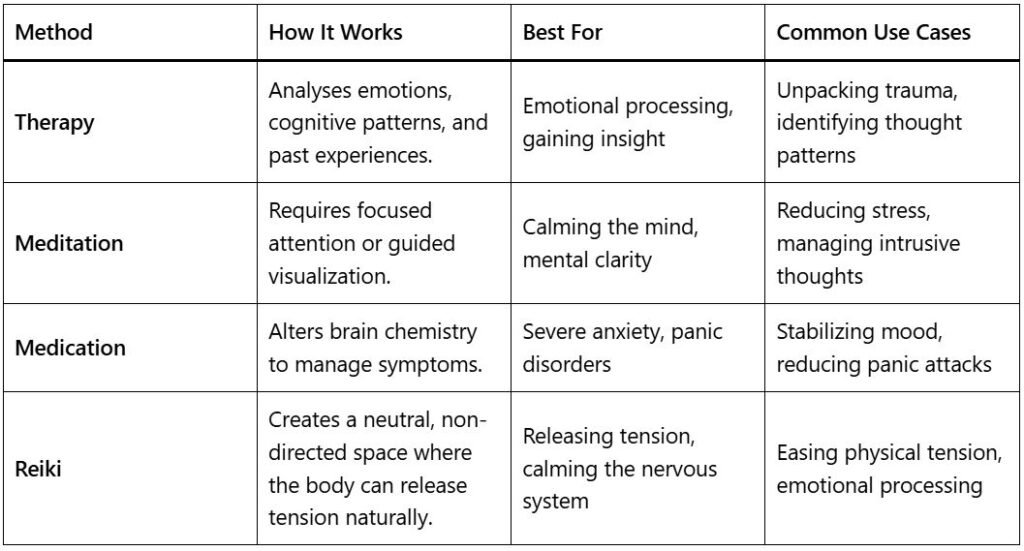
How Does Reiki Compare to Other Healing Modalities for Stress and Anxiety?
What If Reiki Doesn’t Work for Me?
Some people wonder, “What if Reiki doesn’t work for my anxiety?” It’s a valid question. Reiki is non-directive, so the energy goes where it’s needed, not necessarily where you expect or want it to go.
- You may feel nothing: This doesn’t mean nothing happened. Reiki can be subtle, and shifts can occur hours or even days later. It’s not a measure of the success of a Reiki treatment that you are able to feel the energy.
- You may feel unexpected emotions: Reiki can bring suppressed emotions to the surface. Staying open to these releases can be profoundly healing. A good practitioner will explain this to you prior to your session.
- You may feel more relaxed but still anxious: Reiki isn’t a quick fix. It’s a gentle, cumulative practice that may require multiple sessions for deeper patterns to unwind, but again this is dependent in part on the experience of the practitioner.
If you’re also wondering about pricing, session formats, and what affects the cost of Reiki, we cover that in detail in a separate article.
How to Choose the Right Reiki Practitioner
- Look for Credentials: Reiki Level 2 or higher is ideal. Reiki level 1 practitioners are not generally considered qualified, according to widely accepted professional standards, to offer paid Reiki treatments.
- Ask About Their Approach: Do they integrate mindfulness, breathwork, or other modalities?
- Trust Your Instincts: The right practitioner will make you feel safe, seen, and heard.
Preparing for Your Reiki Session
- Arrive Honestly: Notice why you are coming for the session, without trying to direct what should happen. Reiki does not respond to goals or requests. It works by allowing the system to release what is ready, at the time it’s ready.
- Stay Open: Reiki often works in unexpected ways. You will receive what you need, not necessarily what you expect.
- Hydrate and Rest: Drink water before and after the session to support the energetic shifts. Reiki can sometimes trigger a short-term adjustment response as the nervous system settles and rebalances. Usually this is not particularly severe after just one session, but it can build over time. Drinking water can support the detox process.
What to Do After a Reiki Session:
- Journal Your Experience: Note any physical sensations, emotional releases, or insights. It’s often a good practice to keep notes on your Reiki experience to reflect back on later so that you can see the pattern of subtle shifts that have taken place.
- Rest and Reflect: Reiki can bring suppressed emotions to the surface. Stay present with whatever arises.
- Hydrate and Ground: Drink plenty of water and spend time in nature to integrate the session. Again, be aware of the detox potential that can be triggered by the Reiki.
Conclusion: A Gentle Path to Inner Peace
Anxiety and stress can feel like being caught in a storm: chaotic, relentless, and exhausting. Reiki offers a gentle, neutral space where you can step out of that storm and reconnect with inner stillness.
Rather than forcing a specific outcome, Reiki allows your body to decide what it’s ready to release, whether it’s physical tension, emotional heaviness, or mental clutter. It’s not about fixing what’s ‘wrong’. It’s about giving yourself the space to let go of what no longer serves you.
Related Articles:
Why Reiki Training Costs Vary So Widely
Is Reiki Jin Kei Do the Right Fit for You?
How Reiki Jin Kei Do Compares to Other Reiki Systems
Best Reiki Training: 5 Signs of a High-Quality Course (+ Red Flags to Avoid)
Reiki Training Reviews: What Students Say After Learning with Steve Gooch
More ways to stay connected:
Subscribe to Energy, Consciousness & The Self newsletter
