
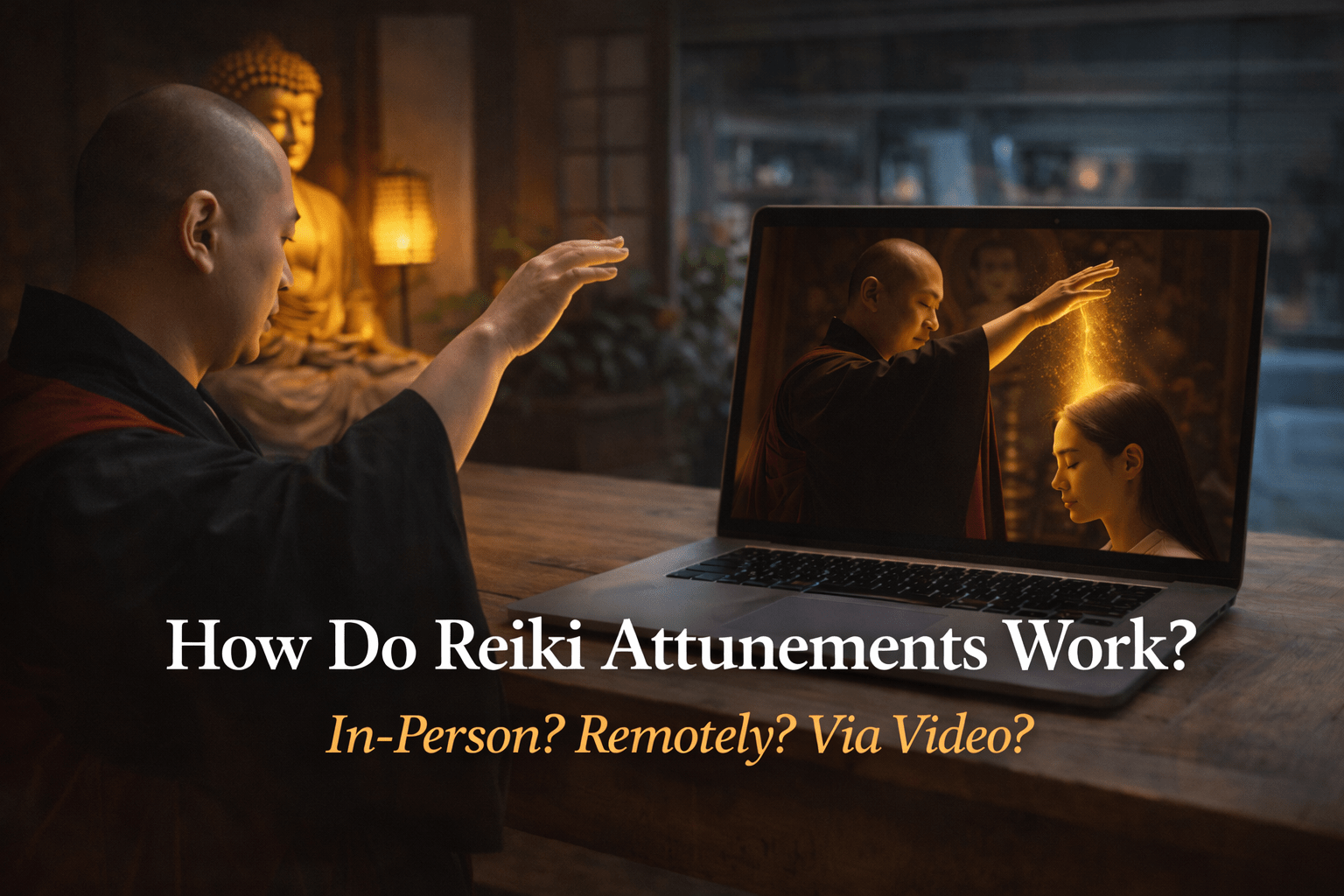
How Do Reiki Attunements Work?
In a previous article, What Is a Reiki Attunement?, a Reiki attunement was described as a recognition event rather than a transfer of energy, power, or ability. That article focused on what an attunement is at a fundamental level and why it is required for Reiki to function as a system at all. This article answers the practical question people are actually searching for: how does a Reiki attunement work in practice?
This article looks more closely at how Reiki attunements function, drawing on repeated observation across years of teaching and training. In particular, it addresses questions that arise from real situations involving recordings, distance, and temporary access, which are not easily explained by simplified transmission models.
How do you know if a Reiki attunement has worked?
When people ask this question, they want to know whether the attunement did something to them.
Most people check this first through how they feel. They notice sensations during or after the attunement, changes in energy, tiredness, emotional movement, or a sense that something has shifted. These experiences vary widely and are all within the range of normal responses.
What those experiences tell you is that the system is responding. They do not, on their own, define what the attunement has established.
One of the clearest practical signs that an attunement has worked is that the student is able to offer a Reiki treatment, and its effects can be noticed either by the student themselves or the recipient of the treatment.
After attunement, students are able to place their hands, settle, and recognise Reiki directly through experience. It does not need to be created, imagined, or directed; it’s encountered and becomes familiar through practice.
Over time, what becomes clear is not the intensity of any particular sensation, but the reliability of access. Reiki is there when a treatment begins, and it comes to rest when that treatment ends.
What matters is that Reiki is there when you practise. Familiarity comes from repetition, not from intense or unusual experiences.
Orientation explains what transmission models can‘t
Attunement is usually described as a process where the teacher gives the student access to Reiki, often framed as the teacher connecting the student to the universal energy field. That description would seem to match how Reiki becomes available to work in a therapeutic context after an attunement.
What becomes clearer over time, however, is that the standard classroom set-up is not the only context in which attunement can occur. Most attunements are given in person, in real time, with the teacher and student present together, either physically or increasingly, online. This is true of my own teaching too, although I have also encountered cases where attunement occurred under conditions that were not planned or expected.
That observation points to a practical distinction.
Attunement is a deliberate act by the teacher. It’s not an accident, and it’s not something a student stumbles into. At the same time, the exact delivery conditions, in person and live in the room or remotely, are not the only factors that determine whether the attunement takes place.
A clearer way to describe what changes is orientation.
Orientation means the student’s system is reorganised so that Reiki is available and recognisable as a practice. After attunement, the student can begin practising and learn what Reiki is through direct experience. Practice becomes workable because access has been established.
This difference becomes clear when looking at cases like the recording example. The delivery method was unusual, but the outcome was not. Describing what happened does not require additional theories, only careful attention to what was observed.
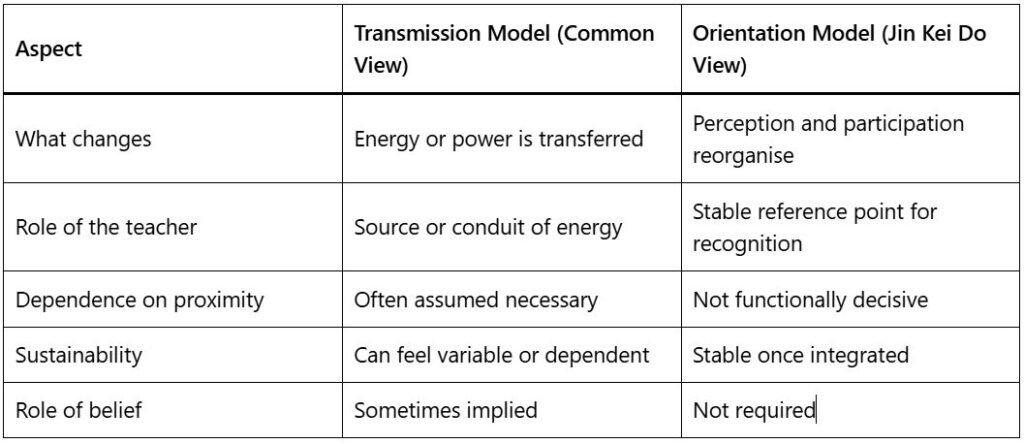
How attunement is described energetically within the Reiki Jin Kei Do lineage
Within the Reiki Jin Kei Do lineage, attunement has traditionally been described using energetic language. This description focuses on what occurs experientially and functionally during the attunement process, rather than a philosophical interpretation.
In this framework, attunement is understood as a process in which the student’s system becomes receptive to a higher-order energetic organisation. The teacher acts as a coherent interface through which alignment with the universal field becomes possible. One way to picture this is as a tuning fork. The teacher is not giving the student a sound but vibrating steadily enough that the student’s own system can find and stabilise the same note. Once that note is established, the system can return to it naturally without the tuning fork needing to be struck again. Symbols, breath, and focused attention are used to establish this coherence.
How energetic activation occurs in attunement
From this perspective, energy is made available rather than imposed. The student draws what is required according to their own capacity, need, and level of development. As each energetic centre is addressed, activation occurs through resonance rather than force. The system recognises a higher-order state and remembers it, which is why Reiki practice later arises without effort or deliberate control.
Once this energetic pattern has been established, it can be re-entered naturally whenever the practitioner engages in Reiki practice. The practitioner is no longer attempting to generate energy but allowing a familiar configuration to arise.
Described in this way, attunement appears as an energetic activation involving flow, vibration, and stabilisation within the body’s energy system. These descriptions are accurate at the level of lived experience and remain meaningful for teaching and practice.
What this energetic language does not fully explain on its own is why attunement produces a stable shift that does not depend on belief, why the effects do not wear off, or why Reiki-like function can sometimes arise outside expected formats. Orientation provides the explanatory frame that accounts for these features.
Energetic activation and orientation are not competing explanations. The energetic description explains what happens. Orientation explains how that change becomes stable and operative over time.
Can you receive a Reiki attunement through a recording or at a distance?
The following situations were not planned experiments and were not intended to test any theory. They are included because they clarify how attunement behaves in practice and help distinguish between stable attunement and situational access.
Watching a recorded attunement
A student once missed a live Reiki class and later watched the class recording. During the recording, she sat through the section where an attunement had originally been given live to the group. She was not expecting anything to happen and had planned to book her attunement separately.
While watching the recording, she experienced what she later described as a full attunement.
This was unexpected and not something I had intended. However, when she later attended her live attunement, it became clear that the shift had already occurred. The live session did not produce a second initiation, but confirmed an orientation that was already present.
This does not suggest that recordings function as a general method of attunement. It does suggest that attunement is not strictly dependent on physical proximity or real-time interaction, and that ritual and intention are not the primary drivers of the process. What mattered was the availability of an orientation that could be recognised and stabilised.
Re-entering an attunement through a recording
A different situation involves a client who repeatedly returns to the recording of her own attunement. She does this deliberately because revisiting that part of the recording has a strong calming and regulating effect on her nervous system.
This does not function as a repeated or cumulative attunement. There is no sense of the process restarting or deepening in the way an initial attunement does. Instead, the effect resembles re-entering a familiar orientation – it seems to have the effect of receiving a very powerful Reiki treatment in fact.
In practical terms, this is similar to returning to a posture or mode of attention the body already knows. The recording functions as a cue rather than a source. This points to attunement as something that establishes a reference point rather than something that must be continually reapplied.
Can Reiki-like effects arise without formal training?
A further situation involved the same client during a period of severe nightmares. Her father, who does not practise Reiki, was the only person available to support her overnight. In response to the urgency of the situation, and without planning or ritual, my attention was briefly oriented in a way that allowed the father to offer a form of calming, Reiki-like support.
This was not framed as an attunement and was presented as being impermanent. He could feel the energy quite distinctly in his hands during the process, but this capacity did not persist beyond the situation itself.
Functionally, this appeared as a context-specific alignment, arising in response to immediate need rather than as a stable capacity. It did not establish an ongoing ability to practise Reiki and did not resemble formal attunement in structure or effect.
This distinction between temporary access and stable integration is essential for understanding how attunements work.
Formal attunement and situational access
The situations described above point to a distinction that is often missed in discussions about attunement.
A formal Reiki attunement establishes a stable orientation that supports ongoing practice. It places the practitioner inside the operative logic of Reiki, where healing functions as a self-regulating process rather than something directed or controlled. This orientation persists over time and becomes more reliable through practice and integration.
Situational access, by contrast, can arise temporarily under specific conditions. It may involve calm, resonance, or a distinct feeling that Reiki is flowing, but it does not establish a stable capacity. Once the situation passes, the access dissolves because it has not been integrated into the person’s ongoing orientation.
Confusing these two leads to inflated claims on one side and unnecessary scepticism on the other. Temporary access does not invalidate formal attunement. Formal attunement explains why Reiki practice remains coherent and reliable rather than intermittent or dependent on circumstance.
Recordings, distance, and responsibility
Experiences involving recordings or distance raise understandable questions about how attunements are delivered and what conditions are required.
What these observations suggest is that attunement does not operate according to simple physical mechanics. Orientation is not limited by distance in the way material processes are. At the same time, this does not imply that recordings or remote exposure can be treated casually or universally.
A formal attunement carries responsibility. It establishes a stable change in orientation that affects how a person relates to practice, experience, and embodiment. That responsibility is practical rather than moral, involving commitment to integration, discernment about teaching or sharing Reiki, and respect for the conditions under which attunement is given.
This requires context, preparation, and integration. These elements are part of what makes attunement reliable rather than accidental.
The fact that orientation can sometimes arise outside expected formats does not remove the need for care. It highlights why clarity, containment, and ethical teaching matter.
Why integration determines stability
An attunement does not stand on its own.
What it establishes is a reference point. Stability develops as that reference point is lived through the body over time. Breath, posture, touch, and presence allow the orientation introduced by attunement to organise itself fully.
Without integration, recognition remains abstract. With integration, it becomes embodied and dependable.
This is why attunements do not need to be repeated, reinforced, or refreshed. What deepens is familiarity, not activation. Practice stabilises what has already been recognised rather than adding anything new.
This also explains why people may experience periods of fluctuation after an attunement. The system is reorganising around a new orientation. As coherence increases, practice settles into simplicity.
Common signs that an attunement has taken hold
People often expect an attunement to announce itself through strong sensations or dramatic experiences. In practice, the signs are usually quieter and more structural.
Common indicators include:
• Reiki practice feeling self-regulating rather than effortful
• The orientation introduced by attunement remaining available without reinforcement
• Sensations coming and going while the reference point stays stable
• Practice settling into simplicity rather than escalating in intensity
These are not guarantees or benchmarks. They describe how attunement is typically recognised over time rather than how it is felt in any single moment.
Why this understanding matters
Understanding how Reiki attunements work removes a great deal of confusion.
- Belief is not required to sustain an attunement.
- Attunements do not wear off over time.
- Reiki practice functions as a self-regulating process rather than an act of will.
- A stable practice can be distinguished from one-off or situational effects.
Most importantly, it grounds Reiki in lived experience rather than mythology or oversimplification.
A Reiki attunement establishes participation within a practice field that is already present. Practice then becomes a process of learning to remain available to that field with increasing ease and clarity.
Seen this way, attunement is neither mysterious nor fragile. It is a functional threshold that allows Reiki to operate as it claims to operate, through alignment rather than effort.
Seen clearly, how a Reiki attunement works becomes straightforward rather than mysterious. Knowing this helps you identify the signs of a high quality course and avoid the common pitfalls of over-mystified training.
Related Articles:
Why Reiki Training Costs Vary So Widely
Is Reiki Jin Kei Do the Right Fit for You?
How Reiki Jin Kei Do Compares to Other Reiki Systems
Online Reiki Training vs In-Person Reiki: What Actually Makes the Difference?
Best Reiki Training: 5 Signs of a High-Quality Course (+ Red Flags to Avoid)
Reiki Training Reviews: What Students Say After Learning with Steve Gooch
More ways to stay connected:
Subscribe to Energy, Consciousness & The Self newsletter
