
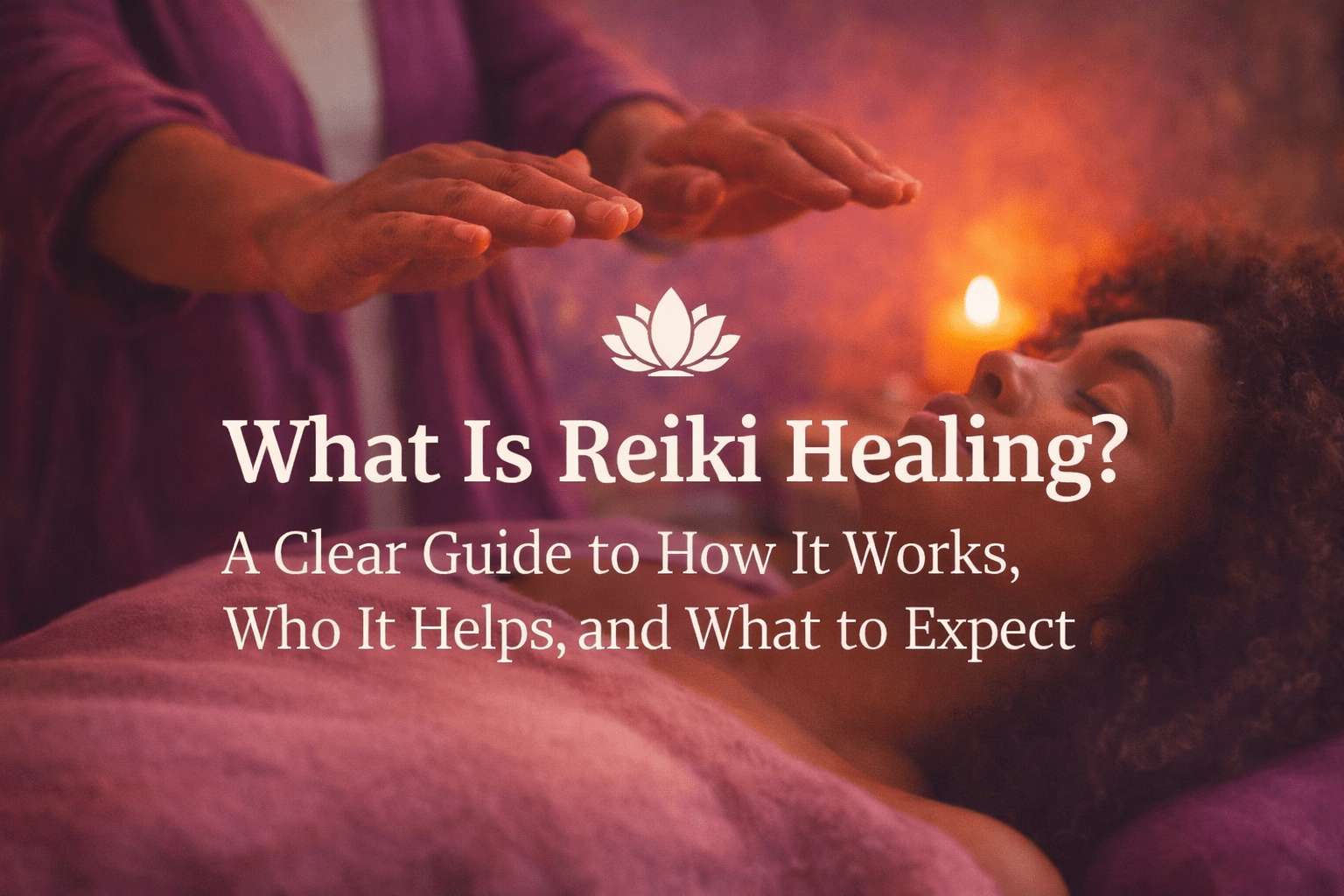
What Is Reiki Healing? A Clear Guide to How It Works, Who It Helps, and What to Expect
Introduction
Reiki healing comes up frequently in conversations about wellness, yet many people are unsure what it is or what it involves.
Reiki healing is an energy-healing discipline where the practitioner places his or her hands directly on or just off the body of the person receiving the healing experience. At its foundation, Reiki is a structured practice that works with the person’s natural ability to find balance: physically, emotionally, mentally, and spiritually. Reiki, in fact, creates the conditions where natural healing processes can unfold more easily, on all levels of being.
Drawing from almost 30 years as a Reiki Master Teacher, I’ve seen how Reiki can offer meaningful support for people navigating stress, emotional challenges, physical recovery, or a desire for deeper connection to themselves.
In this guide, you’ll find clear, grounded answers about what Reiki healing is, how it works, and how it may be able to support you on your life journey.
At a Glance: Reiki Healing
- Reiki is a structured healing discipline that supports the body’s innate capacity to return to balance across physical, emotional, mental, and spiritual levels.
- It is non-directive, the practitioner does not diagnose, prescribe, or attempt to fix specific conditions.
- Reiki does not require belief, visualisation, or intention for it to function.
- A session typically involves light, respectful touch or hands placed just above the body, with the recipient fully clothed and at rest.
- Unlike many modern energy modalities, Reiki works by allowing the recipient’s system to draw what is needed, rather than having energy directed or manipulated.
- People often explore Reiki during periods of stress, transition, recovery, or when seeking a deeper reconnection with themselves.
What is Reiki Healing, Really?
Reiki is a natural energy healing technique that promotes physical, emotional, and spiritual balance through gentle, non-invasive touch or distance connection.
Originating in Japan in the early 20th century, the system of Reiki was created by Mikao Usui as a method of supporting the body’s innate healing ability. The word “Reiki” comes from two Japanese words:
- Rei – meaning universal life force
- Ki – meaning life force energy
At its core, Reiki healing is based on the idea that when our life energy is strong and flows freely, we are more resilient, more vibrant, and better able to handle physical and emotional challenges. When that energy is depleted or blocked, we are more vulnerable to stress, illness, and emotional stuckness.
Reiki healing works to restore balance at all levels, physical, emotional, mental, and spiritual, by gently reconnecting you with your own natural vitality. Essentially, reconnecting you to your own innate state of perfection that has been submerged or lost through a life time of conditioning, emotional wounds, external expectations, and the everyday stresses that gradually pull us away from our true selves.
A First Encounter with Reiki
Many years ago, shortly after I had begun practising and teaching Reiki, one of my students came over for a practice session. She was still in training, and we were working through hands-on exercises, taking turns giving and receiving Reiki.
Midway through the session, the phone rang. A journalist was calling to ask whether I would be willing to be interviewed for a magazine article about Reiki. I agreed, and when she asked about timing, I said, “I’m actually with one of my students right now. If you’re free, you’re welcome to come over. You can do the interview and also experience a Reiki session for yourself.”
She accepted and arrived shortly afterwards.
My student and I gave her a Reiki treatment together. When the session ended, she sat up and said she hadn’t really felt very much. She was polite, professional, and clearly unconvinced. We completed the interview, and she left.
The next day, she called again, but this time she sounded completely different.
She explained that she kept several plant cuttings on her kitchen windowsill, small stems sitting in jars of water, waiting to take root. They had been there for weeks without any sign of growth. When she returned home after the Reiki session, she noticed her hands were tingling. Although she didn’t believe in energy healing, she felt an unprompted urge to hover her hand gently over the tops of the cuttings. She didn’t think much of it and went to bed.
The following morning, she woke to find that every single cutting had developed new roots overnight.
Something had occurred that didn’t fit her expectations, and she didn’t know how to account for it.
That, in my experience, is often how Reiki first makes itself known. Not through dramatic sensation during a session, but through quiet, observable changes that appear elsewhere, once the system has had time to respond in its own way.
How Does Reiki Healing Actually Work?
In a Reiki healing session, a trained practitioner channels universal life energy through their hands to the client. This energy is not the practitioner’s own; rather, the practitioner acts as a conduit for healing energy that flows wherever it is needed most. It’s important to note that the practitioner is not ‘giving you’ the energy or ‘pushing it into you.’ The mechanism in Reiki is that you are drawing the energy that you need through the channel that is the practitioner. The practitioner plays no part in deciding or dictating where the energy will go, or what it will do. They simply facilitate the healing process, allowing you to draw the energy that you need.
Clarifying Misconceptions About Reiki Healing
Over the years, many practices have been added onto Reiki by individuals and schools, often blending it with other belief systems and modalities. It is not uncommon to see Reiki today combined with references to spirit guides, angels, ascended masters, crystals, psychic readings, affirmations, ASMR triggers, past life information, and other tools.
While these additions may hold meaning for those who practice them, it is important to be clear: None of these elements are part of the original system of Reiki and none of them are needed for an effective Reiki treatment. Some might find these additional add-ons to be off-putting, or they may generate fear or hesitation. None of these elements have anything to do with Reiki healing.
Traditional Reiki practice does not involve:
- Calling on external entities (spirit guides, angels, masters)
- Giving psychic readings or energetic diagnoses
- Directing the energy to fix specific problems
- Using crystals or sound frequencies to manipulate outcomes
- Affirmations, ASMR stimulation, or past life regressions
In traditional Reiki:
- The practitioner does not direct, control, or prescribe what should happen.
- The energy works naturally, without interference, according to what is needed at the deepest level of the client’s being.
Maintaining the purity of Reiki practice ensures that the experience remains grounded, respectful, and aligned with its original purpose: To support the body’s natural ability to heal and return to balance, without imposition or manipulation.
Many people also have understandable questions about whether a particular Reiki system is actually right for them. A more detailed exploration of fit, expectations, and who different approaches tend to suit can be found here.
What Happens During a Session
You may lie fully clothed on a massage table or sit comfortably in a chair. The practitioner places their hands lightly on or just above different areas of your body. Many people experience sensations like warmth spreading across their chest, tingling in their hands or feet, or a deep, comforting sense of relaxation. However, you shouldn’t be disappointed if you don’t feel these sensations. Sensitivity to energy varies from one person to another, and often develops alongside greater awareness of what is happening in the body. Some people may feel a lot, some may feel very little. Reiki experiences vary widely, and noticeable shifts may be immediate, gradual, or very subtle. Having experience of sensations of energy in the body, is not an indicator of whether the treatment is effective or not.
One of the unique aspects of Reiki healing is that it doesn’t require belief for it to work. You don’t have to “try” to receive Reiki. The energy meets you exactly where you are, working gently to support your body’s and mind’s natural return to balance. Likewise, the practitioner, doesn’t ‘try’ to make you receive energy. There is no ‘doing’ in Reiki. Just ‘being’.
So, Reiki cannot be ‘made’ or forced to fix certain issues. Reiki always works for the highest good, whatever that is. Sometimes, Reiki resolves the specific issue you’re addressing. Other times, the challenge remains because you have a deeper learning journey to complete first.
Distant Reiki
Distance doesn’t limit Reiki. You can practice and receive healing energy from anywhere in the world, as the energetic connection transcends physical space to deliver sessions just as powerful as those held in person. Sometimes distant treatments can feel more powerful than a hands-on treatment.
Example: Sarah, a high-stress executive, received distance Reiki healing while traveling abroad. She described it as “an anchor in the middle of the storm,” noticing a shift in her ability to relax and sleep after just one session.
If you have questions about consent, boundaries, and how distant Reiki works mechanically, read my guide: Do You Need Permission to Offer Distant Reiki?
Reiki Healing Compared to Other Healing Approaches
If you’re unfamiliar with other energy healing systems, you can skim this section or return to it later, it’s included to help clarify how Reiki differs in approach.
Many alternative and complementary healing methods exist today, from massage therapy to energy psychology to modern meditation techniques. While all can offer meaningful support, it’s important to understand how Reiki differs.
Unlike modalities that diagnose, direct, or manipulate energy toward specific outcomes, Reiki healing remains entirely non-directed. The practitioner does not control where the energy goes or what it “fixes.” Instead, Reiki allows the body’s own innate intelligence to draw in and use the energy as needed, always working for the highest good of the individual. This stands Reiki apart from most other therapeutic interventions and allows the bodies innate wisdom to take over, not impacted by the intentions of the practitioner.
Compared to techniques like acupuncture or guided therapeutic meditation, Reiki requires no physical intervention, verbal processing, or mental effort from the receiver. It is a deeply passive, yet profoundly active, process of energetic realignment. It’s as if the state of ‘being’ is manifesting within the state of ‘doing’.
This distinction, Reiki’s neutrality, respectfulness, and non-invasive nature, makes it uniquely gentle and accessible for people from all walks of life.
Reiki Compared to Other Popular Energy Healing Systems
With the growing interest in complementary healing, many people encounter a wide range of energy-based practices alongside Reiki. While these systems often share similar language like “energy,” “healing,” or “vibration,” they differ significantly in how they approach healing. Understanding these differences will help you make an informed decision.
Reiki vs Pranic Healing
Pranic Healing is a system that focuses on cleansing and energising the energy body using specific hand movements, techniques, and visualisation. It involves the practitioner actively removing “dirty”, negative or blocked energy and projecting clean or positive energy into targeted areas. The practitioner plays an active, directive role and works within a defined energy anatomy. While many people report positive experiences with Pranic Healing, others find certain aspects of the method, such as the forceful clearing techniques or strong diagnostic framework, less comfortable. This includes some individuals who have previously trained in the system but later switched to more passive or non-directive approaches.
Reiki, on the other hand, is entirely non-directed. The practitioner does not diagnose, assess, or attempt to remove or insert energy. Reiki doesn’t acknowledge the concept of ‘negative energy’, seeing all energy as offering the potential for further growth and as an expression of the life-lessons the recipient needs to traverse on their journey to wholeness. Reiki allows the recipient’s system to draw in what is needed through the practitioner as a passive channel. The energy flows according to the innate wisdom of the client’s body and being. There is no diagnosis, no direction, and no energetic manipulation.
Reiki vs Quantum Touch
Quantum Touch is based on using breathing techniques, body awareness, and focused intention to raise one’s own energetic frequency before placing hands on the body. The practitioner applies mental focus to direct healing energy to specific areas, often amplifying effects with intention and focused visualisation techniques.
Reiki does not involve intention-based focusing or vibrational manipulation. The Reiki practitioner is not “doing” or projecting anything. They create a still, receptive space through which Reiki flows without visualisation, control, or guided influence. The process is entirely non-mental, silent, and intuitive. The goal of the Reiki practitioner is to maintain a space of complete emptiness: no judgement, no intention, no manipulation; just void.
Reiki vs Spiritual or Intuitive Healing
Spiritual or intuitive healing methods often involve channelling messages, intuitive impressions, or psychic readings during the session. Practitioners may describe what they “sense” in the field or offer interpretations of energy blocks or emotional states. Sometimes this can involve past-life impressions or diagnosing a problem as being linked to a past-life experience.
Reiki is not interpretive. The practitioner does not assess or comment on your energetic state or emotions. There is no psychic diagnosis or insight offered unless absolutely vital to the healing process. Reiki simply facilitates an environment where the energy supports what is most needed, without analysis or commentary. The wisdom of Reiki is given precedence over the intuitive or psychic impressions of the practitioner.
Reiki vs Crystal Healing or Sound Healing
Crystal and sound healing use tools believed to carry particular frequencies or qualities that can help balance the body or emotions. These sessions often rely on placing crystals on the body, or using tuning forks, singing bowls, or mantras to generate specific vibrations. Many people find sound healing particularly powerful.
Reiki requires no tools. It is a complete and sufficient system in itself. While some practitioners combine Reiki with these modalities, traditional Reiki does not depend on external instruments. The energy of Reiki alone, received passively and without manipulation, is the core of the method.
If you’re weighing up different Reiki approaches and want a clearer comparison between systems, you may find a more detailed breakdown here.
Best Ways to Experience Reiki Healing
There are many ways to experience Reiki healing, depending on your goals, availability, and personal preferences.
- Private Reiki Session:
Ideal for deep personal work, where full attention is given to your unique energetic needs in a calm, dedicated setting. - Distance Reiki Session:
Suitable for those who can’t attend in person, distance Reiki offers the same energetic support without geographical barriers. Some even find it more powerful due to the reduced physical distractions. - Group Reiki Share or Circle:
Often more affordable and social, group sessions allow you to experience Reiki alongside others, sharing collective energy in a community setting. Receiving a Reiki treatment from a group of practitioners simultaneously can be an astonishingly powerful process. - Reiki Healing Retreat:
Immersive retreats combine Reiki sessions with meditation, reflection, and nature connection, allowing for extended periods of energetic and emotional reset.
Ultimately, the best way to experience Reiki is the one that resonates most with your current needs and comfort level.
What Are the Benefits of Reiki Healing?
Many people seek out Reiki for stress relief, emotional healing, and spiritual reconnection, but its benefits can truly transform every layer of your life.
Emotional Healing Benefits:
- Reduced stress and anxiety
- Greater emotional resilience
- Feeling calmer, lighter, and more centered
- Release of old emotional wounds and pacifying deep-seated traumatic memories
Physical Support Benefits:
- Deep relaxation
- Improved sleep quality
- Support for pain management
- Enhanced overall vitality
Spiritual Connection Benefits:
- Feeling more connected to yourself and others
- Increased sense of purpose and inner peace
- Heightened intuition and self-trust
While Reiki healing is not a replacement for medical care, many people find it a powerful complement to other healing approaches, supporting clearer understanding, emotional processing, and meaningful personal change. Many people have seen dramatic shifts on a physical, emotional, mental or spiritual level from the use of Reiki. This can happen after just one treatment or many. Reiki’s transformational power has been experienced and witnessed countless times around the world. Others have experienced no appreciable shift in whatever they were seeking treatment for. It’s at this point that it’s important to emphasise that Reiki gives us what we need, not what we want. Those two things are not always congruent.
A Real Example of How Reiki Supports Change Without Forcing Outcomes
One woman I worked with had previously experienced significant relief from arthritis through Reiki. Some time later, she began suffering from recurring stomach pain that medical tests were unable to clearly explain. The pain was persistent, and she returned to Reiki hoping it would address the physical symptoms directly.
During the sessions, there was no attempt to target the stomach or remove pain. Reiki was allowed to unfold in its usual non-directed way. Over time, she began to notice a subtle but consistent change in her appetite and food preferences. In particular, she gradually lost the desire to eat a specific meat product that had been part of her regular diet.
There was no conscious decision to change her eating habits and no effort to correct behaviour. The shift happened naturally. As the food dropped out of her diet, the stomach pain disappeared and didn’t return.
This example illustrates how Reiki often works. Rather than forcing symptoms to resolve, it supports the system in recognising and adjusting underlying patterns. The change might appear simple on the surface, but reflects a deeper rebalancing that honours the body’s own intelligence and timing.
Summary: Reiki healing supports the body’s natural ability to return to balance, helping to ease physical tension, calm emotional stress, and promote overall wellbeing.
What Keeps the Cost of Reiki Healing Up?
While Reiki itself is a non-directed practice, meaning the practitioner cannot control or tailor the energy to fix specific problems, certain factors can influence the cost of a Reiki session.
These factors are not about altering how Reiki works, but rather reflect the context, experience, and setting offered:
- Practitioner Experience: Reiki practitioners with decades of personal practice and teaching experience, sometimes internationally, often charge more. Their depth of understanding, energetic presence, and integrity of lineage (meaning their training can be traced authentically back through a respected line of teachers to the original Reiki system) brings a different quality of support to a session.
- Session Context: Some Reiki practitioners offer sessions within environments that encourage deeper relaxation and reflection, such as dedicated healing spaces, retreats, long-form journeys or private studios. The cost reflects the care and professionalism in creating an environment conducive to healing.
- Additional Resources: In some cases, practitioners may offer complementary support around the Reiki session, such as guided meditation beforehand, or post-session reflection, aimed at helping clients process their own experiences. This does not change the Reiki itself but may enhance the overall journey.
- Combining Therapies: Sometimes the practitioner will offer Reiki in combination with another therapy, such as massage. The cost will reflect the combined nature of the treatment where the practitioner is drawing on different skill-sets to provide a more targeted or responsive intervention in the client’s problem.
Example: Receiving Reiki in a peaceful, dedicated retreat setting, away from everyday distractions, may support a deeper sense of rest and internal awareness compared to a quick session in a busy wellness centre.
Summary: The cost of a Reiki session reflects the practitioner’s experience, the quality of the environment provided, and the overall support for your healing journey, not a guarantee of specific results or targeted fixes. Reiki is non-directed and neutral, responding to what is needed beyond the practitioner’s conscious control. Premium pricing often reflects premium experience not just a longer session time.
What Keeps the Cost of Reiki Healing Down?
There are also ways that Reiki healing can remain accessible.
Factors That Lower Costs:
- Group Settings: Group sessions or Reiki shares.
- New Practitioners: Reiki Level 1 or Level 2 practitioners building experience. There is no statutory guidance, but most Reiki practitioners agree that professional practice begins at Level 2. Level 1 is usually intended for personal use with friends and family.
- Shorter Sessions: 30-minute Reiki healing sessions offered at a lower rate.
- High-Volume Models: Clinics or spas offering Reiki as a short, add-on service.
- Online or Distance Options: Remote Reiki healing sessions reduce facility costs and therefore can cost less than an in-person treatment session.
Summary: Lower-cost Reiki healing isn’t necessarily lesser quality, but it’s important to tune into the practitioner’s experience and your own needs.
If you’d like a deeper explanation of Reiki pricing, including why costs vary and what actually influences fees, you can read the full guide to Reiki cost and pricing here.
Where I Fall In This
I believe Reiki healing should feel deeply rooted and well structured, with real support throughout.
I’ve spent almost 30 years teaching and practicing Reiki healing, alongside the Buddho system of healing, a Buddhist-derived energetic practice that informs and deepens my approach to Reiki, as well as mindfulness and personal transformation. My approach is built around:
Deep emotional and spiritual reconnection
- Structured energetic techniques as well as deep intuitive understanding of what the energy is working on
- Techniques drawn from the Buddho system that deepen and complement the traditional Reiki approach
- Supportive guidance to help you sustain your growth long after a session ends
Whether through private sessions, structured training, or immersive retreats, my goal is to help you experience Reiki healing not as a one-off relaxation method, but as a catalyst for lasting inner alignment.
Is Reiki Healing Right for Me?
Reiki healing is a beautifully gentle and accessible practice, but like any path, it resonates more strongly for some than others.
Reiki healing may be a good fit for you if:
- You’re feeling stressed, emotionally stuck, or energetically depleted
- You have physical problems or pain that other interventions are not positively impacting
- You’re open to complementary and holistic healing approaches
- You’re seeking greater inner balance, clarity, or connection
- You’re ready to support your own healing journey in a natural, non-invasive way
Example: One client came to Reiki after feeling emotionally drained from caregiving. Through a series of sessions, she rediscovered a deeper sense of self-compassion and emotional resilience.
Reiki healing may not be the right fit if:
- You’re expecting instant, guaranteed “cures” for medical conditions
- You’re unwilling to engage with inner change or energetic self-awareness
- You’re highly skeptical to the point of closedness.
Reiki healing is never about forcing change. It’s about gently creating the conditions where true transformation can naturally unfold.
If you’re also considering Reiki training and want to understand what distinguishes a high-quality course from a superficial one, a practical guide is available here.
How to Experience Reiki Healing
If Reiki healing feels like it could support your journey, there are several simple ways to begin:
- Private Reiki Healing Session: Experience personalized, focused energy support in a 1:1 setting.
- Reiki Level 1 Training: Learn to work with Reiki energy for your own self-healing and growth.
- Healing Retreats: Immerse yourself in deeper energetic practices, often blending Reiki, meditation, and spiritual reconnection.
Starting is simple. Often, the first session or first class opens the doorway to powerful shifts that ripple into every part of life.
Conclusion
If you’re still exploring whether Reiki healing is right for you, the most reliable understanding comes through direct experience rather than theory alone. Reiki healing is not about escaping life’s challenges, it’s about building inner resilience, peace, and vitality to meet life more fully. It reconnects you to the part of yourself that knows how to heal, grow, and thrive. If you’re curious to experience Reiki healing for yourself, I invite you to take the next step. Wherever you are on your journey, Reiki healing can offer a grounded, compassionate hand, helping you reconnect with the strength and wisdom already within you.
Related Articles:
Why Reiki Training Costs Vary So Widely
Is Reiki Jin Kei Do the Right Fit for You?
How Reiki Jin Kei Do Compares to Other Reiki Systems
Online Reiki Training vs In-Person Reiki: What Actually Makes the Difference?
Best Reiki Training: 5 Signs of a High-Quality Course (+ Red Flags to Avoid)
Reiki Training Reviews: What Students Say After Learning with Steve Gooch
Other ways to stay connected:
Subscribe to Energy, Consciousness & The Self newsletter
