
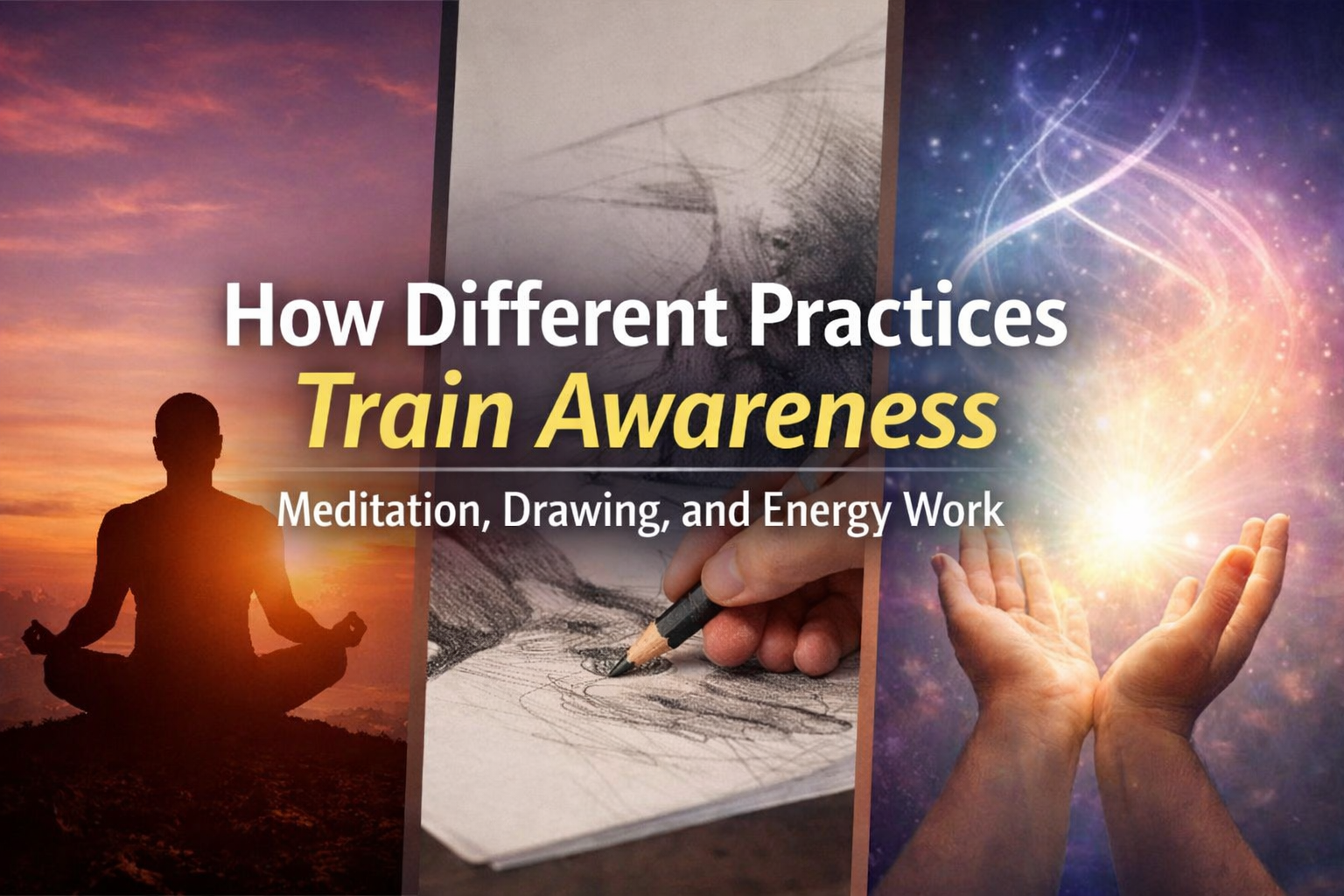
How Different Practices Train Awareness: Meditation, Drawing, and Energy Work
People are trying to become more aware. They take up meditation, experiment with drawing or other creative practices, and explore Reiki or energy work. Progress often feels inconsistent. Most people assume these practices are doing the same thing. That assumption is what causes progress to stall.
Each one trains awareness in a different way. When that distinction is not clear, it is easy to stop too early or assume something is not working, when in reality a different capacity is being developed.
What Do We Mean by “Awareness”?
Awareness is the capacity to perceive what is actually happening, internally and externally, without distortion. It is not the same as thinking, analysis, or interpretation. It is a direct form of perception that can be trained.
This matters because awareness is not a single skill. It has multiple dimensions, and most practices develop only one of them. Understanding that changes how each method is used.
Awareness develops through three distinct capacities: stability, precision, and sensitivity. Most practices strengthen one of these. Very few develop all three together.
Meditation Trains the Stability of Awareness
Meditation develops the ability to remain present without being pulled into thought or reaction. With consistent practice, the mind becomes more settled, and attention is less easily disrupted. Thoughts are still present, but they are seen more clearly and followed less automatically. This builds stability.
The experience of this is usually a sense of space and a reduction in mental noise. Situations feel less overwhelming, and reactions slow down. There is more room to respond rather than react.
At the same time, this stability does not automatically increase the accuracy of perception. A person can feel calm and centred while still misreading situations or overlooking important details. Stability supports awareness, but it does not complete it.
Drawing Trains the Precision of Perception
Drawing, when used as a practice, trains you to see clearly. Most people draw based on what they think is there rather than what they actually see. The brain simplifies what is in front of us into familiar shapes and symbols. Drawing interrupts that process by forcing attention onto what is actually present.
One simple practice shows how strong this effect can be. In Buddho training, students sit in front of a mirror and look at their own reflection for several minutes without distraction. Although this is presented as a meditation, what it develops is precision of perception.
At first, it feels uneventful. Then something begins to change. Details start to emerge that were not noticed before. Lines, creases, and subtle features become more visible, often leading to the question of where they suddenly came from.
What is changing is not the face itself, but the way it is being seen. The familiar image begins to break down, and attention shifts from what is assumed to what is actually there.
To draw accurately, attention has to remain on raw visual information. Assumptions have to drop, and observation becomes more deliberate. Over time, this builds precision, the ability to see what is actually there rather than what is assumed.
This often feels intense at first. There can be frustration as familiar shortcuts no longer work, followed by a noticeable shift in clarity. The world begins to appear more detailed and structured.
At the same time, this precision does not automatically stabilise awareness internally. A person can see very clearly and still react quickly or miss what is happening within their own experience.
Energy Work Trains Sensitivity to Internal Experience
Practices like Reiki develop awareness through direct attention to the body. This includes the use of structured elements within the system, such as specific symbolic forms, which are often misunderstood when separated from the context they are taught in. Instead of focusing on thought or visual input, attention is placed on sensation and internal experience. Over time, this increases sensitivity to subtle changes in the body and strengthens the connection between perception and behaviour. This builds sensitivity, the ability to perceive internal signals that are usually overlooked.
This process does not introduce anything new. It reveals what the body is already responding to. As sensitivity increases, patterns that were previously unnoticed begin to come into awareness.
One example illustrates this clearly. A woman who had previously worked with Reiki developed recurring stomach pain. The treatments reduced the discomfort, but the pain kept returning. Over time, her relationship with a specific food began to change. Her desire for it faded, and eventually she stopped eating it. When she did, the pain disappeared. Nothing was fixed in the sense of an external intervention. She became aware of the cause and stopped doing the thing that was creating the problem.
This kind of awareness often feels like an increased sensitivity to the body. Subtle sensations become more noticeable, and there is a clearer sense of what supports balance and what disrupts it. Without a clear understanding of awareness, this can be misunderstood as a mechanical process that fixes problems. In practice, it is a way of perceiving what is already happening.
How These Practices Compare
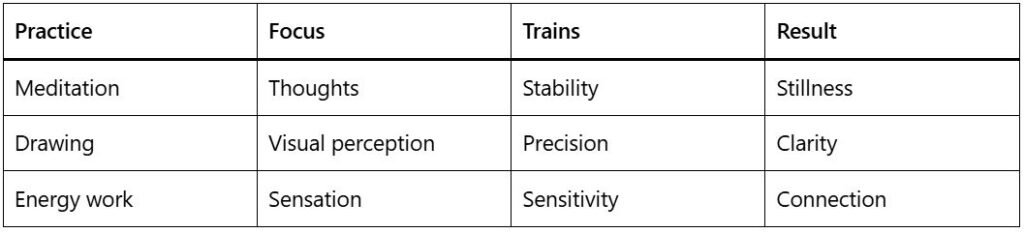
Each of these approaches develops a different dimension of awareness. When only one is used, development remains limited to that dimension. Most people train one and assume they are developing awareness fully, which is why progress often feels incomplete.
Where Each Approach Breaks Down
Relying on a single method creates gaps in development. Meditation can produce stability, yet important details in the environment or in behaviour can still be missed. Drawing can produce high levels of perceptual accuracy, yet internal reactions may continue unchanged. Energy work can increase sensitivity, yet clarity and stability may not be fully developed.
These gaps explain why progress often plateaus. The same dimension continues to improve while others remain underdeveloped. This is where most people get stuck. They keep developing the same capacity instead of addressing what is missing. This is why people plateau.
Experiencing the Difference Directly
These differences can be observed directly. Sitting still and following the breath for a few cycles develops stability. Looking at an object and focusing on the spaces around it rather than the object itself sharpens perception. Placing attention on sensation within the body or between the hands develops sensitivity.
Each practice produces a distinct shift because each one is training a different aspect of awareness.
How to Use This in Practice
The most effective starting point depends on the current imbalance. Meditation is useful when the mind is busy or reactive, as it stabilises attention. If perception feels unclear or unfocused, drawing or observational practice improves accuracy. A sense of disconnection from the body can be addressed through energy work, which develops sensitivity.
It is not necessary to do all of these at once. However, relying on only one approach leads to partial development. When stability, precision, and sensitivity are developed together, awareness becomes more complete and more reliable.
Final Thought
Awareness develops through stability, precision, and sensitivity. When only one of these is trained, experience remains limited. As these are developed together, perception becomes clearer and response becomes more accurate. As these are developed together, perception becomes clearer and response becomes more accurate. Systems like Buddho have historically integrated these dimensions into a single, cohesive path.
More ways to stay connected:
Subscribe to Energy, Consciousness & The Self newsletter
