Tag: Esoteric Buddhism

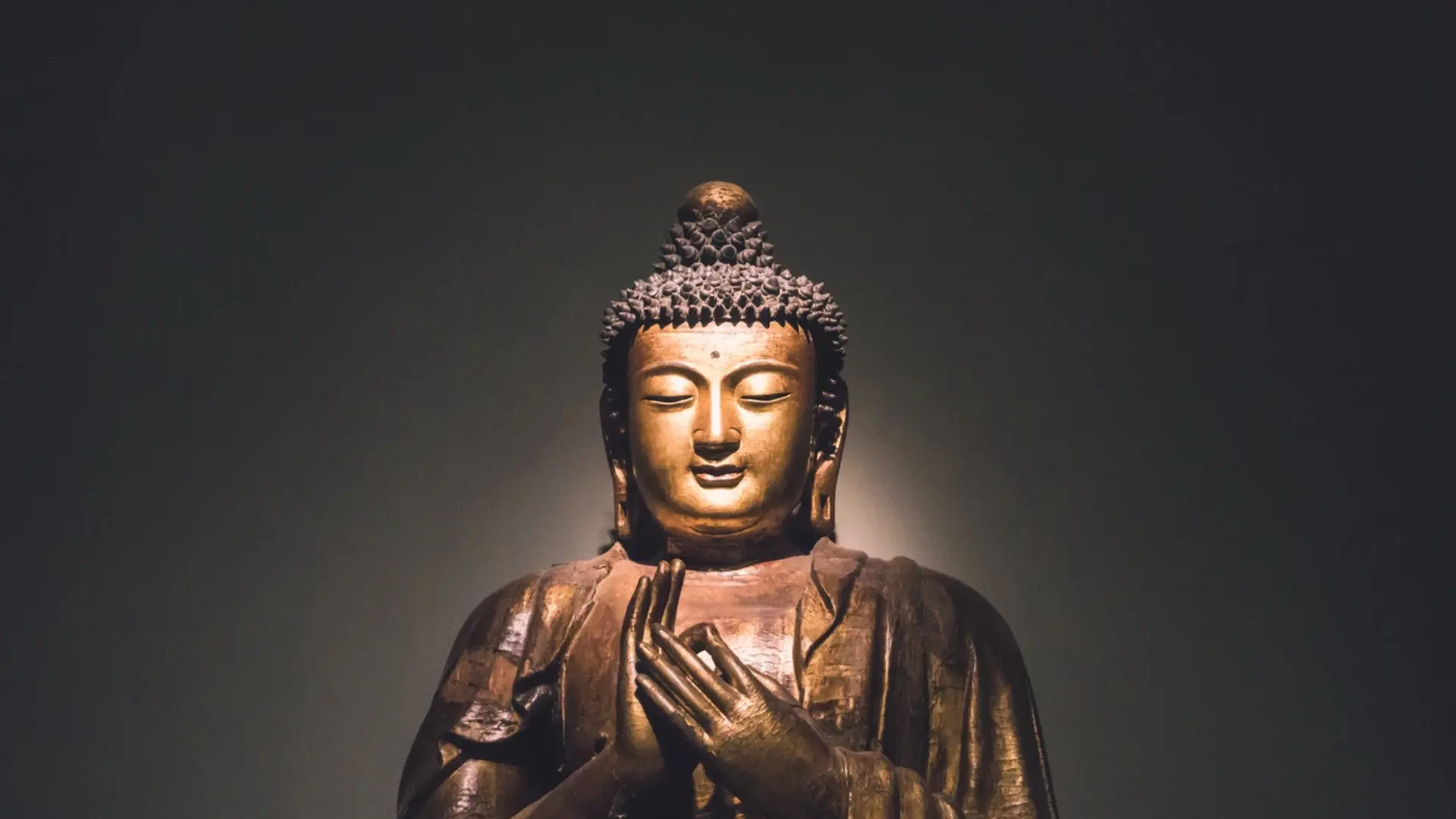
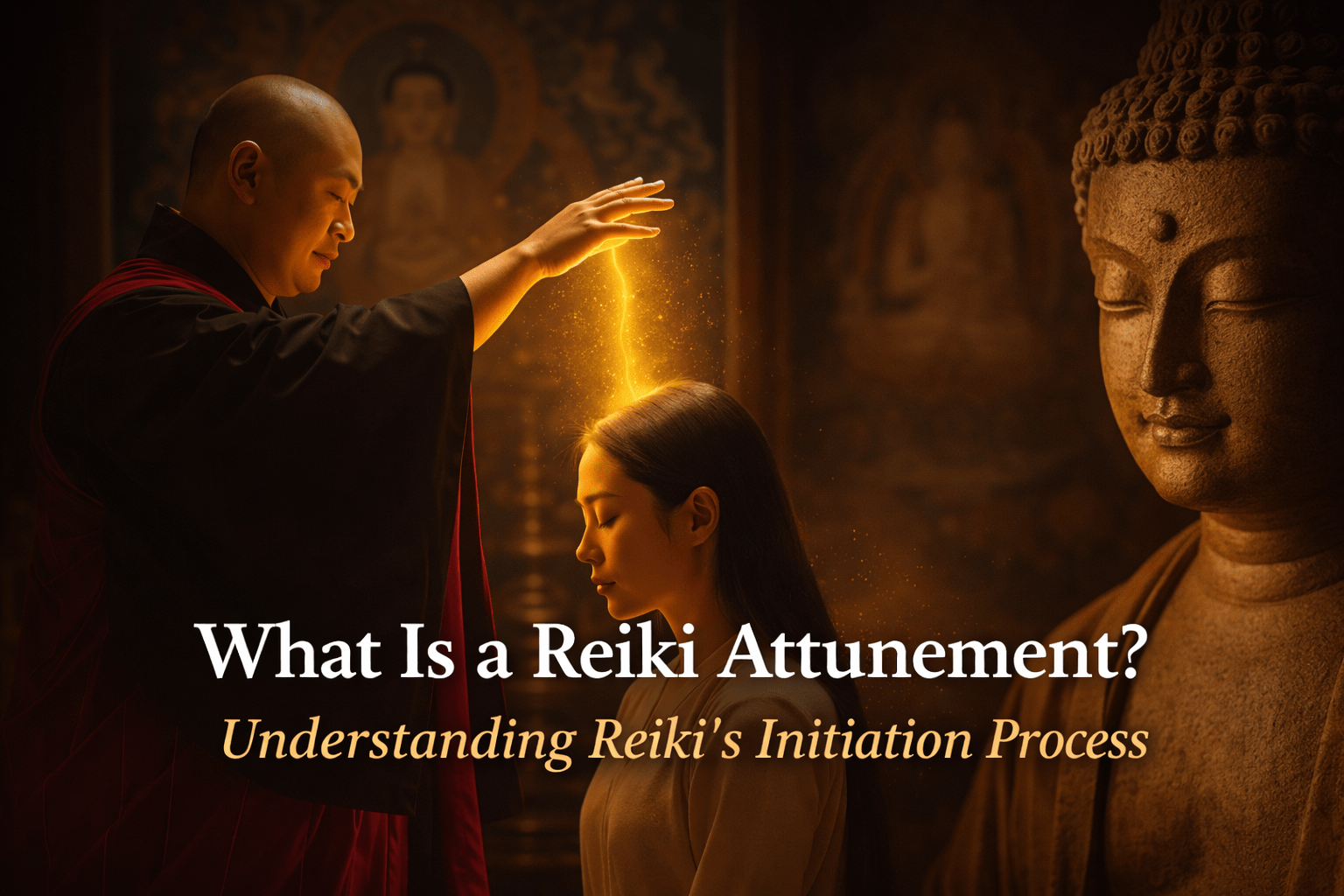
A Shingon Buddhist monk gives a student a Reiki attunement in a temple. Feb 2, 2026

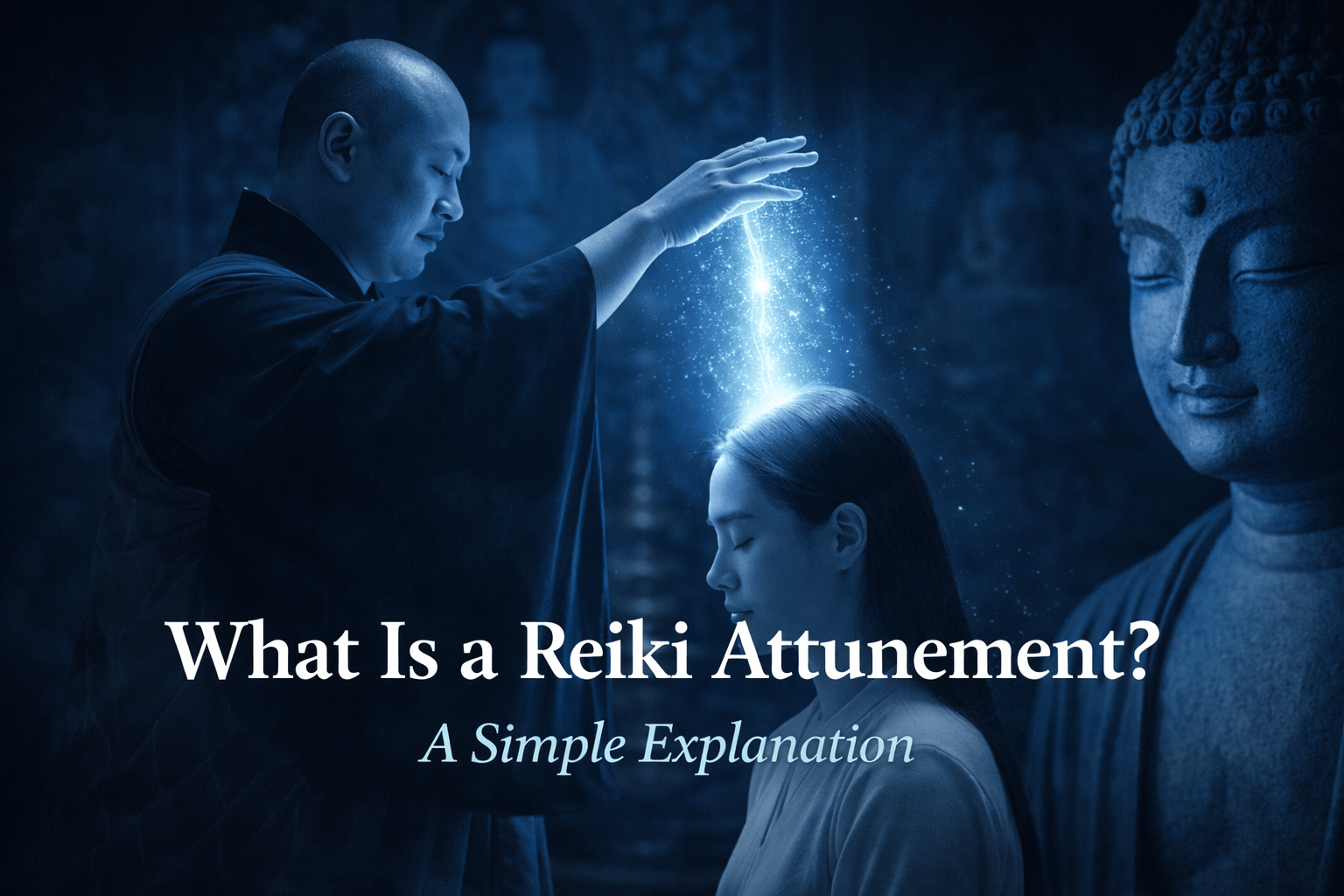
What Is a Reiki Attunement?

A Reiki attunement is one of the most talked about and least clearly understood aspects of Reiki training. People encounter many different explanations, from energy activation to spiritual initiation, and it can be difficult to know which descriptions actually reflect how Reiki functions in lived practice. This matters because how attunement is understood shapes how Reiki is taught, practised, and integrated over time. This article addresses the question directly, drawing on long term teaching experience and on parallels with established esoteric traditions, to clarify what a Reiki attunement is and how it operates in practice.

A monk gives someone a Reiki attunement Feb 2, 2026
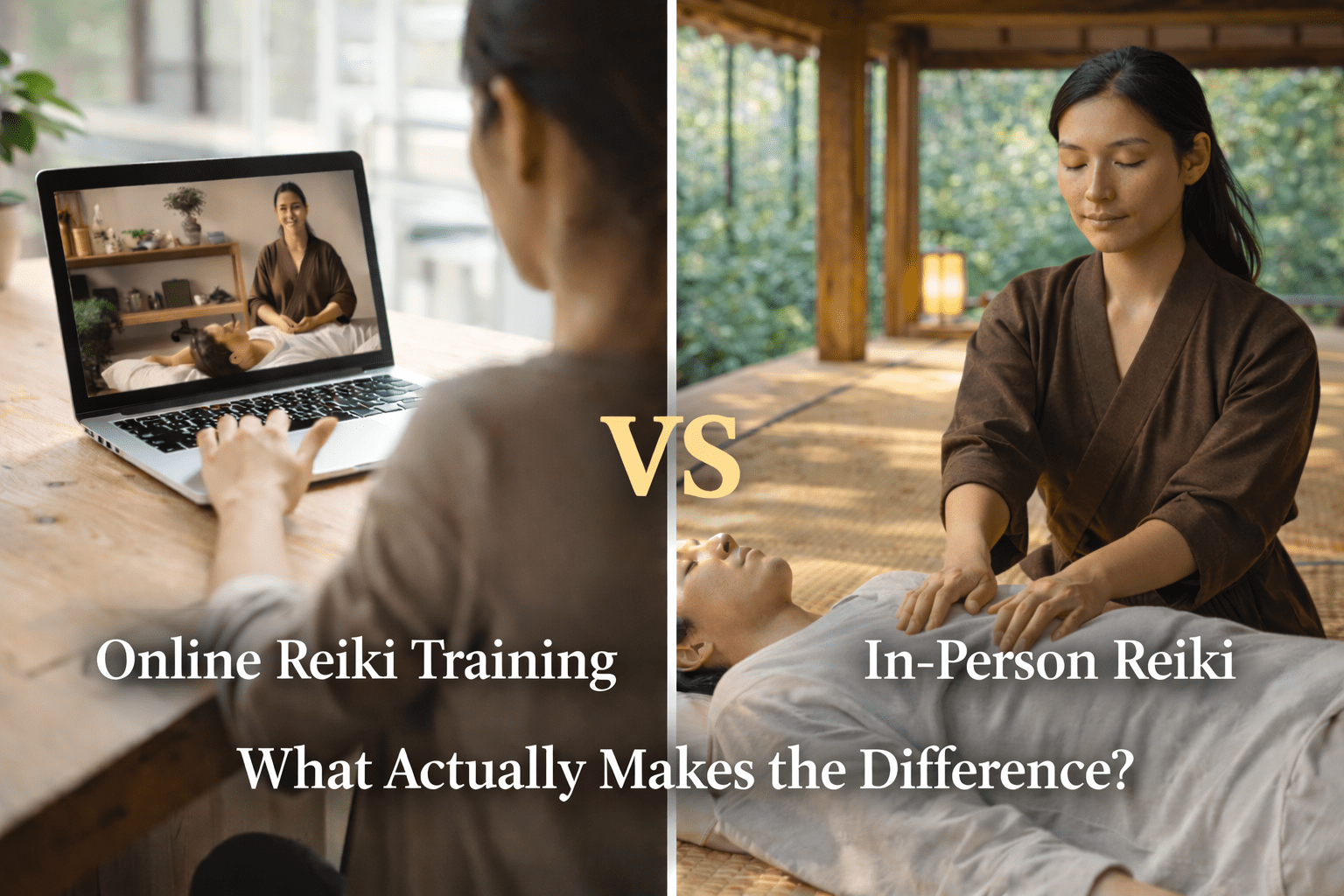
Featured inmage for an article addressing the issue of online vs face to face Reiki showing a woman at a laptop and another doing Reiki in a live class Jan 26, 2026

Online Reiki Training vs In-Person Reiki: What Actually Makes the Difference?

In-Person, Online, or Recorded? This article explores online Reiki training vs in-person Reiki in practical terms, focusing on how people actually learn, practise, and integrate Reiki. If you are trying to decide between online Reiki training and in-person Reiki, you are not alone. One of the most common questions people ask before enrolling on a course is whether Reiki should be learned face to face or whether online Reiki training can be just as effective. Some teachers insist Reiki must be taught in the same room, with hands-on guidance throughout. Others offer live online Reiki classes or structured recorded Reiki training and argue that distance does not limit the quality of learning or transmission. Online Reiki training can be effective when it is taught clearly and approached with engagement. Reiki transmission does not rely on physical proximity alone, but on how the student receives and integrates the process. The difference between online and in-person training lies more in learning structure, feedback, and pacing than in whether Reiki functions. What Actually Changes Between Training Formats This question is often framed purely as an issue of attunement, focusing on whether Reiki can be transmitted at a distance. In practice, the difference between online Reiki training and in-person Reiki courses affects far more than the moment of attunement. It influences how students learn to give a full Reiki treatment, how clearly hand positions and treatment flow are demonstrated, how often techniques can be reviewed, and how much opportunity there is to practise between sessions. It also affects pacing. In-person Reiki training often delivers a large amount of material over a short period, while online and recorded Reiki courses usually allow students to return to the material as their understanding deepens. Questions about physical presence matter, particularly in relation to energetic transmission and feedback. Questions about learning structure, repetition, confidence-building, and real-world practice matter just as much when deciding between online Reiki training or in-person Reiki. Rather than promoting one format over another, this article examines how Reiki training actually works across different formats. It looks at how transmission functions, how physical presence influences learning and practice, and how live and recorded Reiki training support skill development over time, so you can decide which approach fits your learning style and circumstances. 1. The Core Paradox The Smoking Gun: If Distance Healing Works, Why Would Distance Training Be Different? At Reiki Level 2, practitioners are taught distant healing, traditionally referred to as Enkaku Chiryo. This practice is based on a clear premise. Reiki is not understood as something that travels through physical space in a conventional way. Using the Hon Sha Ze Sho Nen symbol, a practitioner opens a channel through which a recipient receives healing regardless of physical location or time difference. This principle is widely accepted within Reiki practice. Once this is acknowledged, an obvious question follows. If a practitioner can open a channel that allows a recipient thousands of miles away to receive Reiki, a teacher can also open a channel that allows a student to take part in an attunement process without being in the same room. Any serious discussion about online or recorded Reiki training needs to engage with this point directly. 2. Reiki Is Drawn, Not Pushed Why Physical Proximity Supports Rather Than Governs Transmission A common misunderstanding around Reiki attunements is the idea that the teacher gives energy to the student. In both Reiki treatments and attunements, the teacher does not push energy into the recipient. The traditional explanation is that the practitioner becomes a clear channel, often compared to a hollow bamboo, through which Reiki flows, drawn through that channel by the recipient. The roles involved are distinct. The teacher holds the energetic framework and facilitates access to the resonance of Reiki.The student allows that resonance to permeate their own system. Being in the same room can help some students feel more settled, focused, and supported during the process. At the same time, physical proximity does not determine whether transmission occurs. The outcome is shaped by the recipient’s capacity to draw Reiki at a deeper level than conscious awareness, rather than by physical distance. This explains why many students report receiving attunements with the same clarity in live online settings, with cameras off, or through recorded guidance. In each case, they are engaging directly with the process rather than observing it passively. 3. The Source of Reiki Attunements Esoteric Buddhism and Empowerment Reiki did not develop in isolation from earlier spiritual traditions. In both Reiki and esoteric Buddhist systems, empowerment is understood as a process of energetic maturation. It authorises a practitioner to engage in specific practices by clearing internal pathways and stabilising their capacity to work with energy. In traditional Japanese Reiki lineages, this process is called Reiju. It is commonly described as a nuanced energetic clearing that allows Ki to flow more freely through the student’s system. In Buddhist traditions, particularly Japanese Mikkyō and Tibetan Vajrayana, the equivalent ritual is known as abhisheka or wang. These terms refer to the ripening of the practitioner’s mindstream so that deeper levels of practice become accessible. Despite differences in ritual form and terminology, both systems describe empowerment as a process that reveals existing potential rather than adding something external. Transmission is completed through the student’s ability to receive, integrate, and stabilise the experience. Mikao Usui’s teachings were shaped by Japanese esoteric Buddhism, known as Mikkyō. While earlier accounts described him as a Tendai priest, modern research points to a broader engagement with Shingon, Tendai, and possibly other influences. What matters here is structural similarity. The Reiki attunement process closely mirrors Buddhist empowerment practices in function. In both traditions, empowerment is experiential and operational in nature, and remote empowerments have been recognised for centuries and employed within various esoteric Buddhist schools. 4. Transmission Beyond Presence Why Time and Distance Do Not Limit Transmission Tibetan Buddhism provides a clear framework for understanding transmission beyond physical presence. In the Nyingma school, the Terma tradition describes teachings and empowerments transmitted across
Read More
Jun 9, 2025

The Reiki Attunement: A Gateway to Authentic Empowerment

The Reiki attunement is the heart of the Reiki journey, a direct experience that awakens your natural connection to universal energy. This transformative process raises the vibration of your chakras, aligns your energy field, and clarifies your inner channels. Unlike common beliefs, it’s not a technique that can be undone or repeated; once received, it’s with you for life. Discover why attunement is more than a ceremony; it’s a profound reminder of your inherent potential.

Aug 16, 2023

The Most Powerful Healing Technique

I don’t know about you, but I’ve got tired of the endless claims on the internet about which is the most powerful healing technique. Is it Pranic Healing? Is it Reiki? Is it Vortex Healing? So many claims and so many different healing modalities out there and frankly, from my experience, all the hype, and the question itself, is total bullshit. Because it’s not about which is the most powerful. That’s just ego. In reality, the question should be about whether the healing modality is a good fit for the healing required and whether it delivers the results. And if it does, that STILL doesn’t make it the most powerful. It makes it the appropriate intervention in that particular case. And what does the concept of ‘most powerful’ even mean? This is ego on a rampage. ‘Power’ is a perceptual concept and is reliant on many variables and not all of them are related. The system I know best is Reiki. I’ve been teaching it for 25 years and have written two books on the subject (you can find them here: Mindfulness Meditation & The Art of Reiki and Reiki Jin Kei Do: The Way of Compassion & Wisdom) and I think it’s a pretty powerful intervention for some people. For some, it’s a waste of their time and money, because other things serve them better. I don’t know about Pranic Healing. I know lots of ex-Pranic Healers who wouldn’t touch that system again with a barge pole. Why? I’ve no idea and it’s never interested me to find out. I also know nothing whatsoever about Vortex Healing or for that matter any other healing modality. Reiki is my thing and I’m happy to stick to that. It does what I need it to do for me personally as a spiritual development practice. What I do know, from years of experience is that there is one system of healing and more importantly, spiritual development, that is significantly better and more powerful than Reiki. When I say, ‘more powerful’, I mean in terms of the specific mechanism of how the energy in Reiki works and it’s the antithesis of how energy works in all other energy healing methods (as far as I can tell). That system is called Buddho. Buddho is the original esoteric Buddhist practice from which modern secular Reiki developed. When a practitioner works with Reiki, he or she is calling on the energy that manifests within the Buddho system. Reiki is just a conduit for Buddho. It makes sense then that Buddho without the mediating device of Reiki, is more powerful than when Reiki is the filter through which the energy passes. I’ve taught Reiki to 1000-plus people over the years and probably Buddho to only a couple of hundred or so, but those who have taken Buddho training have all said that they prefer working with Buddho, rather than Reiki. Why? It gets results when Reiki doesn’t. That’s not to say that Buddho is somehow better than Reiki. Each healing case requires its own specific form of intervention. Sometimes Reiki is the thing, sometimes Buddho. But regardless, Buddho does get to the root of the problem quicker, more decisively, and more powerfully. One of my students once said that Reiki starts out very gently and then goes on increasing until it becomes extremely powerful. It’s like there is a gentle flow to it as it builds and builds. They said that Buddho on the other hand, is like a flash of lightning; it’s full power instantly and very fast. This is true. This is how Buddho works. I don’t know about other healing systems. The comparison between them and Reiki is pointless because they work on a different principle. It’s like comparing a plane to a helicopter. But Buddho and Reiki are of the same order. Buddho is before and after modern Reiki. It’s its origins and it’s the destination that Reiki leads to. For me, working with either Reiki or Buddho is primarily about my own personal spiritual journey. I’m not a fan of practicing energy healing and avoid it whenever I can, passing potential clients on to my own students. I just find the practice boring, though I’m always delighted when someone finds that their problem is resolved or alleviated because of a treatment I’d given them. If I do find myself giving a Reiki treatment, I tend to blend Buddho techniques in with Reiki. The two systems are essentially one in any case, so there’s seamless compatibility. Moving in and out of Reiki/Buddho techniques in a state of flow is the best of energy healing it seems to me. I think Reiki has a lot more potential than just energy healing though. And Buddho even more so. They both point in the same direction, but Buddho is the rocket booster that Reiki lacks. Buddho is a method straight out of Highest Yoga Tantra of Tibet (the Reiki fundamentalists will of course repeat their tired mantra that ‘everything Reiki comes from Japan’. No, it doesn’t and Buddho is the proof of that). It’s an expression of Mantrayana and thus an amazing tool of personal liberation. This is the system that Usui (the founder of the system of Reiki) accessed in formulating his contemporary understanding which we know of as Reiki. If you haven’t learned Buddho, I suggest you do. You’ll need to find yourself a teacher of Reiki Jin Kei Do because the Buddho teachings are held exclusively within that tradition. Or you could just go straight to my courses page and check out whether I’m running any Buddho classes soon. You can find it here: Courses. Buddho is a system however that is for the committed and serious spiritual seeker. It requires dedication and practice of the teachings. If you want to know what the most powerful healing technique is, then it has to be Buddho. The Highest Yoga Tantric practices of Tibet, pretty much top everything else, especially Western New Age methods.
Read More

Jan 21, 2022
Dec 24, 2021
Dec 24, 2021
Dec 24, 2021
Dec 24, 2021