
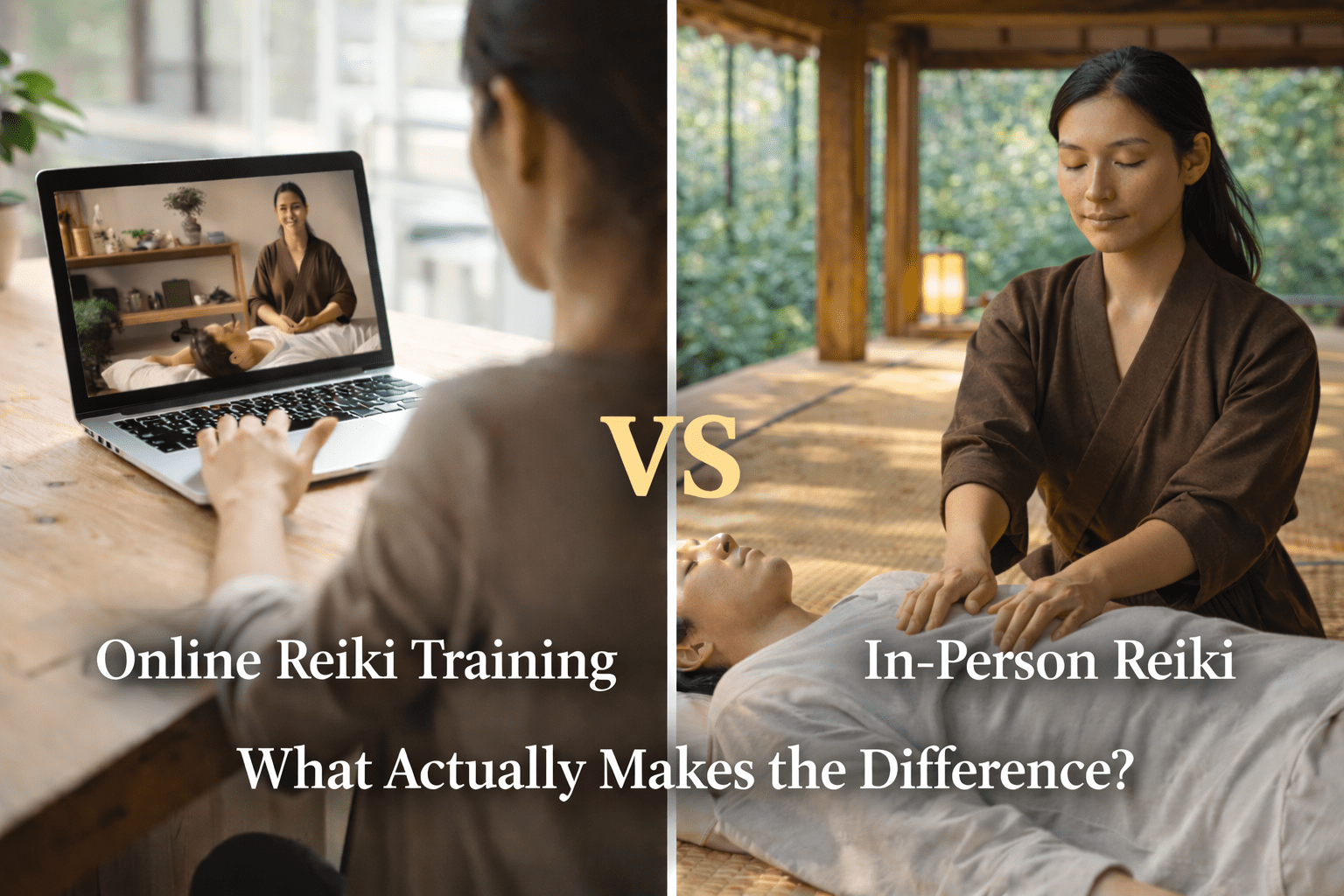
Online Reiki Training vs In-Person Reiki: What Actually Makes the Difference?
In-Person, Online, or Recorded?
This article explores online Reiki training vs in-person Reiki in practical terms, focusing on how people actually learn, practise, and integrate Reiki.
If you are trying to decide between online Reiki training and in-person Reiki, you are not alone.
One of the most common questions people ask before enrolling on a course is whether Reiki should be learned face to face or whether online Reiki training can be just as effective. Some teachers insist Reiki must be taught in the same room, with hands-on guidance throughout. Others offer live online Reiki classes or structured recorded Reiki training and argue that distance does not limit the quality of learning or transmission.
Online Reiki training can be effective when it is taught clearly and approached with engagement. Reiki transmission does not rely on physical proximity alone, but on how the student receives and integrates the process. The difference between online and in-person training lies more in learning structure, feedback, and pacing than in whether Reiki functions.
What Actually Changes Between Training Formats
This question is often framed purely as an issue of attunement, focusing on whether Reiki can be transmitted at a distance. In practice, the difference between online Reiki training and in-person Reiki courses affects far more than the moment of attunement.
It influences how students learn to give a full Reiki treatment, how clearly hand positions and treatment flow are demonstrated, how often techniques can be reviewed, and how much opportunity there is to practise between sessions. It also affects pacing. In-person Reiki training often delivers a large amount of material over a short period, while online and recorded Reiki courses usually allow students to return to the material as their understanding deepens.
Questions about physical presence matter, particularly in relation to energetic transmission and feedback. Questions about learning structure, repetition, confidence-building, and real-world practice matter just as much when deciding between online Reiki training or in-person Reiki.
Rather than promoting one format over another, this article examines how Reiki training actually works across different formats. It looks at how transmission functions, how physical presence influences learning and practice, and how live and recorded Reiki training support skill development over time, so you can decide which approach fits your learning style and circumstances.
1. The Core Paradox
The Smoking Gun: If Distance Healing Works, Why Would Distance Training Be Different?
At Reiki Level 2, practitioners are taught distant healing, traditionally referred to as Enkaku Chiryo.
This practice is based on a clear premise. Reiki is not understood as something that travels through physical space in a conventional way. Using the Hon Sha Ze Sho Nen symbol, a practitioner opens a channel through which a recipient receives healing regardless of physical location or time difference.
This principle is widely accepted within Reiki practice.
Once this is acknowledged, an obvious question follows.
If a practitioner can open a channel that allows a recipient thousands of miles away to receive Reiki, a teacher can also open a channel that allows a student to take part in an attunement process without being in the same room.
Any serious discussion about online or recorded Reiki training needs to engage with this point directly.
2. Reiki Is Drawn, Not Pushed
Why Physical Proximity Supports Rather Than Governs Transmission
A common misunderstanding around Reiki attunements is the idea that the teacher gives energy to the student.
In both Reiki treatments and attunements, the teacher does not push energy into the recipient. The traditional explanation is that the practitioner becomes a clear channel, often compared to a hollow bamboo, through which Reiki flows, drawn through that channel by the recipient.
The roles involved are distinct.
The teacher holds the energetic framework and facilitates access to the resonance of Reiki.
The student allows that resonance to permeate their own system.
Being in the same room can help some students feel more settled, focused, and supported during the process. At the same time, physical proximity does not determine whether transmission occurs. The outcome is shaped by the recipient’s capacity to draw Reiki at a deeper level than conscious awareness, rather than by physical distance.
This explains why many students report receiving attunements with the same clarity in live online settings, with cameras off, or through recorded guidance. In each case, they are engaging directly with the process rather than observing it passively.
3. The Source of Reiki Attunements
Esoteric Buddhism and Empowerment
Reiki did not develop in isolation from earlier spiritual traditions.
In both Reiki and esoteric Buddhist systems, empowerment is understood as a process of energetic maturation. It authorises a practitioner to engage in specific practices by clearing internal pathways and stabilising their capacity to work with energy.
In traditional Japanese Reiki lineages, this process is called Reiju. It is commonly described as a nuanced energetic clearing that allows Ki to flow more freely through the student’s system.
In Buddhist traditions, particularly Japanese Mikkyō and Tibetan Vajrayana, the equivalent ritual is known as abhisheka or wang. These terms refer to the ripening of the practitioner’s mindstream so that deeper levels of practice become accessible.
Despite differences in ritual form and terminology, both systems describe empowerment as a process that reveals existing potential rather than adding something external. Transmission is completed through the student’s ability to receive, integrate, and stabilise the experience.
Mikao Usui’s teachings were shaped by Japanese esoteric Buddhism, known as Mikkyō. While earlier accounts described him as a Tendai priest, modern research points to a broader engagement with Shingon, Tendai, and possibly other influences.
What matters here is structural similarity.
The Reiki attunement process closely mirrors Buddhist empowerment practices in function. In both traditions, empowerment is experiential and operational in nature, and remote empowerments have been recognised for centuries and employed within various esoteric Buddhist schools.
4. Transmission Beyond Presence
Why Time and Distance Do Not Limit Transmission
Tibetan Buddhism provides a clear framework for understanding transmission beyond physical presence.
In the Nyingma school, the Terma tradition describes teachings and empowerments transmitted across centuries and lifetimes. According to this view, Guru Padmasambhava placed instructions within the mindstreams of future practitioners, to be revealed when conditions were appropriate.
The validity of these teachings depends on continuity of transmission and the readiness of the recipient.
This is further explained through the doctrine of the Three Kayas.
Teachers such as Garchen Rinpoche describe the physical body of a teacher as limited to one place and lifetime, while the awakened mind is understood as Dharmakaya, all-pervasive and unrestricted by time or space. From this perspective, transmission occurs when openness meets an ever-present field of awakened intention. It is accessed rather than moved.
5. The Meeting of Intentions
Why Reception Shapes the Outcome
Across Reiki and Tibetan traditions, transmission is described as a meeting of minds.
The teacher introduces a recognition. The student meets that introduction through attention, trust, and engagement.
Teachers such as Lama Lena and Namkhai Norbu Rinpoche demonstrated through recorded and webcast transmissions that shared physical space is not required for authentic transmission. What shapes the outcome is the quality of engagement rather than the delivery platform.
6. Why “Online Reiki” Is a Misnomer
All Reiki training already involves distance.
Reiki transmission does not travel through the internet, video platforms, or recording devices. It does not require a signal, bandwidth, or physical connection between teacher and student.
Technology supports communication and instruction. Transmission itself occurs through the same non-local field used in distant healing, independent of screens or devices.
Online formats make this mechanism explicit. In-person formats can obscure it by overlaying the process with physical proximity.
A Real Example of Transmission Occurring Through Recorded Teaching
A woman in Egypt enrolled in an online Reiki Level 1 class with me but contacted me the day before the training to say she would be unable to attend live as something had come up. She asked whether she could watch the class via the recording instead later that weekend. I agreed, but with the understanding that we would arrange a live attunement as soon as possible after she had completed the material.
After the class, she watched the full recording. When she reached the section where the attunement had taken place during the actual training, she chose to sit down and follow the instructions exactly as they had been given in the live class.
At the end of that process, she contacted me to say that she had in fact been attuned and was able to practise Reiki. When we later spoke, it was evident that the process had fully engaged, despite the fact that no live transmission was occurring at the time she watched the recording.
This does not mean that recordings alone are sufficient training. What made this possible was not the recording itself, but the structure of the course, the clarity of the original transmission, and the student’s active engagement with the process. Without those conditions, recorded material is easily reduced to information rather than practice.
For further real-world outcomes and student experiences, see Reiki Training Reviews: What Students Say After Learning with Steve Gooch.
7. Responsibility and Discernment
Different formats do not guarantee the same quality of training.
Lineage, clarity of instruction, and coherence of the system remain relevant. Recorded training requires preparation and active engagement.
Across all formats, transmission depends on:
- the clarity of the teacher
- the coherence of the system being taught
- the readiness and sincerity of the student
Access can increase. Responsibility remains central.
8. When Physical Presence Supports the Process
Physical proximity influences certain aspects of learning and practice.
Traditional Japanese Reiki lineages, including Jikiden Reiki, value in-person training for practical and experiential reasons. In these contexts, Reiju is often understood as a repeated energetic clearing. Being in the same space allows a teacher to sense changes in a student’s system and adjust timing and emphasis during the process.
Hands-on training also supports the development of Byōsen, the tactile sensitivity to energetic imbalance. Immediate physical feedback can help students recognise subtle sensations and build confidence in early practice.
A shared environment can support settling and attention for some learners.
9. Physical Proximity and Non-Local Transmission
Alongside these practical benefits, many teachers emphasise that sacred energy is not limited by physical space.
Reiki explicitly teaches non-local transmission through the Hon Sha Ze Sho Nen symbol.
Tibetan traditions reflect this understanding through the Terma lineage and historical records of empowerments granted through letters, broadcasts, and live transmissions.
Physical proximity supports learning and feedback. Transmission rests on deeper factors.
10. When Distance Reveals Assumptions
Distance-based formats can bring unexamined assumptions to the surface.
When Reiki is taught face to face, it is easy to attribute the experience of transmission to physical closeness, touch, or being in the same room. When those factors are removed, students are left with a simpler question of what is actually occurring.
Seeing a teacher through a screen makes it harder to rely on proximity as an explanation. This can clarify that transmission does not depend on physical presence, but on how the process itself functions.
In this way, distance does not weaken understanding. It can sharpen it by stripping away assumptions that are otherwise taken for granted.
11. The Real Risk of Remote Training
The real risk of remote Reiki training is not that transmission fails. It is that the format makes it easier for students to disengage from the learning process.
Without a fixed room, timetable, or teacher physically present, some students treat recordings as information rather than as practice. They watch rather than do. They move on without repetition. Over time, this weakens confidence and integration.
Effective online Reiki training addresses this directly. Recordings are structured as guided experiences, not as background material. Students are expected to pause, practise, repeat techniques, and apply what they are learning in real situations.
When the format is used this way, distance does not reduce quality. When it is treated casually, learning suffers. The difference lies in how the training is approached, not in whether it takes place online.
Distance Does Not Equal Quality
Recognising that Reiki transmission is non-local does not mean all distance-based training is equivalent. The difference lies in structure, depth, and teacher involvement.
High-quality online Reiki training includes live transmission, contextual explanation, guided practice, and ongoing integration support. Low-cost, pre-recorded courses that offer certificates without interaction, feedback, or lineage accountability operate at a very different level. The question is not whether Reiki can be taught at a distance. It is whether the training is held within a coherent system that supports real practice and development over time.
12. Practical Advantages of Digital Training
Digital Reiki training allows students to return to the material repeatedly, which supports gradual integration rather than one-time exposure. Techniques, treatment flow, and explanations can be reviewed as understanding develops.
Learning outside a group setting can also reduce performance pressure. Some students settle more easily when they are not being observed, which can improve concentration and confidence during early practice.
Because training and practice often take place in everyday environments, students learn to apply Reiki within the conditions of normal life. This can support continuity, as the skills are developed in the same spaces where they will later be used.
13. Comparing the Options
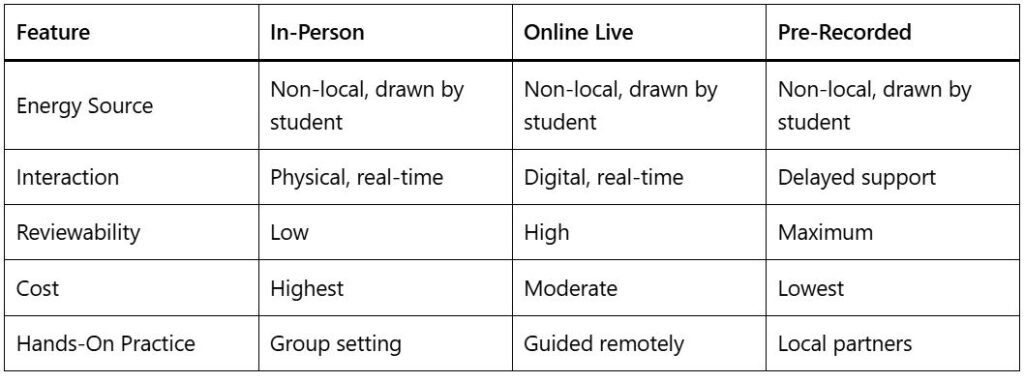
A Matter of Fit and Preference
When everything is taken into account, one practical conclusion becomes clear.
In the end, the choice between online Reiki training and in-person Reiki often comes down to personal preference and learning style rather than questions of validity or effectiveness.
Some people enjoy learning online. They value the ability to pause, rewatch demonstrations, practise in their own space, and integrate the material gradually. Others find online learning difficult and prefer the structure, social contact, and shared environment of face-to-face training.
Neither preference reflects seriousness or depth of intention. It reflects how an individual learns best.
Reiki does not require a single mode of delivery. What matters is whether the format supports engagement, consistency, and real practice. For some students, that support comes from being in the same room as a teacher. For others, it comes from flexibility, repetition, and self-paced study.
Understanding this helps shift the question from which format is correct to which format is supportive for the person learning.
Who Online Reiki Training May Suit Less Well
Some learners benefit from fixed schedules, shared retreat environments, or immediate physical reassurance. Others integrate more effectively through repetition and self-paced study.
These preferences reflect learning style rather than capability.
Understanding Transmission as a Drawn Process
In Reiki, the practitioner is understood as a clear channel rather than a source of energy. The teacher facilitates access to a universal field, and the student draws that resonance at a level deeper than conscious awareness. From this perspective, attunement functions less as a transfer of energy and more as a realignment with a universal field that was never absent.
This model aligns with older esoteric traditions in which empowerment activates innate capacity. Transmission functions through resonance and participation. Physical presence can support learning and feedback without determining whether transmission occurs.
Final Thought
What Shapes Quality
Clarity of transmission.
Integrity of teaching.
Readiness of the student.
These factors shape the experience across all formats.
Related Articles:
Why Reiki Training Costs Vary So Widely
Is Reiki Jin Kei Do the Right Fit for You?
How Reiki Jin Kei Do Compares to Other Reiki Systems
Best Reiki Training: 5 Signs of a High-Quality Course (+ Red Flags to Avoid)
Reiki Training Reviews: What Students Say After Learning with Steve Gooch
More ways to stay connected:
Subscribe to Energy, Consciousness & The Self newsletter
