
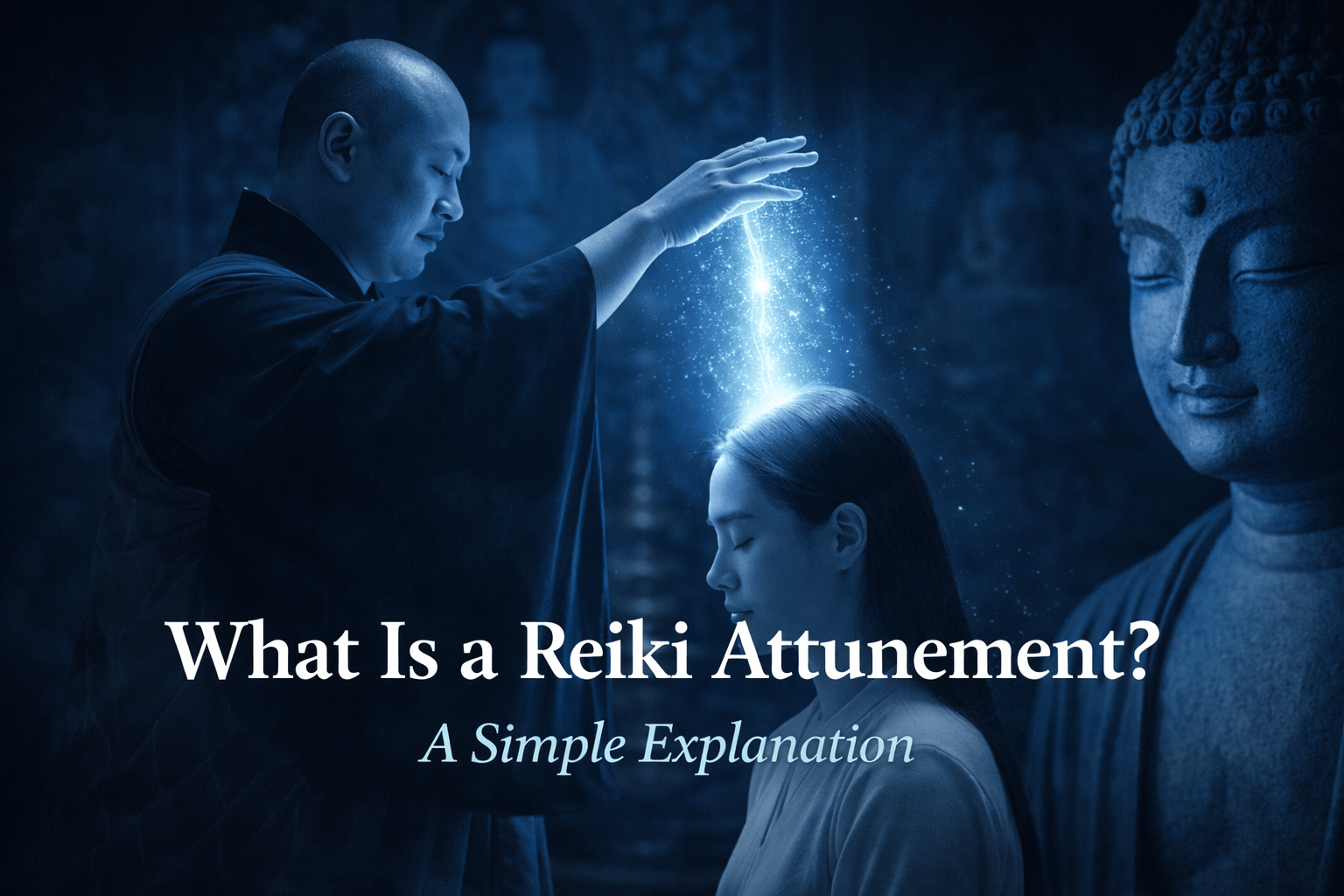
What Is a Reiki Attunement? A Plain English Explanation
A Reiki attunement is often described as an energy upgrade, a ritual, or a way of being “plugged into” something outside yourself. Those explanations sound simple, but they don’t really explain what’s happening in practice.
A Reiki attunement is better understood as an initiation into how Reiki actually works, rather than a transfer of energy or power.
So what does that mean in real terms?
Reiki isn’t something you do by effort or technique alone. It works when a person is oriented in a particular way. An attunement is what establishes that orientation.
After an attunement, Reiki doesn’t feel like something you are trying to control. It begins to operate through you rather than from you. Most practitioners notice that Reiki flows naturally, stops on its own, and responds to the needs of the person receiving it without conscious direction.
Why can’t Reiki just be learned from a book or video?
You can learn the ideas of Reiki from reading or watching videos, but recognition doesn’t happen through information alone.
Reiki relies on a direct shift in perception. For most people, that shift doesn’t happen just by understanding concepts. It happens when the body-mind briefly aligns with how Reiki actually functions. An attunement creates the conditions for that alignment to occur.
Once that alignment has happened, even briefly, practice becomes about stabilising and familiarising yourself with it, rather than trying to create it again. In more advanced stages of practice, methods such as Buddho develop this further by stabilising awareness so the process becomes consistent rather than occasional.
Is Reiki experienced as energy?
Yes, very clearly.
Most practitioners feel warmth, tingling, pressure, movement, or flow, especially in the hands. Energy may be sensed moving through the body, gathering in the lower abdomen, or circulating naturally. People receiving Reiki often feel these sensations as well.
These experiences are real and consistent across cultures and traditions.
What matters is how they’re understood.
In Reiki, energy isn’t pushed into someone. It’s drawn by the recipient according to their own needs. The practitioner doesn’t decide how much flows, and the process naturally comes to rest when it’s complete.
This doesn’t behave like energy being transferred as a substance. It behaves like a self-regulating process.
From a deeper perspective, what’s felt as energy is the body’s way of sensing awareness moving through form. Sensation, vitality, and awareness aren’t separate things. They’re different ways the same process is experienced.
How does this relate to Buddhist empowerment traditions?
In esoteric Buddhist traditions such as Vajrayana and Shingon, certain practices can’t be done meaningfully without empowerment. This isn’t about hierarchy or permission in a moral sense. It’s about whether the practice actually works as intended.
Without empowerment, a person may perform the outer form of a practice, visualisations, mantras, or healing actions, but they remain outside the practice field. With empowerment, the practitioner is positioned inside it.
Reiki attunement functions in the same way, but with much less ritual and philosophy. Where Buddhism speaks of Buddha-nature or recognition, Reiki often speaks of connection. The language differs, but the function is the same.
Does a Reiki attunement wear off?
No.
An attunement isn’t an energetic charge that fades. It’s a shift in orientation. What can fade is familiarity, not the attunement itself.
Some people say they’ve “removed” an attunement through prayer or intention, often because the experience felt unsettling. What’s actually happening is a withdrawal from engaging with what was recognised, not a reversal of the attunement itself.
Once something has been recognised directly, it can’t truly be undone, even if a person chooses not to work with it.
Why does integration matter after an attunement?
After an attunement, people may feel tired, emotionally open, or quieter than usual. This isn’t because anything is being cleared out. It’s because the system is reorganising around a new way of functioning.
Recognition needs to be lived through the body to stabilise. That’s why practice after attunement matters. Not to add anything new, but to allow the recognition to settle into everyday experience.
What about modern hybrid Reiki teaching?
Many teachers train in multiple systems and blend what they’ve learned. The knowledge gained this way can be valuable. Problems arise when it’s unclear which attunement framework is actually being used.
Attunement isn’t the same as teaching content. A person can learn ideas and symbolic elements from many traditions, but attunement establishes participation in a specific practice field. Without clarity about that field, students can feel sensitive and active, but lack depth or stability.
Reiki symbols also need this kind of context, because their real function depends on form, mantra, attunement, lineage and practice.
This is why traditional systems are careful about how empowerments are handled. Not out of rigidity, but because orientation matters.
In simple terms
A Reiki attunement isn’t about receiving energy.
It’s about being positioned so Reiki can function through you naturally.
Once that’s established, practice becomes less about doing and more about allowing. Reiki becomes something you participate in, rather than something you try to make happen.
If you’d like a deeper exploration of Reiki attunement, including its relationship to Vajrayana and Shingon Buddhist empowerments, lineage coherence, and the idea of the practice field, you can read the full in-depth article here.
Related Articles:
How Does a Reiki Attunement Work?
Why Reiki Training Costs Vary So Widely
Is Reiki Jin Kei Do the Right Fit for You?
How Reiki Jin Kei Do Compares to Other Reiki Systems
Online Reiki Training vs In-Person Reiki: What Actually Makes the Difference?
Best Reiki Training: 5 Signs of a High-Quality Course (+ Red Flags to Avoid)
Reiki Training Reviews: What Students Say After Learning with Steve Gooch
More ways to stay connected:
Subscribe to Energy, Consciousness & The Self newsletter
