
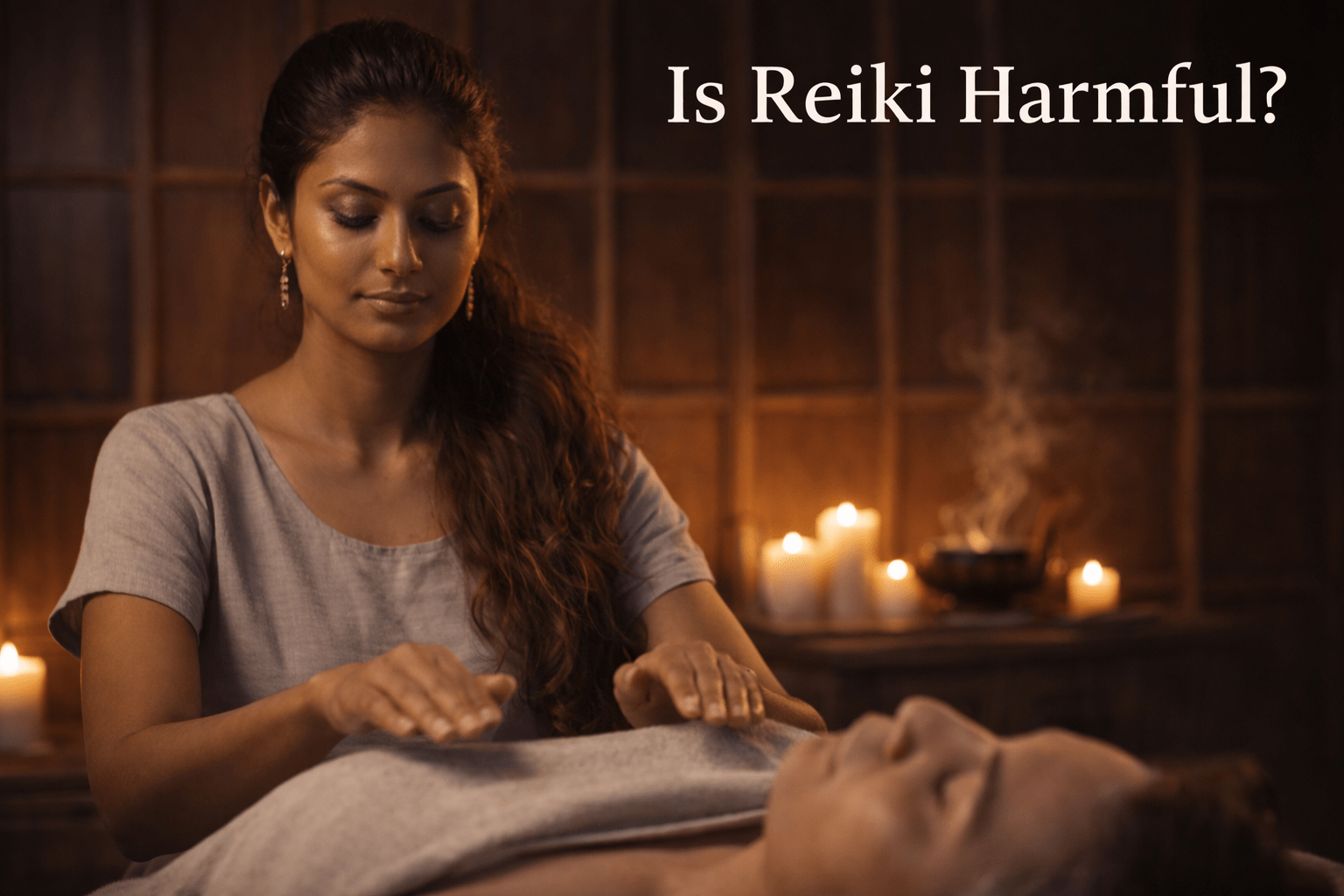
Is Reiki Harmful?
If you are considering Reiki, or have already experienced it, it is reasonable to ask a direct question: is Reiki harmful?
You will find confident claims online at both extremes. Some describe Reiki as completely harmless and suitable for everyone. Others warn that it can be dangerous, destabilising, or even abusive.
The reality is more nuanced. Reiki itself is generally low risk, but harm can occur depending on how it is used, who delivers it, and what expectations are attached to it.
This question applies not only to receiving Reiki, but also to learning it. Concerns are often raised about Reiki training and attunements in particular, including whether they can destabilise someone or cause harm if handled badly. These aspects are addressed later in this article.
This article looks at what “harmful” actually means in the context of Reiki, what research and healthcare guidance say, and where real risks tend to arise in practice.
What people usually mean when they ask if Reiki is harmful
Most concerns fall into three overlapping areas:
- Physical safety
- Psychological or emotional effects
- Indirect harm through misuse, false claims, or delayed medical care
Reiki is a non-invasive practice. If you would like a clear overview of what Reiki actually involves before considering questions of safety, you can read my detailed guide on what Reiki is and what Reiki healing is. It involves light touch or no touch at all, with the client fully clothed. There is no physical manipulation, no ingestion of substances, and no forced breathing or movement. From a purely mechanical standpoint, this places Reiki among the lowest-risk body based practices.
Because Reiki involves no physical manipulation, substances, or forced breathing, it carries a different risk profile from more invasive practices such as deep-tissue massage or intensive breathwork.
That does not mean harm is impossible. It means that when problems occur, they tend to come from context rather than the technique itself.
Physical harm, what the evidence shows
Across published research and public health summaries, Reiki is consistently described as low risk in physical terms.
Major health bodies report no evidence of serious physical injury directly caused by Reiki sessions. Adverse medical events are not a prominent feature of the clinical literature.
This includes use in hospital settings, where Reiki has been offered as supportive care for relaxation and comfort, including in oncology and neonatal environments. Where safety monitoring has been included, no serious adverse events attributable to Reiki have been reported.
A common myth is that Reiki can interfere with medical devices such as pacemakers. Reiki does not involve electrical currents or electromagnetic output. There is no evidence that it interferes with implanted medical devices.
That said, absence of reported harm does not mean every possible effect has been exhaustively studied. Many trials simply do not track adverse events in detail. This limits certainty, but it does not point toward hidden physical danger.
Emotional and psychological effects
Most people experience Reiki as calming or neutral. Some report emotional release, deep relaxation, or temporary tiredness.
Occasionally, people report experiences they find uncomfortable, such as:
- Feeling emotionally raw after a session
- Fatigue or lightheadedness
- Heightened awareness of unresolved stress or grief
These effects are typically short-lived. They are not unique to Reiki and can occur with other relaxation or contemplative practices.
Where greater care is needed is with people who have a history of trauma, severe anxiety, or certain mental health conditions. Deep relaxation or inward attention can sometimes bring material to the surface more quickly than expected.
This does not make Reiki dangerous, but it does mean sessions should be paced carefully, consent should be clear, and practitioners should stay within their scope. Reiki is not a replacement for mental health care, and it should not be presented as such. Reports linking Reiki to psychosis or serious psychological harm are extremely rare and usually involve multiple contributing factors, such as sleep deprivation, intensive spiritual practice, or pre-existing vulnerability. There is no credible evidence that Reiki alone causes psychotic illness. Where such cases are discussed, they are almost always associated with extreme or poorly designed training environments rather than standard Reiki sessions or attunements delivered in a grounded way.
The most common source of real harm
The clearest risk associated with Reiki does not come from the practice itself.
It comes from using Reiki instead of appropriate medical care, or from practitioners making claims they cannot support.
This includes situations where:
- Someone delays seeking diagnosis for a serious condition
- A practitioner advises stopping medication
- Reiki is promoted as a cure for cancer or other progressive disease
- Clients are told negative outcomes are their fault for not believing enough
Public health organisations consistently draw a firm line here. Reiki may be used as a complementary approach, alongside medical care, but not as a substitute.
Studies showing worse outcomes associated with “alternative medicine” use generally involve refusal or delay of effective treatment. This is not an indictment of Reiki itself. It is a warning about how any unproven therapy can become harmful when framed as an alternative to necessary care.
Ethical and professional risks
Another area where harm can occur is professional conduct.
Reiki is not uniformly regulated. Training standards vary widely. There is no single governing body for Reiki, which makes practitioner ethics, transparency, and boundaries especially important. Most practitioners work ethically and responsibly, but the lack of regulation means clients need to be discerning.
Red flags include:
- Pressure to continue sessions or dependency-based language
- Claims of exclusive healing ability
- Lack of clear consent or boundaries
- Inappropriate touch or requests to undress
- Fear-based explanations about energy damage or blockage
Reiki can be delivered without physical contact at all. Touch, if used, should be light, respectful, and clearly agreed in advance.
In the UK, voluntary registers and codes of conduct exist to provide some level of accountability, but they are not a substitute for personal judgement and clear communication.
Three questions to ask before booking a Reiki session
- How do you see Reiki fitting alongside medical or mental health care if I am receiving it?
- How do you handle emotional or unexpected reactions during or after a session?
- What boundaries and ethical guidelines do you work within?
How Reiki is framed in healthcare settings
Where Reiki appears in hospitals or cancer support environments, it is consistently described as supportive care.
It is offered to help with relaxation, stress reduction, and coping. It is not presented as a treatment for disease.
This framing matters. When Reiki is used in this way, risks are reduced because expectations are realistic, boundaries are clear, and medical care continues as normal.
So, is Reiki harmful?
For most people, Reiki is not harmful when used appropriately.
The available evidence and healthcare guidance suggest that:
- Direct physical harm is unlikely
- Serious adverse effects are not commonly reported
- Mild, short-term emotional or physical reactions are possible
- The greatest risks come from misuse, overclaiming, or replacing medical care
Reiki becomes problematic only when it is framed as something it is not.
This includes situations where Reiki is presented as involving spirit guides, external entities, or psychic mediation, which I examine in detail in Does Reiki Involve Spirit Guides or External Entities?
How to approach Reiki safely
If you are considering Reiki, these points align with the most credible guidance available:
- Treat Reiki as complementary support, not medical treatment
- Continue to seek diagnosis and care for health concerns
- Choose practitioners who welcome transparency and collaboration
- Avoid anyone making promises to cure serious conditions
- Trust your own boundaries and leave if something feels off
Used responsibly, Reiki is a low-risk practice that many people find supportive. Used irresponsibly, it can become part of a wider pattern of poor decision-making. The difference lies in how it is understood and applied.
When Reiki may not be appropriate
Reiki is not suitable for every situation, and it is important to say that clearly.
Reiki may not be appropriate if someone is experiencing active psychosis, severe mental health instability, or a crisis state that requires immediate psychiatric or medical care. In these situations, professional clinical support should come first.
It may also be inappropriate if someone intends to use Reiki as a replacement for diagnosis, medication, or evidence-based treatment for serious physical or mental health conditions.
Being clear about this is not a limitation of Reiki. It is part of using it responsibly and ethically. Questions of suitability also extend to choosing the right system and teaching environment, which is explored further in my article on whether Reiki Jin Kei Do is the right fit for you.
What about Reiki training and attunements?
For many people, the real concern is not receiving Reiki, but learning it.
Questions often come up around Reiki attunements in particular. People worry about whether an attunement can destabilise them, change them in ways they cannot control, or cause psychological or energetic harm.
These concerns are understandable, especially given how attunements are sometimes described online.
What a Reiki attunement actually is, in practical terms
Despite the language often used, a Reiki attunement is not a medical procedure, an energy implantation, or a permanent alteration of the nervous system.
This is explored in more depth in our article on how an attunement functions in lived practice.
In practical terms, an attunement is a short, structured process that helps someone orient to a way of working with attention, touch, and awareness that they were not consciously accessing before.
Nothing is added to the body and there is no forcing involved. Nothing is switched on mechanically.
This is why many people experience an attunement as quiet, subtle, or even uneventful, rather than dramatic.
Can a Reiki attunement be harmful?
For the vast majority of people, no.
There is no evidence that Reiki attunements cause physical injury, neurological damage, or long-term psychological harm.
However, as with any practice involving energetic work, introspection, attention, and learning a new internal orientation, context matters.
Potential difficulties tend to arise in a few specific situations.
When attunements can feel uncomfortable or overwhelming
Some people report temporary effects after an attunement, such as:
- Feeling emotionally sensitive or reflective
- Tiredness or a need for rest
- A heightened awareness of stress patterns
These effects are usually short-lived and settle naturally.
More caution is appropriate if someone:
- Has a history of severe trauma
- Is currently experiencing acute mental health instability
- Is undergoing intense life stress without adequate support
In these cases, the issue is not that Reiki is dangerous, but that any inward-facing practice can amplify what is already present if introduced too quickly or without proper grounding. A responsible teacher will pace training, normalise neutral or subtle experiences, and avoid framing discomfort as evidence of damage or failure.
The real risks in Reiki training
When training environments become risky
Problems tend to arise when Reiki training – framed as a healing therapy, turn into an intensive spiritual programme without notice. Risk increases when courses are overly compressed, emotionally demanding, or framed in ways that push students beyond what they can comfortably integrate.
This can include long training days with little rest, encouragement to ignore fatigue, or the expectation that strong emotional or physical reactions are a sign that something is “working.” These conditions can potentially increase stress on the nervous system and can amplify existing vulnerability. This is not unique to Reiki and is also seen in poorly structured meditation retreats and other inward-facing practices.
As with Reiki treatments, the main risks do not come from the attunement process itself.
They come from how training is delivered and explained.
Training becomes riskier when it includes practices that fall outside a teacher’s competence or scope. Examples include mandatory fasting or restrictive “cleansing” diets after attunement, pressure to radically change eating habits, or presenting physical distress as something that must be endured rather than questioned. Reiki teachers are not medically trained, and introducing dietary or health prescriptions adds unnecessary physical and psychological strain.
This includes:
- Teachers presenting attunements as powerful interventions that can “break” someone
- Fear-based explanations about energy damage or blockages
- Encouraging dependency on the teacher for ongoing energetic stability
- Promising dramatic transformation as a guarantee
- Using mystical language without practical grounding
- Teaching students to interpret sensations or intuitive impressions as medical diagnoses, which can cause unnecessary fear or delay appropriate assessment.
When attunements are framed in this way, anxiety increases, and ordinary nervous system responses can be misinterpreted as something going wrong.
That interpretation, rather than the attunement, is what causes distress.
Does Reiki training destabilise people?
For most people, learning Reiki is stabilising, not destabilising.
It typically encourages:
- Slower attention
- Better awareness of stress and tension
- More sensitivity to boundaries, both physical and emotional
In rare cases where someone feels unsettled after training, it is almost always temporary and resolves with rest, normal routine, and reassurance.
Long-term harm from Reiki training is not supported by credible evidence.
Why some horror stories circulate online
Stories about Reiki being dangerous usually come from one of three sources:
- Training environments with poor boundaries or inflated claims
- Individuals already in psychological distress interpreting experiences through fear-based frameworks
- Reiki being mixed with intensive spiritual practices without adequate grounding
These stories are not evidence of Reiki itself being harmful. They are evidence that how something is taught matters. This is not unique to Reiki. Similar issues appear in meditation, breathwork, yoga, and other contemplative disciplines when they are poorly contextualised. In most cases, the problem is not the practice itself, but the combination of intensity, fatigue, and fear-based interpretation layered on top of it.
How to approach Reiki training safely
If you are considering Reiki training, the same principles apply as with receiving Reiki:
- Choose teachers who explain things clearly and calmly
- Avoid anyone who frames attunements as dangerous or uncontrollable
- Be wary of dramatic promises or warnings
- Expect training to be paced and grounded
- Know that subtle or neutral experiences are completely normal
Reiki training should increase clarity and confidence, not fear.
Reiki training should never require fasting, dietary restriction, medical-style diagnosis, fear-based compliance, or dependence on a teacher for ongoing stability. These are ethical red flags, not signs of depth or authenticity, and they point to poor teaching rather than to Reiki itself.
A clear bottom line on training and attunements
Reiki attunements themselves are not harmful.
They do not damage the body, override free will, or permanently alter someone in unpredictable ways.
Where harm does occur, it is almost always due to poor teaching, exaggerated claims, or fear-based framing, not the attunement process.
Approached sensibly, Reiki training is one of the gentler entry points into hands-on contemplative practice.
Common questions about Reiki safety
Is Reiki a scam?
Reiki itself is not a scam, but the field is unevenly regulated. Problems arise when practitioners make medical claims, promote dependency, or sell fear. This article outlines how to recognise ethical practice.
Can Reiki make you feel worse?
Some people experience temporary tiredness, emotional sensitivity, or heightened awareness after a session. If distress is strong, prolonged, or worsening, it should not be explained away and medical or psychological support should be sought. If symptoms are severe, worsening, or persist beyond a short adjustment period, they should not be explained as a “cleansing” process and medical or psychological advice should be sought.
Can Reiki cause anxiety or psychological harm?
Serious harm is rare. When difficulties occur, they are usually linked to poor boundaries, fear-based explanations, or overly intense training environments rather than Reiki itself. If your concern is specifically about anxiety itself, I explore this more fully in my article on whether Reiki can help with anxiety and stress.
Are Reiki attunements dangerous?
Attunements themselves are not dangerous. Risk arises from how they are framed and taught, not from the process. Calm pacing and grounded teaching matter.
Is Reiki safe for people with pacemakers or medical devices?
Reiki does not involve electrical currents or electromagnetic output and there is no evidence that it interferes with pacemakers or implanted medical devices. As with any complementary approach, it should be used alongside, not instead of, medical care.
Related Articles:
Why Reiki Training Costs Vary So Widely
Is Reiki Jin Kei Do the Right Fit for You?
How Reiki Jin Kei Do Compares to Other Reiki Systems
Online Reiki Training vs In-Person Reiki: What Actually Makes the Difference?
Best Reiki Training: 5 Signs of a High-Quality Course (+ Red Flags to Avoid)
Reiki Training Reviews: What Students Say After Learning with Steve Gooch
More ways to stay connected:
Subscribe to Energy, Consciousness & The Self newsletter
