How Do the Reiki Symbols Work?
Reiki symbols often raise questions for people moving beyond Reiki Level 1.
They can look mysterious when you first encounter them. They carry a sacred quality, which often makes beginners wonder where their power comes from. Does it come from the shape, the practitioner, the attunement, the Reiki energy itself, or the relationship between all of these?
The clearest answer sits inside the deeper structure of Reiki practice.
Reiki practitioners use the symbols as sacred meditative and energetic devices. Through the symbols, a practitioner develops concentration, enters specific qualities of Reiki, refines their own inner state, and brings those same qualities into meditation, self practice, treatment, distant Reiki, emotional healing and spiritual development.
The symbols give the mind a stable object of attention. They support one pointed concentration and help the practitioner enter the vibrational quality represented by each symbol. From that meditative relationship, the symbols can then support healing practice.
Each symbol carries a specific energetic signature. Its shape, mantra, attunement, lineage transmission and the practitioner’s direct relationship with it all contribute to that signature. The shape matters because different configurations of line, curve, direction and space create different vibrational qualities. A circle carries a different energetic feel from a square. A spiral carries a different energetic feel from a straight line. In the same way, a Reiki symbol carries its own distinct frequency.
One configuration of shapes can’t stand in for another. The visual form matters because the form gives access to the function.
From the Reiki Jin Kei Do and Buddho perspective, the symbols also sit within a wider field of esoteric Buddhist influence. Reiki Jin Kei Do and Buddho understand the symbols as having relationships to deeper meditative and mantra based principles. That gives the symbols a much deeper context than their basic treatment uses.
Short answer: how do Reiki symbols work?
Reiki symbols help the practitioner enter, stabilise and express specific qualities of the Universal Energy Field, or Reiki energy.
A properly trained Reiki student receives the symbols through instruction and attunement. The teacher passes on the visual form, the mantra, the meditative method and the practical use of each symbol. Through practice, the student learns how the energy changes when each symbol is used.
A Reiki symbol works through several connected elements:
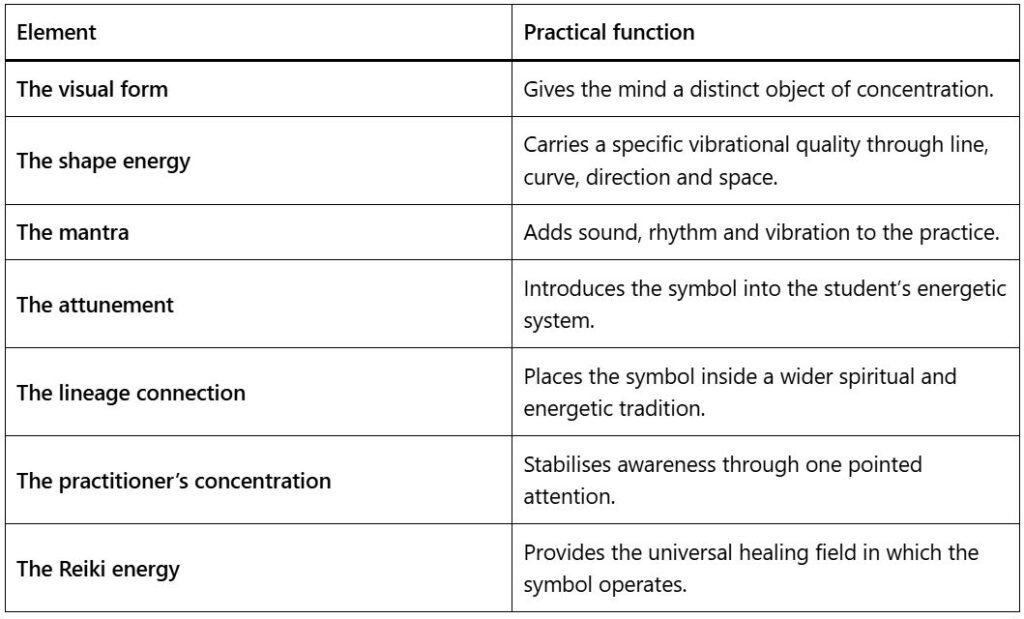
These elements work together. The symbol gives form. The mantra gives sound. The attunement gives energetic connection. Meditation gives stability. Practice turns the symbol from an idea into direct experience.
What are Reiki symbols?
Reiki symbols are sacred meditative forms used in Reiki practice, especially from Reiki Level 2 onward.
At Level 1, students usually learn self treatment, hands on treatment, meditation and the foundations of Reiki practice. They build a direct relationship with Reiki energy through their own body, hands and experience.
At Level 2, students learn symbols that expand the practice. They start working more consciously with emotional healing, distant Reiki, deeper concentration and specific energetic qualities.
Reiki Master training usually introduces one further symbol, relating to spiritual development, initiation and the process of attuning others to Reiki.
Different Reiki lineages place different emphasis on the symbols. One system may include additional symbols, while another may focus more strongly on meditation, treatment, or the sacred role of the symbols within a disciplined spiritual path. Serious Reiki training keeps the symbols inside a living practice, where instruction, attunement, meditation and direct experience all work together.
Reiki symbols as meditation devices
A Reiki symbol gives the mind a stable object of attention. In Samatha meditation, the practitioner develops calm, stability and concentration by resting attention on a chosen object. That object may be the breath, a visual form, a sound, a mantra, a point in the body or another suitable focus.
Reiki symbols can function in the same way. The practitioner may draw the symbol, visualise it, repeat its mantra, hold it in awareness, or place it in the heart centre during meditation. The symbol gathers attention. The mind becomes less scattered. Awareness becomes more stable. The practitioner begins to enter the quality of the symbol directly.
The mantra works alongside the visual form as its sound based companion. The symbol gives form. The mantra gives vibration. Used together, they support and strengthen each other. The sound, rhythm and repetition of the mantra help the practitioner enter the symbol’s quality more deeply.
This matters because the symbol trains the practitioner from the inside. With repeated practice, it becomes an inner gateway. The practitioner feels the quality of the symbol in their own body, mind and energy field. Then, when they use the symbol in a healing context, they bring an embodied connection into the work.
Reiki symbols and shape energy
The shape of a Reiki symbol matters. Every shape carries a vibrational quality. A circle does not feel the same as a square. A spiral does not feel the same as a triangle. A straight vertical line does not feel the same as a sweeping curve. Form creates energetic resonance.
Reiki symbols work partly through this principle of shape energy. Their lines, curves, directions, internal structure, surrounding space and internal spaces all create a specific vibrational pattern.
The mantra adds another layer of vibration. The attunement connects the practitioner to the symbol’s energetic function. Meditation stabilises the relationship.
A random symbol will produce a different energetic effect. A Reiki symbol carries a specific configuration, a specific lineage context and a specific energetic quality. When the practitioner works with that symbol through training and meditation, they learn to enter that frequency more directly.
The Reiki Jin Kei Do and Buddho perspective
Reiki Jin Kei Do and Buddho give the symbols a wider esoteric context.
From this perspective, the symbols sit inside a deeper field of meditative, energetic and mantra based practice. Their shapes, sounds and functions connect with wider esoteric principles, and those connections help explain why the symbols carry such specific energetic qualities.
Within the Reiki Jin Kei Do and Buddho traditions, teachers present the symbols as part of a living energetic system. Practitioners work with them through attunement, meditation, mantra, concentration and direct experience.
That’s why any random shape can’t replace them. A Reiki symbol carries a particular energetic function, and that function becomes accessible through the correct relationship between form, sound, lineage, meditation and practice.
Other Reiki traditions may explain the symbols differently. The Reiki Jin Kei Do and Buddho perspective places the symbols within a broader spiritual and energetic training system.
Do Reiki symbols have power by themselves?
The outer shape has importance, although the full power of the symbol comes through training, meditation and attunement.
A person can find Reiki symbols online, copy the shapes and repeat the names. That gives them the outer form. Proper Reiki training gives them the energetic connection, the meditative method and the lineage context.
The symbol, mantra, attunement and meditation work together. A teacher passes on the symbol inside a training context. The student practises with it, feels how the energy responds, and builds confidence through direct experience.
You could compare it to learning music. Seeing a musical note on a page gives you information. Training allows you to turn that note into music. Reiki symbols work in a similar way. The shape carries meaning, and the practitioner learns how to bring that meaning alive through practice.
Why does the Reiki attunement matter?
A Reiki attunement amplifies and refines the student’s connection with Reiki. As the training develops, the student receives, channels and works with the energy more strongly, clearly and precisely.
From Reiki Level 2 onward, the teacher brings the symbols directly into the attunement process. The teacher places the symbols into specific locations within the student’s subtle energy field. Depending on the lineage, the system may understand these locations as chakras, tandens, marma points or other energetic centres.
This is why the attunement matters so much once symbols enter the training. The student receives more than a shape and a set of instructions. The teacher introduces the symbol into the student’s energetic system through a direct transmission. That transmission helps activate the student’s relationship with the symbol and the specific quality it carries.
Over the years, I’ve met students who had already completed Reiki training elsewhere and came to me confused because they couldn’t feel energy in their hands. They assumed something was wrong with them.
After speaking with them, I discovered that in some cases their original teacher had left the attunement out of the training. They’d received explanations and techniques, but they hadn’t received the energetic transmission.
Once they understood that, the problem became clearer. Their sensitivity hadn’t failed. Their training had missed the central energetic process that allows Reiki practice to function properly.
Good Reiki training includes information, direct experience, proper instruction, attunement, meditation and practice. All six belong together.
What do the Reiki symbols do?
Different lineages explain the Reiki symbols in different ways, although the core functions stay recognisable across many systems.
In Reiki Jin Kei Do and Buddho, the practitioner also works with the specific qualities of each symbol as those qualities relate to deeper originating patterns, mantra currents and meditative source material. That keeps the symbols connected to a broader field of practice.
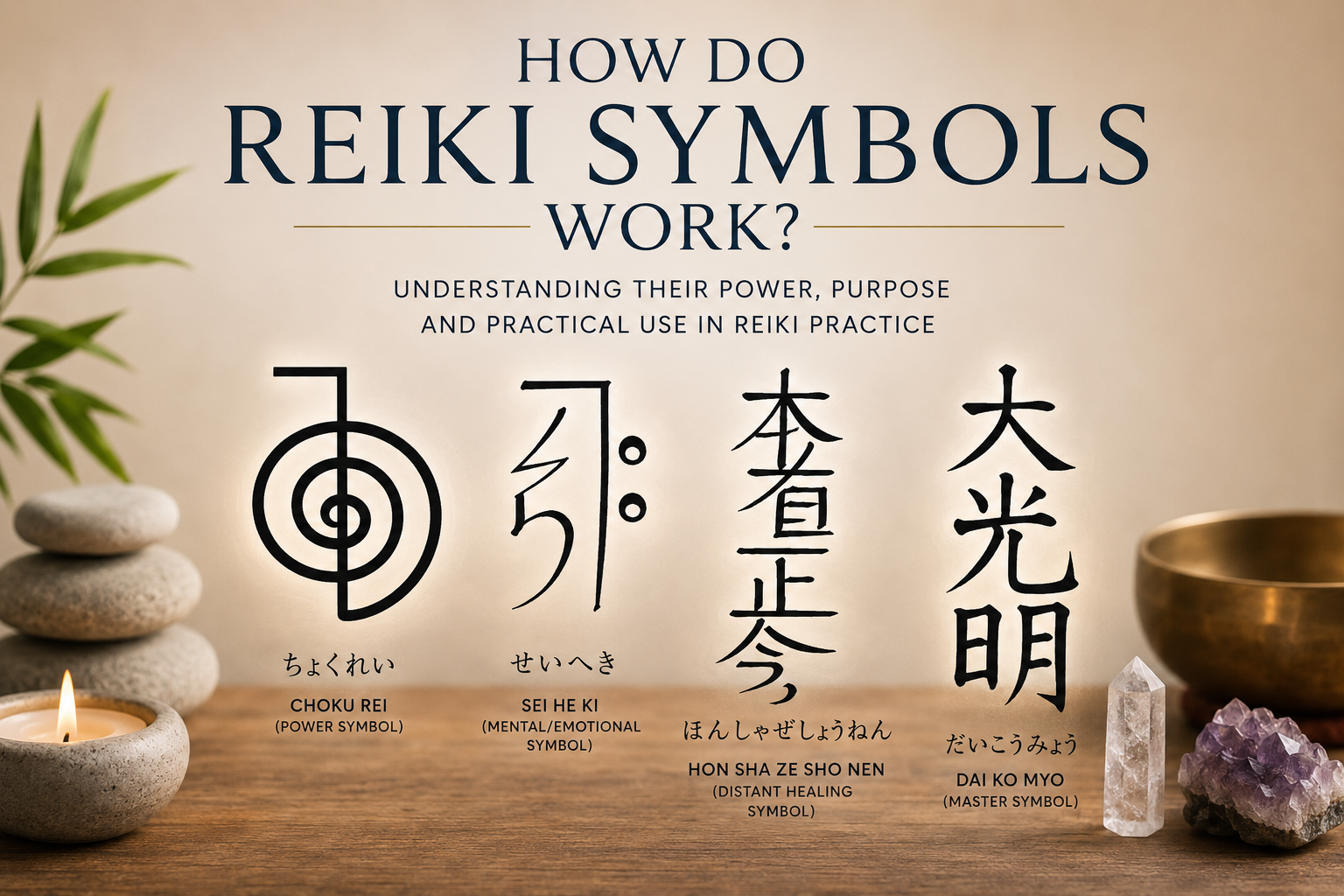
The power symbol helps the practitioner focus Reiki and bring energy to a specific area. It also supports concentration, energetic clarity and directed awareness. Practitioners may use it in meditation, self practice, treatment, room cleansing, blessing, and specific protection practices taught within their lineage.
The mental and emotional symbol supports mental and emotional healing. It also helps the practitioner enter a subtler quality of mind and feeling. Practitioners may use it when working with anxiety, grief, old memories, recurring thought patterns, habits, inner conflict and emotional conditioning.
The distant healing symbol allows Reiki to move beyond physical contact. It also helps the practitioner work beyond ordinary ideas of distance and separation and recognise these as less fixed than they appear. Practitioners use it for absent healing, past events, future situations and people who can’t be physically present.
The Master symbol belongs to Reiki Master training. It carries a deeper initiatory and spiritual function. Reiki Masters use it in attunements, meditation and their own development as practitioners and teachers. It’s believed that this symbol was added to the system in the West, and is not a part of the original Japanese expression of the system.
How do Reiki symbols work in treatment?
In treatment, Reiki symbols help the practitioner bring a specific quality of energy into the work.
The practitioner may draw the symbol over the body, visualise it in a particular area, repeat the mantra inwardly, or hold the symbol in awareness while Reiki flows. The symbol helps the practitioner enter the quality it represents and bring that quality into the treatment field.
The practitioner’s own prior practice matters here. A symbol becomes more effective when the practitioner has already worked with it in meditation, received it through attunement, and developed a direct energetic relationship with it.
During treatment, the symbol acts as a bridge between the practitioner’s trained awareness, the recipient’s energy field, and the specific quality of Reiki invited into the work. The recipient draws the Reiki according to need. The practitioner provides the conditions through training, intention, stillness and connection.
How do Reiki symbols help with distant Reiki?
The distant healing symbol gives the practitioner a way to work beyond ordinary physical contact.
In Reiki Jin Kei Do and many other Reiki lineages, distant Reiki doesn’t depend on energy travelling across space in a physical sense. Reiki is the Universal Energy Field. The distant symbol helps the practitioner enter a state of connection in which ordinary ideas of time, space and separation are revealed to be illusory.
A practitioner can use distant Reiki for someone in another location, for a past event that still carries emotional charge, or for a future situation that needs support. One of the strongest examples from my own teaching came from my first ever Reiki client, who later became my first student.
After completing Reiki Level 2, she began sending Reiki to a serious car crash she had experienced years earlier. The crash had almost killed her. Although her body had recovered, the emotional imprint remained. Every time she drove near the place where the crash happened, her body reacted with fear. She would shake as she approached that point in the road.
After learning distant Reiki, she began sending Reiki to the moment of the crash. She practised consistently for around three months.
Then one day, she drove past the same place and felt nothing. No shaking or fear. She had already passed the location before she realised where she was.
The memory remained, and the emotional charge had gone. The distant symbol helped her connect with the unresolved charge around the experience, while Reiki worked at the level her system could receive. Distant Reiki therefore, in this context can be seen as another form or approach to self-treatment.
Do you need to draw Reiki symbols perfectly?
You should learn the symbols carefully and treat them with respect.
The form matters because the symbol’s shape is part of how it works. The lines, spaces, direction and structure all contribute to the energetic quality of the symbol. A student needs to learn the correct form from a qualified teacher, then practise it until the symbol becomes familiar in the hand, the mind and the body.
This matters in meditation as much as in treatment. When you draw, visualise or contemplate a Reiki symbol, you’re using it as a sacred meditative form. The more accurately you learn it, the more clearly you can enter the quality it represents.
Over time, the relationship becomes more internal. A trained practitioner may draw the symbol physically, visualise it, use the mantra inwardly, or meditate on the quality it carries. A beginner needs to learn the form accurately. An experienced practitioner learns to recognise the energetic quality from the inside.
Are Reiki symbols secret?
Traditionally, Reiki teachers passed the symbols directly to students and treated them with care.
Today, anyone can find them online. That has changed access to the outer form, although it has not replaced proper training.
Respect matters more than secrecy. The symbols carry function, lineage, practice and responsibility. A serious student treats them as part of a discipline rather than as spiritual decoration.
Can anyone learn Reiki symbols online?
Online information can introduce the subject, but proper use requires training.
A diagram shows the outer shape. A video explains the basic idea. Proper Reiki training gives the student instruction, attunement, practice, correction and direct energetic experience. Good training also teaches when to use a symbol, when to keep the treatment simple, and how to work ethically.
The symbol belongs inside the whole practice.
How do Reiki symbols deepen with practice?
At Level 1, many students focus on feeling Reiki in their hands and learning the treatment structure. At Level 2, the symbols ask for more sensitivity, stronger concentration and a more direct relationship with specific qualities of energy.
This deepens through repetition. A student might meditate on a symbol visually, repeat the mantra inwardly, hold it in awareness, or place it in the heart centre during practice. At first, students think about the shape and the steps. With practice, the process becomes more natural, and the symbol begins to feel alive in the practitioner’s awareness.
The power symbol starts to feel distinct from the mental and emotional symbol. The distant symbol creates a different kind of connection. The Master symbol carries a different depth again.
Over time, the practitioner moves from asking, “What does this symbol mean?” to feeling, “I know this energy.” That shift comes through repeated practice and a growing sensitivity to the energy itself.
Final answer: how do Reiki symbols work?
Reiki symbols work through the relationship between form, shape energy, sound, attunement, meditation, lineage and Reiki energy.
The symbol gives focus. The shape carries vibration. The mantra gives sound and rhythm. The attunement introduces the symbol into the student’s energetic system. Meditation stabilises awareness and builds a direct inner relationship. The lineage connection places the symbol inside a deeper spiritual and energetic context. Reiki provides the universal healing field.
Together, these elements allow the practitioner to work with greater precision, deepen meditation, train concentration, awaken internal qualities, strengthen treatment, support emotional healing, and make distant Reiki possible.
Their power comes through practice. A Reiki symbol is far more than a shape on a page. In the hands of a properly trained practitioner, it becomes a living part of the Reiki system.
Related Articles:
Why Reiki Training Costs Vary So Widely
Is Reiki Jin Kei Do the Right Fit for You?
How Reiki Jin Kei Do Compares to Other Reiki Systems
Best Reiki Training: 5 Signs of a High-Quality Course (+ Red Flags to Avoid)
Reiki Training Reviews: What Students Say After Learning with Steve Gooch
More ways to stay connected:
Subscribe to Energy, Consciousness & The Self newsletter
